Hi everyone!
This was my final project/lecture that Prof. Fawzia asked to be posted on the course blog!
Hope you all have a good look at it 🙂
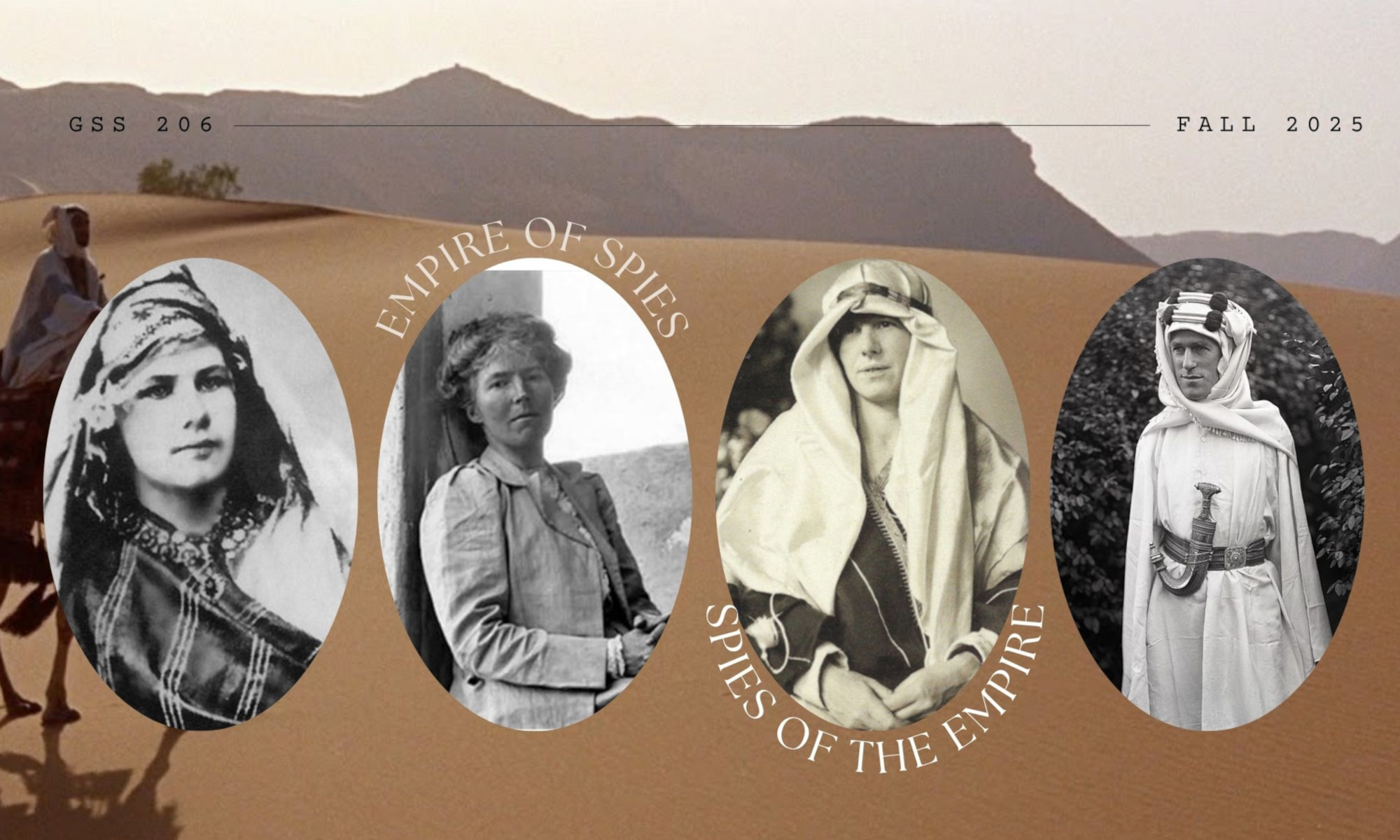
Spies of Empire/Empire of Spies
GSS206-NES204-THR214, Fall 2025
Hi everyone!
This was my final project/lecture that Prof. Fawzia asked to be posted on the course blog!
Hope you all have a good look at it 🙂
Hello my fellow yelpers! I recently watched the 2014 period drama thriller, “Theeb”. Written and directed by Naji Abu Nowar, the film premiered at the 71st Venice International Film Festival. This movie, unlike many shot in a similar area, picturing a similar time period, is completely in Arabic (with the exception of a few English words spoken by the British soldier (played by Jack Fox) sent to blow up the railway). Nowar also only used non-professional actors from the Bedouin community in Southern Jordan. This also differs from the norm in movies about this time period, namely in Lawrence of Arabia (1962) where Prince Feisal (an Arab character) is played by Alec Guinness (random white dude).
The very interesting and very notable aspect of this movie is the absence of women. Originally I came to the conclusion that Nowar was simply a sexist. However, upon further research I discovered that Nowar was planning for there to be women in the movie but none of the Bedouin women in the community they were filming were willing to be in the movie. Nowar didn’t want to lose any authenticity by bringing in professional actors, which led to the whole no women thing.
The plot line is very simple: Theeb and his older brother help guide Edward, a British soldier, through the desert, they are ambushed and Theeb is the only survivor, one of the attackers becomes friends with Theeb, they set off the two of them, and the movie ends with Theeb killing the attacker (“because he killed my brother” as Theeb says to Ottoman guards). The last scene of the movie watches Theeb riding off into the desert on a camel he has now learned how to corral (I always appreciated how Theeb was able to cling onto the back of a camel, FOR HOURS, the strength that he has is astou
nding). Honestly, my biggest issue with the film is that I was worried and am still worried about what happened to Theeb after the movie. How did he survive on his own in the desert? Where did he go? The unfinished ending left
 me slightly frustrated.
I would 100% recommend this movie to anyone, especially those who have watched Lawrence of Arabia. It provides a very different perspective to many of the movies that depict the time period. Not only does having the entire movie be spoken in Arabic change it, but using non-professional actors also adds nuance. It takes away the “oriental glow” that surrounds the whole Lawrence of Arabia type of story and allows viewers to actually see the Arab perspective during this time. Nowar alludes to the very real struggles that Arab guides had during the Ottoman Empire with the installation of the Hejaz Railroad. Also, Wadi Rum and Wadi Araba are beautiful and Nowar’s cinematography is excellent. I truly compel you all to watch this, it was a very interesting watch and one that changed the perspective on the time period.
See you next week with the next movie, yelper fam!
Something that immediately stuck out to me while watching Lawrence of Arabia was Alec Guinness’s performance as King Faisal and Anthony Quinns’ performance as Auda abu Tayi. While both actors were both obviously caucasian, both took lengths to appear more Oriental, with Guinness darkening his lashes with mascara and Quinn going as far to wear a fake nose prosthetic and darken his skin with dye. This was, of course, done instead of casting any native actors in major roles for the production. This immediately brought to mind a related study on the usage of yellowface in older Hollywood films (adjacent to this topic but still overall connected through the theory of Orientalism) that I had encountered in another class, particularly through the case study of Anna Mae Wong.
Anna Mae Wong, the first Asian American actress to make it to big Hollywood, often starred in Orientalized and hypersexualized roles in major blockbuster productions such as “Daughter of the Dragon,” and “The Thief of Baghdad” (the latter, interestingly, takes place in Baghdad where an entirely white cast plays Muslims while Anna Mae Wong plays the ambiguously Asian and scantily clad slave). She is situated in the unique position of being both a pioneer and a perpetrator/opportunist, as while she did open the doorway for Asians in Hollywood, she did so through an Orientalist lens. Notably, she was also passed up the main female lead O-Lan in The Good Earth in favor of a yellowface Luise Rainer, a film that snagged both best picture and best actress at the Oscars in 1938. Anna Mae Wong introduces an offshoot on Said’s Orientalism — Anne Anlin Cheng’s Ornamentalism, an essay that defines ornamentalism as a “conjoined presences of the oriental, the feminine, and the decorative.” With this definition there is a clear implication of the loss of power: if a woman is to be so drastically associated with an aesthetic that she “live[s] as an object,” then she must, by association, have the same power as that object. In essence, she lacks agency. Her presence is admired, yet it holds little power.
Anna Mae Wong perfectly fit into the framework of ornamentalism, and the legacy of Eastern representation can be understood through a relative comparison. Guinness and Quinn play Middle Eastern characters, but their power is excused by the fact that they are, ultimately, white. The same can be said of Peter O’Toole, but flipped. This can also be applied off the screen: Lawrence is neither a woman or Oriental, but it is fascinating that he is coded under both identities. His struggle with homosexuality, both inner and outer through other people’s perceptions, as well as his familiarity with the Bedouin, complicates his legacy as a man of great agency.

True Blood is set in a world where vampires have recently come out of hiding due to the scientific advancement of a synthetic blood, True Blood. Sookie begins the show as a beautiful, innocent town weirdo. Everyone knows she can read minds, and in fact, she hates the trait herself. However, she realizes she cannot read the minds of vampires, and thus begins her many dramatic vampire affairs. The lore eventually grows and it is revealed that Sookie is a mindreader because she is part fairy (the show’s getting really bad…), which makes her blood alluring to vampires. Here is where my parallel really begins.
Lawrence, perhaps more than our other spies, was able to manage a balance of being an insider-outsider. While he donned an Arab drag, he wasn’t pretending to be Arab. He was able to travel between worlds because of his “ability to penetrate the inner self of the Arab individual” (Mousa 5). In relation to Arabs then, Lawrence had to be different. He was not one of the in-group; his relationships with Arabs was rooted in individuality, the recognition of difference. Like he says, “I can understand it enough to look at myself and other foreigners from their direction, and without condemning it. I know I’m a stranger to them, and always will be: but I cannot believe them worse, any more than I could change their ways” (Lawrence quoted in Garnett 156). Strangely, Sookie mirrors this insider-outsisder paradigm in her relationships with vampires. She can easily slip into their world because she is different. She doesn’t want to become a vampire or adopt their lifestyle, but they give her a reference point of normalcy–what she finds alluring about them. Furthermore, Sookie uses her ability to mind read to spy for vampires. She occupies human space (she visually appears human, can daywalk, and her power is invisible), but can also traverse the vampire world because of her fairy powers (which are based in light, and can therefore hurt vampires), her connections to the in-group, and the promise of her allure. She is both sympathetic and aggravating. She uses others, but gets used, and treats herself as the center of the universe. Her favorite line is: “If our relationship ever meant anything to you, you’d do this for me.”
Lawrence is somewhat the same. Mousa’s An Arab View and Theeb portrayed Lawrence as much less powerful than other iterations of his tale. He was simply a man in the right place at the right time with the right connections. Whatever role he did play in the Arab Revolt, it was exaggerated. He made promises he could not keep and we’ll never know if he actually thought he could make them happen. He used the Arabs for his own psychosexual, sado-masochistic exploration of the self through the east. He was a vampire! In the same way Sookie is, at least. Sookie spies for vampires but because she cannot read their intentions, often finds herself in situations where she has been cornered, manipulated, and even extorted by the very vampires she is psychosexually, sado-masochistially obsessed with (think: biting and blood, vampires are inherently tied to the concept of pain/consumption, fine line of pleasure/pain). Like Lawrence, she is both spy and insider-outsider, although she’s generally the one who ends up losing. I’d also argue she is sexually exploited in a way Lawrence was able to exploit others because of his rank. His gay love letters are described by Norton as “love letters from a slave to his master.” It brings up the question, how much information can one relationship have before it becomes exploitative? Could Sookie ever have a relationship with a vampire that doesn’t have a ridiculous power imbalance? With a human? Could Lawrence ever do the same with Arabs he claimed to love and work for? With his beloved Dahoum?
Spying necessitates betraying others, but in that, it must be wondered if that also means betraying oneself. Can one really love a person (or people) they exploit? It might be a reach, but to some extent all spy stories are vampiric.
Freya Stark is the only one of the spies that we’ve studied that has had the ability to truly tell her own story. This is mainly because of the fact she didn’t die a tragic, untimely death like Bell, Eberhardt, and Lawrence. For both Eberhardt and Bell, their collections of letters were compiled by loved ones or family members (Florence Bell for Bell, and Victor Barrucand for Eberhardt). Since both of the women were dead, they did not have control over the choice or parts of letters that were selected for their books. Therefore, they were unable to control their own narratives. The same can not be said for Stark. In Beyond Euphrates, a story told through selected diary entries and letters, Stark picks and chooses what she wants to be read and seen by her audience. Furthermore, she comments on each of these excerpts, leading her audience towards a certain thought or belief. She is allowed to write her own story, to control her own narrative (though I’m sure others have many critiques of her (I know we have…)).
This follows the concept of “history is written by the victors”. While Stark is not necessarily a victor, she conquered not dying too young like her peers. It gave her the power to shape her public persona. Stark isn’t the only person or group of people to do it. After the Civil War, the Daughter of the Confederacy rewrote the textbooks to favor the Southern perspective (or rid them of any wrongdoing) that are still used today. Even though the women were unable to vote or had any “power”, they shaped the education systems in the south for hundreds of years. They changed the perception of the decisions made about slavery and other controversies during the Civil War by those in power in the South to be more favorable.
This power to shape your history or perception continues to influence the political scene today. As the government bans books, censors topics in higher ed, and defunds important research it is attempting to rewrite our history. We are allowing those in power to change our perception of reality and their view on history is becoming the accepted view. Trump forcing the Smithsonian to remove any exhibit or piece that would put the United States in a bad light is a prime example of reshaping the perception of the US. In allowing this, we are actively seeing our history be changed.
Freya Stark may have been one woman, but her continued legacy is a result of her ability to maintain control over how others perceive her. This idea is applicable to a wide range of situations, from the Civil War to current politics and we need to be aware of its power.
*I am going to do a different take on this prompt and imagine my vacation to Petra in Jordan with Gertrude Bell in the modern day. It imagines a portion of our day as we walk through the ruins. Italicized text was taken out of readings we did in class.
It’s a hot and windy day in Jordan. Gertrude and I are on the third day of our week-long vacation through the ruins of Jordan. We are currently in Petra. Gertrude refuses to wear modern-day dress, instead choosing to wear the same muslin gowns that her mother, Florence, had sent her throughout her time in Baghdad. Crowds of people surround us, tourists with their families. Men and women are dressed in over-the-top Oriental outfits, selling trinkets and camel rides to the tourists. It is safe to say that it was a typical day in Petra (at least in the modern day Petra). I am unfazed by the bustle, but when I look over to Gertrude her face tells a completely different story.
“This place used to be a fairy tale city, I camped amid a row of ornate tombs, three stories high, what has happened to this place?” she asked me with a disgusted look on her face. I laugh, telling her that this is normal. As we make our way through the crowd, Gertrude walks with her nose in the air, ignoring everyone around her. We are approached by a man dressed in bedouin attire. When he begins to speak to us in English Gertrude looks offended. Scoffing, she exclaims, “This is not the real East, I wish I was in Iraq. I like Iraq. It’s the real East”. The man, confused, walks away. I tell her that she shouldn’t talk to people like this. Her response was to glare and bustle away.
As I trail behind her, I hear her muttering, “Oh how degraded this place has become. All these people, the children, the women. The Arabs have ruined it with their greed. Their need for money and tourism. If the British were in charge this would never have happened. We would have kept it preserved. Only the best could visit, the bravest, certainly no women or children. Only the true explorers.” Once I catch up to her, she suddenly stops, clearly she did not want me to hear what she was saying. Those thoughts were only for herself. Instead, she comments on the weather “it’s breathlessly, damned hot”. I chuckle, telling her that if she didn’t refuse the modern fashion of shorts or light linen pants and a t-shirt she wouldn’t feel so hot. Brushing my comment off she walks away.
We make our way up the hike to the Monastery. I don’t blame her, it is hot. As we climb our way up the steps she remarks that when she had been in Petra last she made this hike on camelback, “Why do these people insist on walking? Camels are much more efficient!”. Laughing, I continue on without comment.
She can be a little bit stuck up. I think she would prefer I wasn’t here at all, that she was all alone in this place. Maybe with her servant Fattuh. She definitely doesn’t want any other tourists here. She would much rather cosplay a lone adventurer than be one of the many. Be the first European women to see these places. She is clearly knowledgeable and interested in our surroundings but would rather explore solitarily.
“Let’s go back to our hotel, maybe there we will be treated with the respect we deserve” she says, interrupting my thoughts. Knowing that I can’t change her mind, I agree to be done for the day. Hopefully some of the other places we visit will be more authentic for her.
There is a line from chapter five of Janet Wallach’s Desert Queen that has stuck with me for weeks. It states, “She, an atheist, had faith only in her family and the British Empire. Her doctrine lay in the righteous destiny of England, her conviction in the belief that the British were chosen to lead the world.” This line is filled with so much contradiction and complexity that it could not be described as anything other than human.
For starters, as stated, Gertrude Bell was a staunch atheist. Despite this, the line is overtly religious in tone, littered with words like faith and belief. While this wording is not used to describe a relationship with any sort of god, I find it strange to apply this language to a person who subscribes to a worldview built on the absence of faith. Moreover, I have kept wondering where this belief that the British were chosen came from. If you do not believe in a god, who exactly chose you? It would not make much sense to assign nature as the chooser. Biologically and even phenotypically, there is no real difference between the French, Germans, British, etc. Yet, Bell was certain the rulers of the world had to be British.
As I continued to think over this line and its seemingly uncharacteristically religious nature, I began to think about how Bell could reject the choice to observe a personal religion but could not escape the religious world she inhabited. The time period that Bell was more religious by far. In Western Europe, specifically, Christianity was so ingrained in society that many of what were considered social norms were directly from the religion. Considering her already high standards, I wonder, if Bell were born today, would she even have any desire to marry.
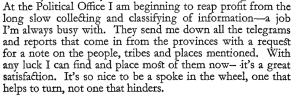
Gertrude Bell demonstrated self-awareness in her role as an agent and as an instrument of empire. She wanted to play a useful role and, in her letters, mentions several times that when she feels she is busy and productive, she is happier, but when there is a lack of work to be done or her duties are minimized, she falls into frustration and sadness. She seems to find purpose in being part of a grand scheme, in her words, “It’s so nice to be a spoke in the wheel, one that helps to turn, not one that hinders.” What does it mean to romanticize one’s own work, especially when that work is being an intelligence officer for the British Empire? This ties too to Bell’s tendency to romanticize the local people and their culture, and the archaeology and history of the region.
Bell emphasizes interpersonal networks, human intelligence, and building relationships, all of which are concrete ways to create and maintain imperial control, but she projects a sense of romantic adventure onto them. She frames herself not as an imperial oppressor, but as one who studies and interacts with local cultures to build relationships and foster positive developments for them. Was this how she justified her work internally? Does this affect the ethics of how her work played out, and how she was perceived by both sides (the local people and the British Empire)? Her relationship with the local people in some ways was ethical, and in other ways served imperial designs – the duality of Bell’s work is important to understanding her, because she did display a genuine appreciate and care for local people and heritage, but it does not negate the influence and the consequences of her role as an agent of the British Empire.

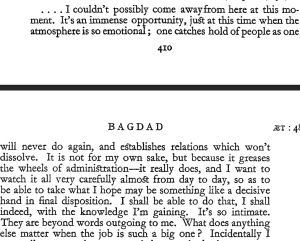
Bell’s work was also beset by a frustration over gendered constraints, and her own personal restlessness. She felt simultaneously thrilled by her work and trapped by limits imposed on her. She did not want to “sit and record”, she yearned to explore and be active – demonstrating the tension between her ambitions and the patriarchal, restrictive environment she grew up in and worked for. Through her letters, frequent references to minutia like the temperature, clothing, and accommodations all reveal her mounting agitation and a sense of containment, which she sought to escape. Her work also takes a toll on her personal life. She mentions loneliness and the difficulty in reconnecting with an old friend. Bell seeks to remain stoic, especially externally, and blames herself whenever this image falters. She sets high standards on herself, even to her own detriment. Her service of empire comes too at a high personal cost.
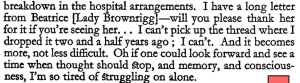
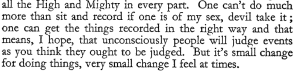
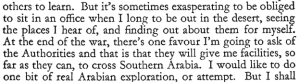
In closing, we might consider Bell’s fascination with the Near East. She was drawn to its ancient history and to its extant cultural traditions – yet paradoxically, in The Desert and the Sown, describes “the Oriental” (the Arab) as like an “overgrown child”. Does Bell fully buy into the imperialist British mindset of bringing civilization to the local people? She is fascinated with ancient Mesopotamia, while her daily work constructs a new, modern nation-state, designed to serve the British Empire’s regional interests. Her affection towards this land is inextricable from her own participation in destroying its capacity for independence. Her work as an archaeologist and in setting up a museum to maintain artifacts, as well as her insistence that the majority of them remain in Iraq rather than be sent abroad, show that she did genuinely value the cultural heritage of local people, and wanted them to maintain a degree of agency over their own relics. Today, in archaeology and in museology, provenance and cultural heritage are crucial factors. It is important to integrate respect both for the ancient aspects of a region and the modern people that this cultural heritage belongs to.
The following two quotes show the paradox of Gertrude Bell – on the one hand, as someone who appreciated the human connection she found with the local people, and on the other hand, as someone who proudly served the British Empire, and sought to further its dominion over the land and people of Iraq.
“But it’s a wonderful thing to feel this affection and confidence of a whole people around you.”
“…whatever our future policy is to be we cannot now leave the country in the state of chaos which we have created, no one can master it if we can’t.”
Letter excerpts from The Letters of Gertrude Bell Vol. 1 and Vol. 2.
Intentions and motivations aside, the readings of the past three weeks have demonstrated that Gertrude Bell is nothing short of extraordinary. From the many occupations and areas of expertise she mastered to her role in shaping today’s Middle East and even her influence on TE Lawrence, Bell engraved her own name into history. Of course, we learn from Janet Wallach’s thorough account of her that Bell’s greatness was, to some extent, to be expected. After all, she was brought up in a generationally elite and educated family (Wallach 32) and was accustomed to the presence of the great socialites and academics she would later come to work with (Wallach 30, 39). From a young age, Bell was well versed in language learning, and soon, she became one of the first women to not only attend, but excel at Oxford (). However, what was not expected is her positionality as a woman posing so little hindrance to her climb up the British bureaucracy. While she did face some hurdles, from having to sit backwards in class (Wallach 48) to facing the demeaning comments and dismissals of Leachman and other colleagues on multiple occasions (Wallach 267) and even having to fight for an official position within the British intelligence order (Wallach Ch 17), Bell’s sheer expertise on the Middle East meant that once she broke these initial barriers, her climb to the top was smooth. So much so in fact, that Winston Churchill himself would come to rely on her knowledge ()!
And for good reason. Bell’s writings, from Persian Pictures to letters in which she extensively describes the peoples and geographies of Syria, Baghdad, and even areas of Europe, are clear evidence of her eye for detail and her unique aptitude for information gathering. In fact, Bell ends up producing detailed maps of what was Mesopotamia, maps which detailed tribal affiliations and public opinion of the British, that would become crucial in her later delineation of modern day Iraq ().
However, and this, I suppose, is what I have written my post to highlight, Bell’s consistent entitlement, whether earned like her positions and knowledge, or inherited like her wealth, meant that she had little sympathy for the struggle of other women, particularly when it came to political involvement. In other words, there is argument to be made that Bell’s scarcity of struggle in coming to power, and the amount of power she held, were the reason she said things like “”(), and was not a supporter of women’s suffrage or a respecter of more conservative women’s practices ()(). This is such an odd positionality. Unlike Eberheardt, Bell did not want to or pretend to be a man. In fact, she embraced her femininity, dressing in luxurious gowns and sophisticated hats (). Yet…Bell was not accepting of the beliefs and needs of other women, she was satisfied by simply being the woman who broke into a men’s world.
Despite this,we still see, like in the short videos and documentary clips we watched in class, many women praise Bell as a latent feminist, one who advanced the positionality of women through her actions and the achievements she showed were possible. Achievements which would earn her titles like Desert Queen and Maker of Kings…and, I suppose, that she was.
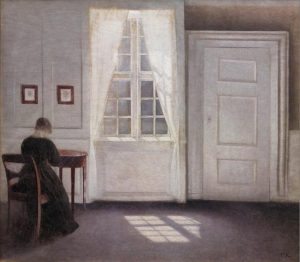
Interior from Strandgade with Sunlight on the Floor
By Vilhelm Hammershoi
Throughout the unit, I noticed a lot how Gertrude Bell had moments of seasonal depression as well as just regular depression. Specifically, in The Letters of Gertrude Bell Volume 1, she exhibited a great amount of seasonal depression while working in Basrah. The transition from being satisfied with her work in December to experiencing physical hardship, illness, strain, and depression in January is reminiscent of this painting and how the woman in it seems sad and reserved. The light in the painting fills the room but it somehow does not warm it which is similar to how the cold feels. Furthermore, when Bell talks about her feeling “limited” by her gender, it feels like how the woman in the painting is alone, cornered, and also “limited” in the way by the artist. I also imagine that the girl in the painting is writing and persevering, similar to how Bell had a sort of quiet endurance despite the inner fatigue she kept feeling when she worked.
Beyond her seasonal depression, Bell deeply mourns the loss of her lover Henry Cadogan. After his death, all her writing is filtered through a lens of grief. If you do a side by side comparison of The Letters of Gertrude Bell with Persian Pictures, you can see that her outlook of the beautiful regions she is visiting is much more grim. Like, in Persian Pictures, she says “Sunshine – sunshine! tedious, changeless, monotonous! Not that discreet English sunshine which varies its charm with clouds… here the sun has long ceased trying to please so venerable a world.” Bell is starting to hate the weather and environment she is in. Although she expresses similar distaste for the weather in the Letters of Gertrude Bell, it is not all encompassing. Just like the woman in the painting, Bell feels colder.
The McGraw Center for Teaching and Learning
328 Frist Campus Center, Princeton University, Princeton, NJ 08544
PH: 609-258-2575 | FX: 609-258-1433
mcgrawdll@princeton.edu
A unit of the Office of the Dean of the College
© Copyright 2026 The Trustees of Princeton University