Hi everyone!
This was my final project/lecture that Prof. Fawzia asked to be posted on the course blog!
Hope you all have a good look at it 🙂
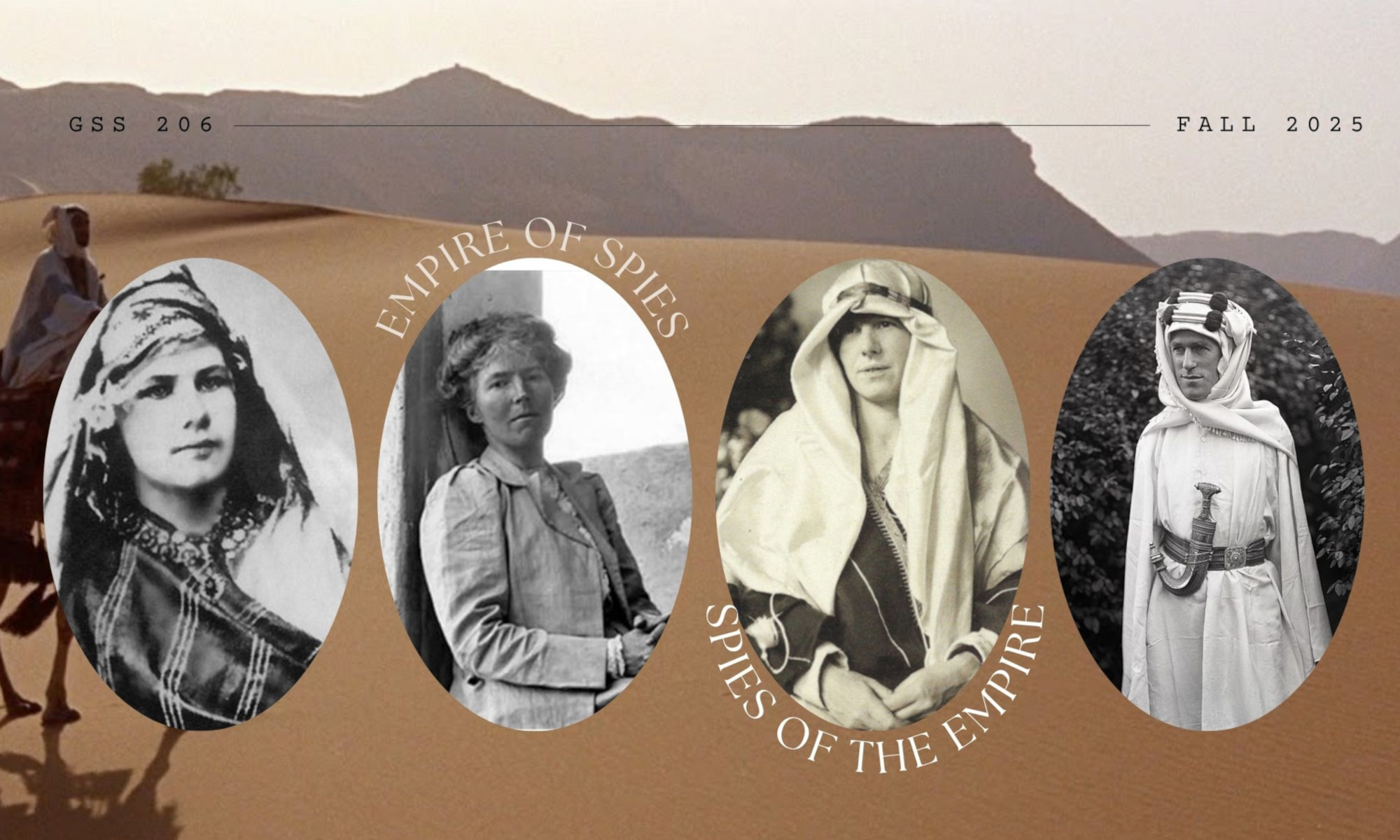
Spies of Empire/Empire of Spies
GSS206-NES204-THR214, Fall 2025
Hi everyone!
This was my final project/lecture that Prof. Fawzia asked to be posted on the course blog!
Hope you all have a good look at it 🙂
Something that immediately stuck out to me while watching Lawrence of Arabia was Alec Guinness’s performance as King Faisal and Anthony Quinns’ performance as Auda abu Tayi. While both actors were both obviously caucasian, both took lengths to appear more Oriental, with Guinness darkening his lashes with mascara and Quinn going as far to wear a fake nose prosthetic and darken his skin with dye. This was, of course, done instead of casting any native actors in major roles for the production. This immediately brought to mind a related study on the usage of yellowface in older Hollywood films (adjacent to this topic but still overall connected through the theory of Orientalism) that I had encountered in another class, particularly through the case study of Anna Mae Wong.
Anna Mae Wong, the first Asian American actress to make it to big Hollywood, often starred in Orientalized and hypersexualized roles in major blockbuster productions such as “Daughter of the Dragon,” and “The Thief of Baghdad” (the latter, interestingly, takes place in Baghdad where an entirely white cast plays Muslims while Anna Mae Wong plays the ambiguously Asian and scantily clad slave). She is situated in the unique position of being both a pioneer and a perpetrator/opportunist, as while she did open the doorway for Asians in Hollywood, she did so through an Orientalist lens. Notably, she was also passed up the main female lead O-Lan in The Good Earth in favor of a yellowface Luise Rainer, a film that snagged both best picture and best actress at the Oscars in 1938. Anna Mae Wong introduces an offshoot on Said’s Orientalism — Anne Anlin Cheng’s Ornamentalism, an essay that defines ornamentalism as a “conjoined presences of the oriental, the feminine, and the decorative.” With this definition there is a clear implication of the loss of power: if a woman is to be so drastically associated with an aesthetic that she “live[s] as an object,” then she must, by association, have the same power as that object. In essence, she lacks agency. Her presence is admired, yet it holds little power.
Anna Mae Wong perfectly fit into the framework of ornamentalism, and the legacy of Eastern representation can be understood through a relative comparison. Guinness and Quinn play Middle Eastern characters, but their power is excused by the fact that they are, ultimately, white. The same can be said of Peter O’Toole, but flipped. This can also be applied off the screen: Lawrence is neither a woman or Oriental, but it is fascinating that he is coded under both identities. His struggle with homosexuality, both inner and outer through other people’s perceptions, as well as his familiarity with the Bedouin, complicates his legacy as a man of great agency.
Freya Stark has been the (if not one of) most intellectually stimulating, accomplished, and devoted spies that we have encountered thus far in our seminar. This playlist will be curating some songs that echo this moral and emotional landscape of Freya Stark’s writings and discussions we’ve had over the last 3 weeks, especially towards her ambivalent stance between devotion and exile as well as humility and power. These songs will be reflecting her own cross-cultural sympathies and her layered identity. I think Freya Stark is a really interesting individual, her loyalties will ultimately is always towards Great Britain, but her complexities in how she sees the Arab World and her seeing faith as beauty in everyday life rather than a dogma makes me view her with a more ethical and reliable lens (although we do have our critiques). Her ability to craft her own story through her own choosing and focusing on her travels makes her a great person to analyze.
“Aaj Jane Ki Zid Na Karo” – Farida Khanum (1960s, poet was Fayyaz Hashmi)
This ghazal’s entreaty “Don’t insist on leaving today” encapsulates the sorrow of transience that permeates Letters from Syria and Perseus in the Wind. In our class discussions, we explored how Stark’s existence fluctuates between belonging and departure, between service and solitude. Khanum’s voice embodies that same duality: restraint, longing, and quiet dignity. Similar to Stark’s prose, it avoids sentimentality while brimming with emotion. The song’s languorous rhythm reflects Stark’s evenings in Damascus or Baghdad, moments caught between closeness and distance, faith and exile. It transforms into an anthem for her moral restlessness: desiring to remain, yet aware that she must perpetually move forward.
“El Helwa Di” – Sayed Darwish
The class emphasized Stark’s admiration for “ordinary service”, her belief that empire fails when it strips people of dignity or agency. Darwish’s song about Cairo’s morning workers gives life to that idea. “Empire redeemed through care.” In Baghdad Sketches, Stark likewise finds holiness in ordinary acts: women baking bread, men sweeping courtyards at dawn. The song reflects her conviction that service ennobles the human spirit and that true civilization is measured not by empire, but by small kindnesses. The song’s gentle strings embodies the grace present within empire as seen through Stark’s eyes, strength for the Arab world lies in its humanity and hospitality not its politics the way the British does. However, Stark still uses moral language to critique empire from within. In Passionate Nomad, Geniesse captures this tension: Stark defends Britain’s Arab policy while privately empathizing with Arabs betrayed by the post-WWI settlement.
“Desert Rose” – Sting ft. Cheb Mami
Cheb and Sting’s English and Arab duet creates the same cultural duality as seen through Letters from Syria. This song represent the constant back and forth with the East and the West, reasoning and reverence. Stark is noted to be “morally exiled”, too Western to belong to the East and too “Eastern”/changed in her perspectives to return and be content at home. This song is the exile to everything she is, perfectly framing Stark as sensual, distant, yearning, yet still patriotic. Stark once wrote, “The desert does not separate; it teaches us the beauty of distance.” Stark’s fascination with Arab “service” and her writings that accustomed affectionate realism rather than Orientalist distance, however she still had her 1930s British views as seeing British’s roles as a moral tutor of the Arabs.
“Riverside” – Agnes Obel
Reflective, quiet, sorrowful, mirroring the tone of Perseus in the Wind where Stark is contemplating beauty, life, aging, and faith. Solitude of travel, the river representing her travels and what she’s saying. Obel sings how she “sees how everything is torn in the river deep. And I don’t know why I go the way down by the riverside..” analogous to Stark and her travel writings and her “feminine ethics of observation”. “The world’s beauty,” Stark wrote, “is the highest service a soul can render.” “Riverside” sounds like the stillness of that service. Stark’s gender and her perspective is very much seeing feminine virtues redeeming imperial contact and this process of her continuing to embody empathy and service through her stops and in conjunction with this song, the analogy of her travels to being along the river.
“Arrival of the Birds” – London Metropolitan Orchestra
While this song is purely instrumental, it is fitting for it to be regarded as Freya Stark’s ultimate life theme song. Stark’s numerous writings can be regarded as the lyrics as her writings have been grand, full of rich text to be deciphered, ultimately mimicking the feeling of returning home changed. The tone of the song is very grand, dignified, tapered right as it would approach arrogance. The song invokes discovery, wonder, and the quiet till of achievement. In Perseus in the Wind, she wrote that “the human spirit grows only when challenged,” and this song embodies that belief. It’s not victory by domination, but victory through understanding. This piece encapsulates her quiet ventures from her childhood struggles to her early travels to her dignified later years as Dame Freya Stark.
Intentions and motivations aside, the readings of the past three weeks have demonstrated that Gertrude Bell is nothing short of extraordinary. From the many occupations and areas of expertise she mastered to her role in shaping today’s Middle East and even her influence on TE Lawrence, Bell engraved her own name into history. Of course, we learn from Janet Wallach’s thorough account of her that Bell’s greatness was, to some extent, to be expected. After all, she was brought up in a generationally elite and educated family (Wallach 32) and was accustomed to the presence of the great socialites and academics she would later come to work with (Wallach 30, 39). From a young age, Bell was well versed in language learning, and soon, she became one of the first women to not only attend, but excel at Oxford (). However, what was not expected is her positionality as a woman posing so little hindrance to her climb up the British bureaucracy. While she did face some hurdles, from having to sit backwards in class (Wallach 48) to facing the demeaning comments and dismissals of Leachman and other colleagues on multiple occasions (Wallach 267) and even having to fight for an official position within the British intelligence order (Wallach Ch 17), Bell’s sheer expertise on the Middle East meant that once she broke these initial barriers, her climb to the top was smooth. So much so in fact, that Winston Churchill himself would come to rely on her knowledge ()!
And for good reason. Bell’s writings, from Persian Pictures to letters in which she extensively describes the peoples and geographies of Syria, Baghdad, and even areas of Europe, are clear evidence of her eye for detail and her unique aptitude for information gathering. In fact, Bell ends up producing detailed maps of what was Mesopotamia, maps which detailed tribal affiliations and public opinion of the British, that would become crucial in her later delineation of modern day Iraq ().
However, and this, I suppose, is what I have written my post to highlight, Bell’s consistent entitlement, whether earned like her positions and knowledge, or inherited like her wealth, meant that she had little sympathy for the struggle of other women, particularly when it came to political involvement. In other words, there is argument to be made that Bell’s scarcity of struggle in coming to power, and the amount of power she held, were the reason she said things like “”(), and was not a supporter of women’s suffrage or a respecter of more conservative women’s practices ()(). This is such an odd positionality. Unlike Eberheardt, Bell did not want to or pretend to be a man. In fact, she embraced her femininity, dressing in luxurious gowns and sophisticated hats (). Yet…Bell was not accepting of the beliefs and needs of other women, she was satisfied by simply being the woman who broke into a men’s world.
Despite this,we still see, like in the short videos and documentary clips we watched in class, many women praise Bell as a latent feminist, one who advanced the positionality of women through her actions and the achievements she showed were possible. Achievements which would earn her titles like Desert Queen and Maker of Kings…and, I suppose, that she was.
The Mirror Trick
In Marie-Odele Delacour and Jean-René Hulue’s “Introduction: The Game of ‘I’”, they draw special attention to the rhetorical and thematic use of perspective in Eberhardt’s writing. In “The Mirror,” a short prelude to the rest of her short story collection, the first-person narrator is Mahmoud Saadi. He is a male wanderer who becomes the vessel for Isabel’s writing, though in the text he is not named, and without further inspection his role is mostly passive. The more active subject is Mohammed, who is described to be of “perfect masculine beauty.”. Mahmoud observes Mohammed looking at himself in a little penny mirror and speculates at his interiority — at the end Mohammed closes the mirror and smiles, and the reader is left unsure as to whether Mohammed was using the mirror to spy upon the spying on Mahmoud.
While reading this passage, I remembered a quote that’s been pinging itself around in my head recently. Margaret Atwood says: “Male fantasies, male fantasies, is everything run by male fantasies? Up on a pedestal or down on your knees, it’s all a male fantasy: that you’re strong enough to take what they dish out, or else too weak to do anything about it. Even pretending you aren’t catering to male fantasies is a male fantasy: pretending you’re unseen, pretending you have a life of your own, that you can wash your feet and comb your hair unconscious of the ever-present watcher peering through the keyhole, peering through the keyhole in your own head, if nowhere else. You are a woman with a man inside watching a woman. You are your own voyeur.” While this refers more to heterosexual objectification, it nevertheless provides an interesting perspective on Eberhart’s superfluous and intersectional identity as a woman who often disparages women, a woman who travels as a man, and a white person who claims a middle-Eastern identity and inheritance.
In their reading of “The Mirror,” Delacour and Hulue claim Eberhardt as an incredibly active participant; through their description, it’s easy to mistake her as a character in the narration itself. With this supportive interpretation, the question that the Atwood reference then invokes is whether or not there is such a thing as an internal, uncorrupted female gaze. The fact that Eberhardt is the female puppeteer behind these two male figures is a significant reverse-power play considering the context of her time, but that logic is marred when taking into account the privilege of her whiteness in shaping ethnic stories. The infinite “spying” aspect of the mirror trick also relates to Atwood’s quote as it is unclear if Mohammed is reflecting internally within himself, if it is only Mahmoud is spying on Mohammed, if it is Mohammed is spying on Mahmoud spying on Mohammed, or, to get really rhetorical, if Mohammed is piercing the veil of Mahmoud to lay his eyes on Eberhardt; Atwood’s quote is less about separate male and female gazes, but and more that they are inevitably melded within a woman. Is Eberhardt, this double agent of politics and identity, just living an amped up version of this psychosis?
As a Kabyle-American, I found all of Eberhardt’s journeys quite fascinating. In a lot of the ways I’ve experienced and understood Algeria, she is transgressive if understood as a woman. While I use the pronouns “she” and “her” for Eberhardt, this is done only for linguistic clarity. I think her gender was far more complicated than just being a woman traveler in drag. Is it fair to even consider her a woman when her gender/religious/cultural expressions were entirely male? If Eberhardt is understood as a man, then really, all she did was not very transgressive. I think I’m inclined to read her this way because the very few times she refers to herself in her daily journals, masculine pronouns are used. So, she is then a masculine European figure, trying to (quasi-)disguise herself as an Arab. Once again, this is very surface level transgressive, and instead further reinforces what Mohamed Boudhan calls “France’s Arabizing function.”
Let me explain! “These Berber assemblies are tumultuous. Passions have free rein; violent, they often end in blood. However, the Berbers always remain protective of their collective rights. They defend themselves against autocracy by suppressing those who dare aspire to it. In Kenadsa the Arab theocratic spirit has triumphed over the republican confederative Berber spirit” (Eberhardt 307; Oranese South II). Essentially, Eberhardt establishes an ethnic hierarchy of her experiences in Algeria. The (often French-associated) Arabs act as enlightened Muslims, much better and more civilized than their primitive, Indigenous counterparts. While her fascination with Arab identity may be read as transgressive from a western lens, when Eberhardt is understood as someone in the lived reality of North Africa, she instead implicates herself with a fellow ruling, dominating class. She, as a native European, is understood as a qualified speaker on civilization, and she knows the Arabs have it where the Berbers don’t. It completely reinforces the French colonial tactic of dividing and conquering. Arabs and Berbers are SO different, and if you can’t be European, it’s much better to be a civilized Arab!
Despite the interesting and somewhat controversial history of Amazigh marabouts, Eberhardt associates this caste of people with Arabo-Islamic civilization. “The marabouts’ influence on Kenadsa has been so profound that Berbers and Kharantine have forgotten their languages, no longer using anything but Arabic. Their behavior has softened and become civilized” (Eberhardt 308; Oranese South II). Eberhardt then believes in a cultural/linguistic homogeneity, a precursor to the aftereffects of French colonialism on North Africa. While Eberhardt claims to be a neutral passerby on her journey to self-discovery in the exotic east, she claims to have “never played any kind of political role” (Bowles 87; Eberhardt’s letter to the editors of La petite Gironde). Yet, just a few sentences later, she admits, “whenever possible, I make a point of trying to explain to my native friends exact and reasonable ideas, explaining to them that French domination is far preferable to having the Turks here again, or for that matter, any other foreigners. It is completely unjust to accuse me of anti-French activities” (Bowles 87; Eberhardt’s letter to the editors of La petite Gironde).
Overall, Eberhardt is an incredibly interesting character, but perhaps for the exact opposite reasons western media lauds her as a transgressive, anti-racial, proto-feminist. To me, she is the perfect example of Europe’s ability to separate, class, and racialize their colonial subjects, as well as setting the stage for the postcolonial Arabization of North Africa. Eberhardt’s views were perhaps more progressive than the average European of the era, however, it wasn’t anything particularly revolutionary, despite how impressive her story was. Like Kabani says, “[Eberhardt] became a mouthpiece for patriarchy, voicing traditional male views on sex, culture, religion and politics” (Kabani ix). It’s like the kids say: fork was found in kitchen!
Hello Students of Spies of Empire!
Lets have some fun interrogating the machinery of Empire as it reveals itself through the shenanigans of some of its more famous–or infamous!—writer-spies-archeologists-travelers: spies one and all!
We will think about what “spying” means” and whose interests it serves–and ask when it can be a force for good or evil, control or being controlled.
More to follow….for now, welcome to the course!
The McGraw Center for Teaching and Learning
328 Frist Campus Center, Princeton University, Princeton, NJ 08544
PH: 609-258-2575 | FX: 609-258-1433
mcgrawdll@princeton.edu
A unit of the Office of the Dean of the College
© Copyright 2026 The Trustees of Princeton University