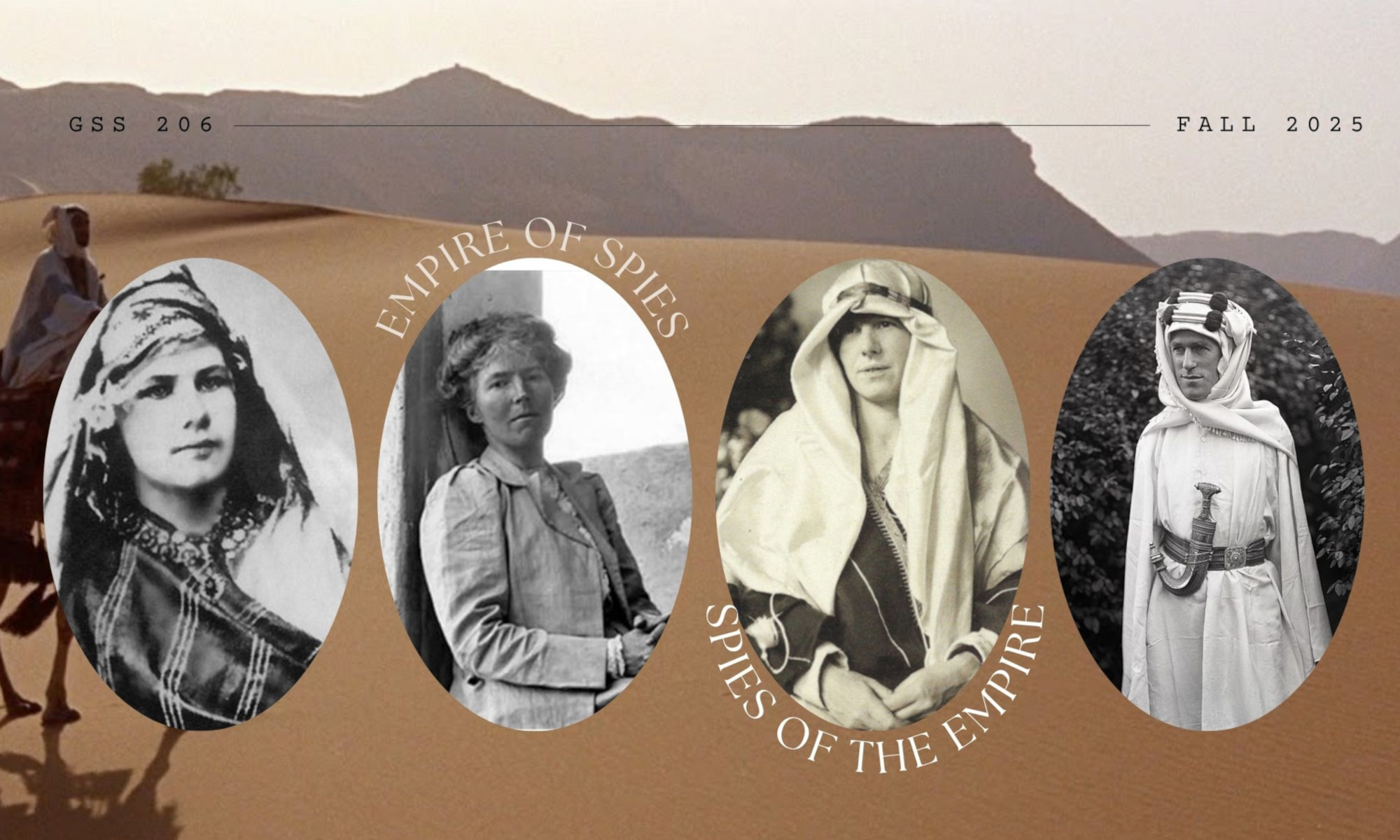
Isabelle Eberhardt: Radically un-Transgressive

As a Kabyle-American, I found all of Eberhardt’s journeys quite fascinating. In a lot of the ways I’ve experienced and understood Algeria, she is transgressive if understood as a woman. While I use the pronouns “she” and “her” for Eberhardt, this is done only for linguistic clarity. I think her gender was far more complicated than just being a woman traveler in drag. Is it fair to even consider her a woman when her gender/religious/cultural expressions were entirely male? If Eberhardt is understood as a man, then really, all she did was not very transgressive. I think I’m inclined to read her this way because the very few times she refers to herself in her daily journals, masculine pronouns are used. So, she is then a masculine European figure, trying to (quasi-)disguise herself as an Arab. Once again, this is very surface level transgressive, and instead further reinforces what Mohamed Boudhan calls “France’s Arabizing function.” 

Let me explain! “These Berber assemblies are tumultuous. Passions have free rein; violent, they often end in blood. However, the Berbers always remain protective of their collective rights. They defend themselves against autocracy by suppressing those who dare aspire to it. In Kenadsa the Arab theocratic spirit has triumphed over the republican confederative Berber spirit” (Eberhardt 307; Oranese South II). Essentially, Eberhardt establishes an ethnic hierarchy of her experiences in Algeria. The (often French-associated) Arabs act as enlightened Muslims, much better and more civilized than their primitive, Indigenous counterparts. While her fascination with Arab identity may be read as transgressive from a western lens, when Eberhardt is understood as someone in the lived reality of North Africa, she instead implicates herself with a fellow ruling, dominating class. She, as a native European, is understood as a qualified speaker on civilization, and she knows the Arabs have it where the Berbers don’t. It completely reinforces the French colonial tactic of dividing and conquering. Arabs and Berbers are SO different, and if you can’t be European, it’s much better to be a civilized Arab! 

Despite the interesting and somewhat controversial history of Amazigh marabouts, Eberhardt associates this caste of people with Arabo-Islamic civilization. “The marabouts’ influence on Kenadsa has been so profound that Berbers and Kharantine have forgotten their languages, no longer using anything but Arabic. Their behavior has softened and become civilized” (Eberhardt 308; Oranese South II). Eberhardt then believes in a cultural/linguistic homogeneity, a precursor to the aftereffects of French colonialism on North Africa. While Eberhardt claims to be a neutral passerby on her journey to self-discovery in the exotic east, she claims to have “never played any kind of political role” (Bowles 87; Eberhardt’s letter to the editors of La petite Gironde). Yet, just a few sentences later, she admits, “whenever possible, I make a point of trying to explain to my native friends exact and reasonable ideas, explaining to them that French domination is far preferable to having the Turks here again, or for that matter, any other foreigners. It is completely unjust to accuse me of anti-French activities” (Bowles 87; Eberhardt’s letter to the editors of La petite Gironde).

Overall, Eberhardt is an incredibly interesting character, but perhaps for the exact opposite reasons western media lauds her as a transgressive, anti-racial, proto-feminist. To me, she is the perfect example of Europe’s ability to separate, class, and racialize their colonial subjects, as well as setting the stage for the postcolonial Arabization of North Africa. Eberhardt’s views were perhaps more progressive than the average European of the era, however, it wasn’t anything particularly revolutionary, despite how impressive her story was. Like Kabani says, “[Eberhardt] became a mouthpiece for patriarchy, voicing traditional male views on sex, culture, religion and politics” (Kabani ix). It’s like the kids say: fork was found in kitchen! 
Birds and Freedom – Isabelle Eberhardt

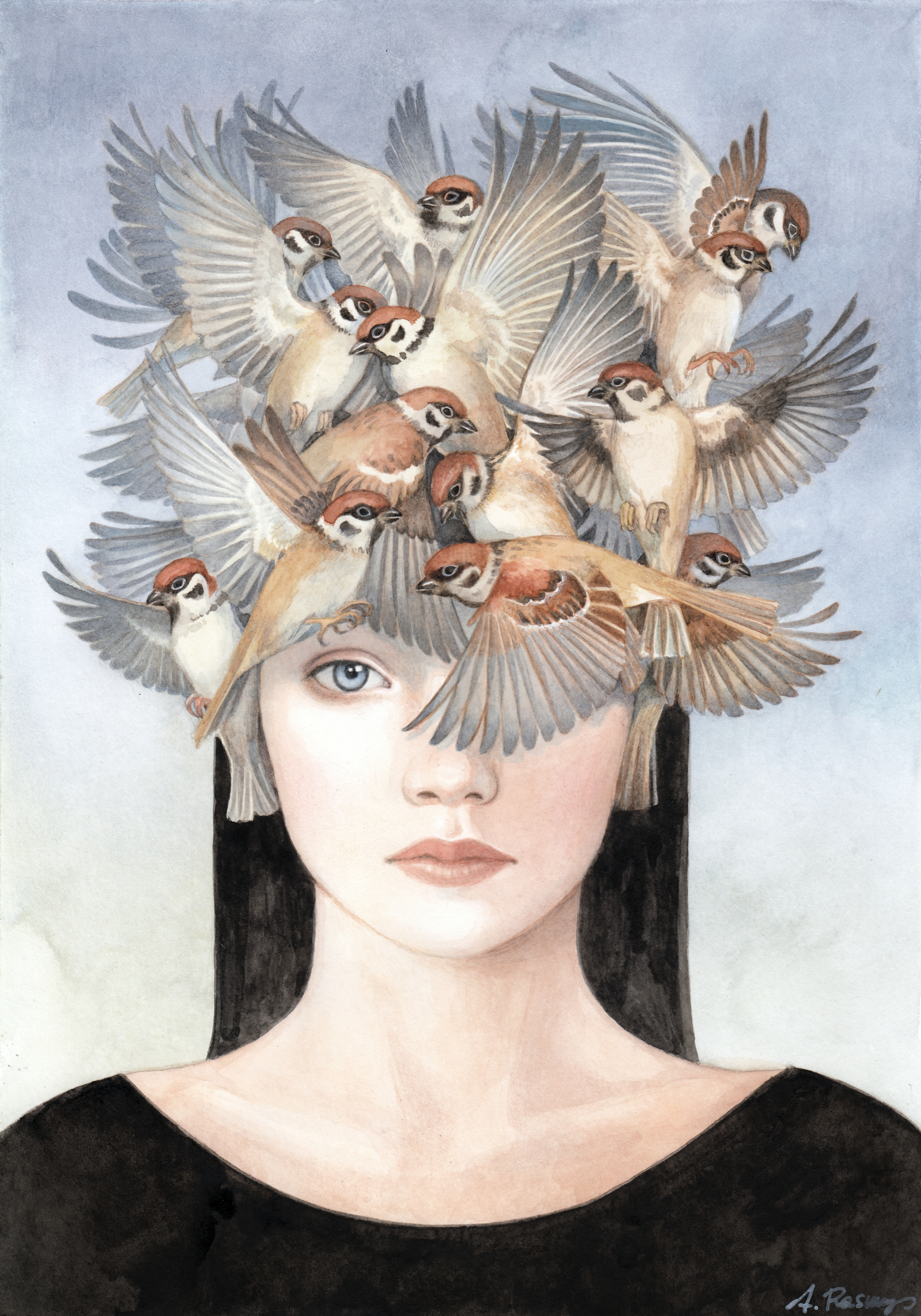
Nostalgia for Freedom I - Every Day OriginalNostalgia for Freedom I by Angelika Rasmus

Nostalgia, wanderlust, sadness, longing… obsession, encapsulation, fracture

“Nostalgia for a place for which I have no name” – Isabelle Eberhardt

This painting by Angelika Rasmus encapsulates the beauty and curse of Isabelle Eberhardt’s flight to Algeria through the unit’s readings on her and her adventures.

Writings from the Sand, Vol 1. An emerging theme was Eberhardt’s fragmentary and impressionistic prose, constantly shifting and exposing her fragmented state of mind. In the painting, the sparrows invoke a fleeting, ungraspable state, circling her consciousness as she juggles her “loyalty” to Algeria, to her Sufi brotherhood, to the French and Layuatey. No single narrative, very known to be a woman despite male-presenting.

Daily Journals, a recurring theme of where, when, what is my (Isabelle’s) inner peace. The tension and turbulence of her circumstances and the situation she puts herself in through her physical dilemma festering from her relations with others, her addiction to keif, her sense of identity and allegiance.  The calm face in the painting suggests her journalistic state, controlled, obedient, however detached from the fractionally expressed thoughts. The woman’s face mirrors the way her journals juxtaposes her self-expression and reflection of constant upheaval in her life through her family life to the conditions she lived in Algeria.

Passionate Nomad (Introduction) “She was a vagabond, a wanderer, not only because of frenzied boredom and innate restlessness, but because she had no real roots anywhere, and therefore belonged nowhere.” Like a bird, with no place to truly call home, constantly in flight, migrating to a place that may seem like a temporary home, but even then not exactly. Eberhardt is a paradox amongst a multitude of things: European-born yet Arabized at least in her “learning” of Islam and the Sufi brotherhood, a woman inhabiting male roles, and a romantic wanderer yet wickedly realist of her own experiences in colonial Algeria. In the painting, there is a sense of lulling calmness, chaos above, individuality of the lady yet multiplicity of the sparrows, and a sense of clarity vs obscurity. There is no stable interpretation of Eberhardt, as can be seen through her readings, her work, her writings.

Eberhardt can not be understood as a simple vagabond or a nomad, she is an anomaly, she is a flock of fractured selves pieced and held together by one strip of sanity in which for her would be the predestined fate that Islam decrees.  Her desires to locate a sense of feminism and being a westerner going into “exotic” lands and do “adventurous” things parallels a life of the sparrow (bird). The obscured eye within the painting suggests a partial blindness, and often noted by many, her using what she could understand to fuel her decisions to the best of her abilities as she grew up with a multifaceted sense of education. The way Eberhardt lives is in constant search for something, whether that be feminism, freedom, escape, a search for meaning, perhaps even a place to call her roots. 

I can’t help but also interpret the multitude of birds in conjunction to the symbolism of birds signifying not only freedom, but depending on the bird, sometimes death, allusion to danger, destruction. Sparrows, in particular, can portray a persistent and obsessive quality. To which Eberhardt was most if not all at certain points of her life in Algeria, especially in the way she was obsessed with Algerian culture and was trusted into the Qadiriyya, and thus not only using Islam as her one string of sanity, but also compelling her mother to also convert (obsession becoming contagious). Her obsession with the male-perspective of Islam allowed her justification to a lot of her decisions, despite her fracturing mental and physical health. Liberation but imprisonment within her own self.

Hello world!

Hello Students of Spies of Empire!

Lets have some fun interrogating the machinery of Empire as it reveals itself through the shenanigans of some of its more famous–or infamous!—writer-spies-archeologists-travelers: spies one and all!

We will think about what “spying” means” and whose interests it serves–and ask when it can be a force for good or evil, control or being controlled.

More to follow….for now, welcome to the course!