Gertrude Bell’s “Religion”

There is a line from chapter five of Janet Wallach’s Desert Queen that has stuck with me for weeks. It states, “She, an atheist, had faith only in her family and the British Empire. Her doctrine lay in the righteous destiny of England, her conviction in the belief that the British were chosen to lead the world.” This line is filled with so much contradiction and complexity that it could not be described as anything other than human.

For starters, as stated, Gertrude Bell was a staunch atheist. Despite this, the line is overtly religious in tone, littered with words like faith and belief. While this wording is not used to describe a relationship with any sort of god, I find it strange to apply this language to a person who subscribes to a worldview built on the absence of faith. Moreover, I have kept wondering where this belief that the British were chosen came from. If you do not believe in a god, who exactly chose you? It would not make much sense to assign nature as the chooser. Biologically and even phenotypically, there is no real difference between the French, Germans, British, etc. Yet, Bell was certain the rulers of the world had to be British.

As I continued to think over this line and its seemingly uncharacteristically religious nature, I began to think about how Bell could reject the choice to observe a personal religion but could not escape the religious world she inhabited. The time period that Bell was more religious by far. In Western Europe, specifically, Christianity was so ingrained in society that many of what were considered social norms were directly from the religion. Considering her already high standards, I wonder, if Bell were born today, would she even have any desire to marry.

The Violence of Grammar: A Tool of Power

One idea that’s been stuck with me since our discussion on the “a” vs. “the” in the Balfour Declaration is how language can decide the fate of an entire people. When Gertrude Bell argued for the use of “a national home” rather than “the national home” for the Jewish people, it might have sounded like a technical adjustment, but to me, it felt like a warning. That “a” became a way to avoid responsibility, to promise without actually promising, to escape accountability. 

As a Palestinian, I have seen this same strategy used before. For example, in the Oslo Accords, the language used to describe Palestinian lands referred to them as “a territory” rather than “the territory which was a choice that allowed Israel to expand settlements and claim land that was never clearly defined as ours in the first place. The ambiguity wasn’t accidental; it was strategic. This showed me that grammar can be violent. A simple “a” can erase and dispossess just as much as bullets or bulldozers.

the use of “a” as a tool of strategic vagueness can be looked at in the broader sense such as in the U.S. Constitution. The way amendments are worded, especially those supposedly guaranteeing “equal protection” or “freedom”, have been deliberately open-ended and therefore leaves space for those in power to interpret justice however they want. Vagueness here is used as a kind of shield: it allows the state to claim moral authority while maintaining the ability to exclude and discriminate. 

I’ve always known that language is never neutral. The smallest choices in phrasing can determine whose lives are protected and whose aren’t. We (the oppressed) tend to celebrate treaties, declarations, and laws as “wins” the moment they’re signed, and it makes sense. These moments usually come after long periods of pain, loss, and struggle, so we cling to any sign of recognition or progress. I would never blame anyone for holding onto hope. But history shows that the real danger lies in the fine print like the indefinite articles, the open-ended clauses, and the carefully chosen ambiguity that gives room to manipulate. We need to look closely at what exactly we’re being offered, and what is being withheld in the wording itself. Because sometimes what looks like a step forward quietly includes the loopholes that will be used against us later.

Reflections on Isabella Eberhardt

I must say, I love a good adventure, Isabella Eberhardt’s adventure however, while wild and exciting, left a confused and hyper romanticized legacy that left a bad taste in my mouth. In looking back at the readings and discussion notes for writing this post, I noticed two major themes along which our study of Isabella Eberhardt fell.  The first theme was intentions and loyalties. Discussion of this theme revolved mostly around Eberhardt’s relationships with different people she came across, particularly, her relationship with the people of Algeria and her relationship with general Lyautey. While there is no definitive evidence which speaks to Eberhardt’s absolute allegiance to anyone but herself and the road, I believe that insight may be gained into her allegiances by analyzing two things. The first is Eberhardt’s own writings about topics surrounding the French and North African populations in both [INSERT TEXT} and [INSERT TEXT]. In [INSERT TEXT] she says “INSERT QUOTE”. Now, while this may have simply been an implication of Eberhardt’s personal admiration for Lyautey rather than her admiration for France’s colonial project, other evidence, such as her saying “INSERT QUOTE” on page [insert pg number] of [INSERT TEXT], suggests that she did, at least somewhat, buy into the French vision of North Africa, even if unintentionally.

The second thing that must be analyzed when attempting to decipher Eberhardt’s loyalties is her biographer’s outlooks on her journey. Now here, opinions do diverge, with some biographers, such as [THAT ONE COUPLE], who in my opinion were more so admirers than experts, claiming that Eberhardt’s allegiances were shifty, and that she was simply trying to survive wherever she went. [AUTHORS’ NAMES] appear to relay that Eberhardt was truly just a writer, a good one, and that if she was looped into French colonial projects, it was unintentional and cause by people taking advantage of her writings. For instance, on [insert pg] of their introduction, they say that Eberhardt “insert quote,” suggesting that Eberhardt was simply an innocent young adventurer trying to live out what she thought to be her purpose. These authors go on to build an what is, in my opinion, an overromanticized or maybe a glorified version of Isabella Eberhardt that focuses more on her allure as an adventurer than about the political motivations and implications of her adventure.

On the other end of the spectrum and just as essential to analyze when studying Eberhardt is [AUTHOR NAME]. [AUTHOR NAME] hints that Eberhardt was indeed mal-intentioned, saying things such as “quote” (cite) and “quote” (cite). These analyses, unlike those that came before, seem to build a more pragmatic version of Eberhardt that adopted the French cause intentionally, regardless of the reason. Since neither side presents definitive evidence, it is difficult to attach labels to Eberhardt, I find it difficult to believe however that someone with that many question marks around them and who has drawn so much attention across time is completely innocent of political involvement. Eberhardt was young, but she was mature and frankly, selfish, her decisions may not have been made in favor of any ideology, but in the pursuit of self-preservation, which for her may have meant walking on the edge between colonist and colonized. 

The second, and in my opinion, equally important theme was Eberhardt’s nonconforming gender practices. Understanding how Eberhardt acted as a man and as a woman, what each gender meant to her and how and where each gender got her is crucial to understanding her person and positionality. One particularly odd thing that stands out about Eberhardt taking on a male persona in Algeria is that she is simply accepted! Even I did not expect that, I was pleasantly surprised but also wondered whether she was accepted because she was a traveller…would a local woman attempting to do the same thing be equally embraced? Both Eberhardt’s own texts and the films which we watched convey her complex understanding of herself as both man and woman. In many texts, including for instance [INSERT TEXT] she refers to herself using male pronouns. Additionally, not only is she addressed by others as Mahmoud, but she also has, as we discussed in class, a male gaze through which she looks upon other women! For example in [INSERT TEXT] she says “quote” (cite), indicating that she views Algerian women in what one might call a typical orientalist light (although to be fair it isn’t quite clear whether she feels this way about European women as well). The conception of herself as a male only in the public space and as female in private and sexual settings is fascinating and is actually a theme in feminist literature. By being male, she is able to access the inner circles of religious orders and society. She is able to freely engage in her hoodlum behaviour with little protest or outright shaming. I wonder however whether she loses a piece of herself in this way…

In the films, Eberhardt is also seen as both man and woman. In the documentary style reflection on her life, people, mostly men, reflect on her as a woman, but also seem to understand and respect the role she held as a man, reflecting the importance of both personas in her legacy. In the recreation of her adventures, she is seen as Mahmoud outside her home and Isabella inside (although the general still refers to her as Mahmoud). Her role as Mahmoud in the film reflects how she was able to form relationships her female existence would have otherwise prevented, specifically her odd relationship with general Lyautey and of course her relationship with many Sufi men.

Tying all of this together is Isabella’s existence as a writer. Through writing, or maybe for writing, she makes sense of herself and the world around her. Her relationships and her positionality, her goals and her past, and much more. We discussed the possibility of her writing being a production of information that categorizes her as a spy…I think that while this may be true, it was not her intention. I believe, because of the passion and colorful language with which she wrote about her travels, that Eberhardt genuinely had a love for the unknown. Whether she got taken advantage of or eventually served the French after losing purpose is a different story. Essentially, I don’t know whether she was a spy or not, and I don’t know that I particularly care…to me she was a woman who defied norms, which in some ways is “cool” but in other ways is genuinely stupid. She was the original Transcendentalist and I am not a huge fan of transcendentalism. She chose to live a difficult but eventful life, a selfish choice, but one that I suppose satisfied her craving for discovery.
 

Desert Ballad: A Playlist for Yasmina

I often do readings while listening to sad playlists full of tragic love songs. While reading Yasmina, I found myself sympathizing with her even more because the music added an extra melancholic element. Her story moves like music, beginning with quiet innocence, swelling with passion, and ending in heartbreak and collapse. These five songs, for me, capture Yasmina’s journey.

  1. “Young and Beautiful” – Lana Del Rey

This song reflects the way Yasmina begins: innocent, dreamy, and living her life as a shepherdess among the ruins. She doesn’t fully understand what’s coming, and when Jacques enters her world, she’s swept along almost without a choice. The line “Will you still love me when I’m no longer young and beautiful?” mirrors Yasmina’s fate. Jacques is captivated by her youth and beauty, but those qualities fade in his memory once he returns to France, leaving her devotion behind.

2. “Love Will Tear Us Apart” – Joy Division

Yasmina and Jacque’s love is doomed before it even begins. She even tells him it’s impossible for a Muslim girl and a French officer to be together. But instead of stopping, they give in, which makes their passion both beautiful and devastating. The song has the same feeling: you know the ending will be tragic, but you can’t look away. For me, the refrain “love will tear us apart” is exactly what happens when Jacques is reassigned. Reality itself rips their love apart.

3. “Boulevard of Broken Dreams” – Green Day

When Jacques leaves for his new post, Yasmina is left in total loneliness. The image that stays with me is her lying facedown in the gorge, immobilized by grief. She doesn’t rage or resist. She just repeats mektoub. That resignation matches the emptiness in Green Day’s song, where the singer walks a lonely road with no one by his side. Yasmina’s “boulevard” is the dusty plain of Timgad, but the isolation and drained hope are the same.

4. “Somebody That I Used to Know” – Gotye ft. Kimbra

This song reflects the cruelty of Jacque’s return. Yasmina still sees him as her Mabrouk, the man she loved and waited for, and she calls to him with joy. But Jacques, now married to a Parisian woman, treats her as nothing but a shameful past. Her outburst: “Why did you use all of your ruses… to seduce me, carry me away, and take my virginity? Why did you lie and promise to return?” This fits perfectly with the song’s bitterness about being turned into a stranger by someone who once defined your whole world. For Yasmina, love was life itself. For Jacques, it became disposable.

5. “Back to Black” – Amy Winehouse

The end of Yasmina’s story is the hardest to read, and Back to Black is the only song that fits. Yasmina spirals into illness, poverty, and prostitution, but even then she still clings to the memory of Jacques. Winehouse’s line “we only said goodbye with words, I died a hundred times” captures the endless mourning Yasmina embodies. The story’s final words, “Yasmina the Bedouin was no more,” echo the song’s raw finality. Both tell of women consumed by love that society never let them keep.

Birds and Freedom – Isabelle Eberhardt

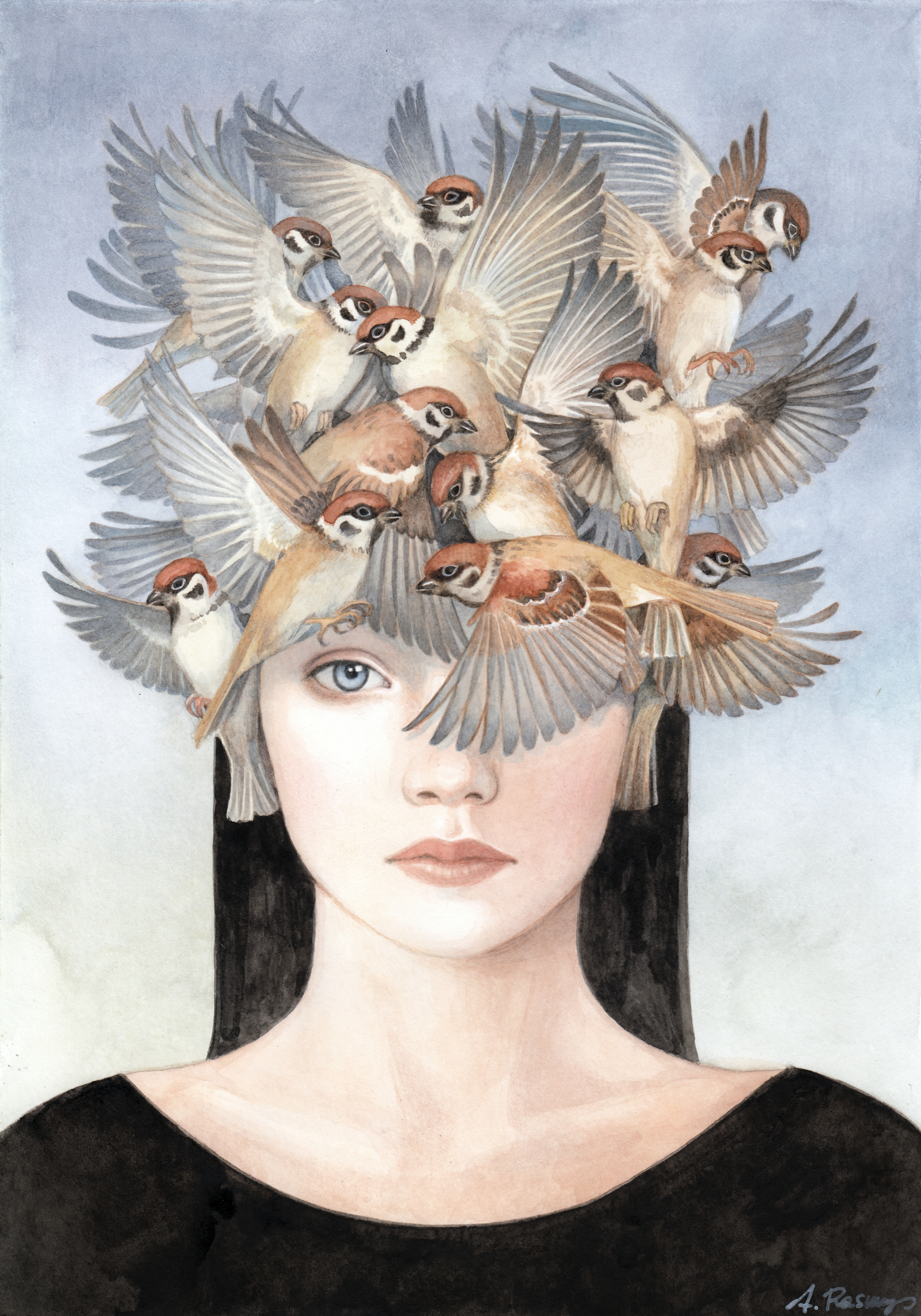
Nostalgia for Freedom I - Every Day OriginalNostalgia for Freedom I by Angelika Rasmus

Nostalgia, wanderlust, sadness, longing… obsession, encapsulation, fracture

“Nostalgia for a place for which I have no name” – Isabelle Eberhardt

This painting by Angelika Rasmus encapsulates the beauty and curse of Isabelle Eberhardt’s flight to Algeria through the unit’s readings on her and her adventures.

Writings from the Sand, Vol 1. An emerging theme was Eberhardt’s fragmentary and impressionistic prose, constantly shifting and exposing her fragmented state of mind. In the painting, the sparrows invoke a fleeting, ungraspable state, circling her consciousness as she juggles her “loyalty” to Algeria, to her Sufi brotherhood, to the French and Layuatey. No single narrative, very known to be a woman despite male-presenting.

Daily Journals, a recurring theme of where, when, what is my (Isabelle’s) inner peace. The tension and turbulence of her circumstances and the situation she puts herself in through her physical dilemma festering from her relations with others, her addiction to keif, her sense of identity and allegiance.  The calm face in the painting suggests her journalistic state, controlled, obedient, however detached from the fractionally expressed thoughts. The woman’s face mirrors the way her journals juxtaposes her self-expression and reflection of constant upheaval in her life through her family life to the conditions she lived in Algeria.

Passionate Nomad (Introduction) “She was a vagabond, a wanderer, not only because of frenzied boredom and innate restlessness, but because she had no real roots anywhere, and therefore belonged nowhere.” Like a bird, with no place to truly call home, constantly in flight, migrating to a place that may seem like a temporary home, but even then not exactly. Eberhardt is a paradox amongst a multitude of things: European-born yet Arabized at least in her “learning” of Islam and the Sufi brotherhood, a woman inhabiting male roles, and a romantic wanderer yet wickedly realist of her own experiences in colonial Algeria. In the painting, there is a sense of lulling calmness, chaos above, individuality of the lady yet multiplicity of the sparrows, and a sense of clarity vs obscurity. There is no stable interpretation of Eberhardt, as can be seen through her readings, her work, her writings.

Eberhardt can not be understood as a simple vagabond or a nomad, she is an anomaly, she is a flock of fractured selves pieced and held together by one strip of sanity in which for her would be the predestined fate that Islam decrees.  Her desires to locate a sense of feminism and being a westerner going into “exotic” lands and do “adventurous” things parallels a life of the sparrow (bird). The obscured eye within the painting suggests a partial blindness, and often noted by many, her using what she could understand to fuel her decisions to the best of her abilities as she grew up with a multifaceted sense of education. The way Eberhardt lives is in constant search for something, whether that be feminism, freedom, escape, a search for meaning, perhaps even a place to call her roots. 

I can’t help but also interpret the multitude of birds in conjunction to the symbolism of birds signifying not only freedom, but depending on the bird, sometimes death, allusion to danger, destruction. Sparrows, in particular, can portray a persistent and obsessive quality. To which Eberhardt was most if not all at certain points of her life in Algeria, especially in the way she was obsessed with Algerian culture and was trusted into the Qadiriyya, and thus not only using Islam as her one string of sanity, but also compelling her mother to also convert (obsession becoming contagious). Her obsession with the male-perspective of Islam allowed her justification to a lot of her decisions, despite her fracturing mental and physical health. Liberation but imprisonment within her own self.

Hello world!

Hello Students of Spies of Empire!

Lets have some fun interrogating the machinery of Empire as it reveals itself through the shenanigans of some of its more famous–or infamous!—writer-spies-archeologists-travelers: spies one and all!

We will think about what “spying” means” and whose interests it serves–and ask when it can be a force for good or evil, control or being controlled.

More to follow….for now, welcome to the course!