Lawrence’s Self-Made Authority

As I read Seven Pillars, a few sentences stood out because they exposed the contradictions and self-shaping that Lawrence leans on throughout the book. One of the clearest examples is his early admission that this is a “self-focused narrative…unfair” to the soldiers and even to his British colleagues. On the surface it sounds humble, almost like he’s trying to be transparent, but I think it was more like a pre-emptive shield. By naming his bias up front, he gives himself permission to center his own experience anyway. And honestly, that annoyed me. It’s like he wants to claim subjectivity when it suits him, but still make his perspective the emotional and intellectual anchor of the entire revolt. He gets to frame the story while acting like he’s too self-aware to be blamed for it.

In Chapter I, when he says the campaign stripped fighters of “ordinary morality, pity, and a sense of individual responsibility,” I noticed how quickly the revolt became a stage for his inner psychological drama. The way he talks about moral decay and alienation overshadows everything else. He’s choosing which emotions to foreground, and they almost always circle back to him. Instead of exploring the broader ethical or political meaning of what’s happening, he turns the whole desert into a metaphor for his own unraveling. The chapter ends up feeling less like a collective wartime experience and more like Lawrence working through an existential crisis. How much of this “suffering” is something everyone felt? How much is part of the persona he’s building: half heroic, half damaged philosopher-soldier?

Then in Chapter II, when he defines “the Arabs” mostly through language and shared social structures. He’s drawing a giant map, dividing people into neat categories, and presenting all of it like it’s objective fact. His descriptions sound academic, but they flatten real differences and turn whole populations into abstractions. This reminded me how quickly ethnographic writing, especially by someone who already sees himself as a cultural interpreter can slip into essentialism without ever admitting that’s what’s happening.

Basically, all of this made me way more aware of how Lawrence sets himself up as the voice we’re supposed to trust. He admits things, sure, but then he turns around and uses that to frame everything on his terms.

TE Lawrence & True Blood’s Sookie Stackhouse: Love Bites!

True Blood is set in a world where vampires have recently come out of hiding due to the scientific advancement of a synthetic blood, True Blood. Sookie begins the show as a beautiful, innocent town weirdo. Everyone knows she can read minds, and in fact, she hates the trait herself. However, she realizes she cannot read the minds of vampires, and thus begins her many dramatic vampire affairs. The lore eventually grows and it is revealed that Sookie is a mindreader because she is part fairy (the show’s getting really bad…), which makes her blood alluring to vampires. Here is where my parallel really begins. 

Lawrence, perhaps more than our other spies, was able to manage a balance of being an insider-outsider. While he donned an Arab drag, he wasn’t pretending to be Arab. He was able to travel between worlds because of his “ability to penetrate the inner self of the Arab individual” (Mousa 5). In relation to Arabs then, Lawrence had to be different. He was not one of the in-group; his relationships with Arabs was rooted in individuality, the recognition of difference. Like he says, “I can understand it enough to look at myself and other foreigners from their direction, and without condemning it. I know I’m a stranger to them, and always will be: but I cannot believe them worse, any more than I could change their ways” (Lawrence quoted in Garnett 156). Strangely, Sookie mirrors this insider-outsisder paradigm in her relationships with vampires. She can easily slip into their world because she is different. She doesn’t want to become a vampire or adopt their lifestyle, but they give her a reference point of normalcy–what she finds alluring about them. Furthermore, Sookie uses her ability to mind read to spy for vampires. She occupies human space (she visually appears human, can daywalk, and her power is invisible), but can also traverse the vampire world because of her fairy powers (which are based in light, and can therefore hurt vampires), her connections to the in-group, and the promise of her allure. She is both sympathetic and aggravating. She uses others, but gets used, and treats herself as the center of the universe. Her favorite line is: “If our relationship ever meant anything to you, you’d do this for me.”

Lawrence is somewhat the same. Mousa’s An Arab View and Theeb portrayed Lawrence as much less powerful than other iterations of his tale. He was simply a man in the right place at the right time with the right connections. Whatever role he did play in the Arab Revolt, it was exaggerated. He made promises he could not keep and we’ll never know if he actually thought he could make them happen. He used the Arabs for his own psychosexual, sado-masochistic exploration of the self through the east. He was a vampire! In the same way Sookie is, at least. Sookie spies for vampires but because she cannot read their intentions, often finds herself in situations where she has been cornered, manipulated, and even extorted by the very vampires she is psychosexually, sado-masochistially obsessed with (think: biting and blood, vampires are inherently tied to the concept of pain/consumption, fine line of pleasure/pain). Like Lawrence, she is both spy and insider-outsider, although she’s generally the one who ends up losing. I’d also argue she is sexually exploited in a way Lawrence was able to exploit others because of his rank. His gay love letters are described by Norton as “love letters from a slave to his master.” It brings up the question, how much information can one relationship have before it becomes exploitative? Could Sookie ever have a relationship with a vampire that doesn’t have a ridiculous power imbalance? With a human? Could Lawrence ever do the same with Arabs he claimed to love and work for? With his beloved Dahoum?

Spying necessitates betraying others, but in that, it must be wondered if that also means betraying oneself. Can one really love a person (or people) they exploit? It might be a reach, but to some extent all spy stories are vampiric.

Shaping Perception

Freya Stark is the only one of the spies that we’ve studied that has had the ability to truly tell her own story. This is mainly because of the fact she didn’t die a tragic, untimely death like Bell, Eberhardt, and Lawrence. For both Eberhardt and Bell, their collections of letters were compiled by loved ones or family members (Florence Bell for Bell, and Victor Barrucand for Eberhardt). Since both of the women were dead, they did not have control over the choice or parts of letters that were selected for their books. Therefore, they were unable to control their own narratives. The same can not be said for Stark. In Beyond Euphrates, a story told through selected diary entries and letters, Stark picks and chooses what she wants to be read and seen by her audience. Furthermore, she comments on each of these excerpts, leading her audience towards a certain thought or belief. She is allowed to write her own story, to control her own narrative (though I’m sure others have many critiques of her (I know we have…)).

This follows the concept of “history is written by the victors”. While Stark is not necessarily a victor, she conquered not dying too young like her peers. It gave her the power to shape her public persona. Stark isn’t the only person or group of people to do it. After the Civil War, the Daughter of the Confederacy rewrote the textbooks to favor the Southern perspective (or rid them of any wrongdoing) that are still used today. Even though the women were unable to vote or had any “power”, they shaped the education systems in the south for hundreds of years. They changed the perception of the decisions made about slavery and other controversies during the Civil War by those in power in the South to be more favorable.

This power to shape your history or perception continues to influence the political scene today. As the government bans books, censors topics in higher ed, and defunds important research it is attempting to rewrite our history. We are allowing those in power to change our perception of reality and their view on history is becoming the accepted view. Trump forcing the Smithsonian to remove any exhibit or piece that would put the United States in a bad light is a prime example of reshaping the perception of the US. In allowing this, we are actively seeing our history be changed.

Freya Stark may have been one woman, but her continued legacy is a result of her ability to maintain control over how others perceive her. This idea is applicable to a wide range of situations, from the Civil War to current politics and we need to be aware of its power.


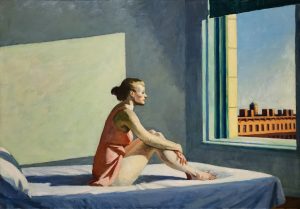
Freya Stark: Empire of Loneliness in Edwards Hopper’s ‘Morning Sun’

Edward Hopper, Morning Sun, 1952

Edward Hopper was a painter who explored American solitude and loneliness more broadly. While Hopper depicts scenes that are rather simple, they still evoke so much emotion. They force the viewer to face emptiness head-on. In Morning Sun, a woman sits on her bed, stares out the window to the sky. But somehow, it feels lonely. Is it the emptiness of the room? Bare walls, a solo figure, a cloudless sky, a simple bloc of buildings, the look on the subject’s face? While studying Freya Stark, it seemed to me that loneliness also permeated her narrative. Stark, perhaps more than the other spies we’ve studied, makes travel seem exceedingly beautiful. Her travel writing stands on its own and would successfully cover her trail (but not dissolve ALL suspicions of her) if we did not know she was a spy. It’s both relaxing and meaningful, adventurous and eye-opening. This makes her spywork particularly captivating and sinister. Quotes like “And if our Empire melts away I think it will not be because we have lost the love of serving but because we have been denying that love to other people, so depriving them of a chance to practise virtues that could make them happy as much as they do us” (Perseus in the Wind, 15) and “It was the fashionable thing to be anti-British in Baghdad at that time” (Baghdad sketches 42) take on a new light. No longer is Stark a judgemental and hoity-toity British traveler, she is an invested patron and benefactor of empire itself. Psychoanalytically, I think much of this is rooted in her low-class (and therefore racialized) upbringing. Her life was deeply nontraditional: a confused family unit, unloving proto-feminist mother, romantically deviant father figure. All of this contributed to her desire to not only be accepted, but to belong to something, to Britain and its empirical values. She took on the identity of a foreigner, despite being British. “She spoke English with a slight foreign accent, [which] made her an immediate object of suspicion to the British authorities,” even though as she writes, “It makes me feel a kind of pariah from my own kind, and awfully disgusted… I am not even pro-native certainly as much of an imperialist as any of the people here” (Ruthven 152, 153). Imagining Hopper’s figure as Stark, in this way, feels significant to me. If the figure is read as Stark, she looks out to the horizon in a trap of loneliness, empty space behind and before her. She works towards empire because of her desire for belonging, but to what end? The room is empty, but so is the view outside the window. All that shows is one bloc of buildings, not even the ground it stands on. This takes on the significance of the consequence of empire: a building with no (or at least an uncertain) foundation. While the sun shines on the subject, the room itself is not warm-toned. It’s cool blue and cold, like a solitary hospital room, evocative of Stark’s nursing experience and her time being ill. The subject’s eyes are dark, perhaps contemplative, her mouth straight and serious. Is she lonely, sad, regretful? What does it mean to her to look away from the presumed comfort of the bed she sits on? She has no cushioning behind her back, despite there being a pillow within reach. Instead, her only comfort seems to be a self-soothing hold. Furthermore, we only see one side of the figure’s face, much like how Stark presents herself (literally and metaphorically): a seemingly innocuous figure with the incredible ability to hide what is underneath the surface. The figure is an incongruity, the only vibrant pink of the piece, yet shadow covers parts of her. Her color is diminished and she almost blends in with the wall behind her. Hopper captures, if read in the context of Freya Stark, the loneliness of empire, its shaky foundation, and the consequence to (not only its victims, but also) its perpetrators. Empire is inherently empty: a sun with no warmth, a bed with no comfort, a room where one is forced to always look ahead, but never successfully move forward. 

Stark and Benjamin

Freya Stark’s era of power overlapped with the life and work of Walter Benjamin, the Frankfurt School writer and thinker. I was especially reminded of Benjamin when I read about Stark’s deep involvement in the production and distribution of propaganda films. In “The Work of Art in the Age of Its Technical Reproducibility,” Benjamin argues that the film medium, though it carries some latent revolutionary/democratic potential, is especially suited to fascism; it’s part of a broader transition in art away from the cult value of a unique item situated in a particular, hallowed viewing space and toward a mechanically-reproduced image, all meaning and authenticity of which is diluted with reproduction. Film is an especially severe example because politics steps up to replace its cult/religious value. It replicates the real world and adheres to genre convention too precisely, such that all the work of interpretation is already done for the viewer. Stark’s propaganda films did the same and took it even further. They explicitly demonstrated the military might of the British Empire, with the express purpose of telling the subject of the film to think, whether they realized it or not: “these people are powerful, I should ally myself with them.” Her films were pure politics, in the sense that they were a honed tool of imperial power, not in the sense that any real dialogue occurred between the film/propagandist and the subject. 

Benjamin would have hated her films, even as he fled the Nazi Germany the British were helping to defeat. He would have found them artless and fascistic; the colonial mechanism isn’t as different from the fascistic one as it seems imperialists of Freya’s era would like to think. This hypothetical opinion of Benjamin’s reflects how I feel, for the most part, about Stark’s life. She was interesting, but seems to have tried to do the work of interpreting her own life for us already, as Benjamin’s film does to the audience, with her re-wrought books, letters, and autobiographies; still these texts tell us little about the person Stark actually was, so we must turn to biographers, and even they are overly sympathetic at times. She was uncreative in her life’s mission and, while she appreciated the aesthetics of revolution and the East, she never broke from the Empire’s mission. 

She, too, was subject to the controlling influence of the British Empire. Although personal circumstances made her unique, in a core way, she was a person “reproduced” under Benjamin’s model—brought up Britishly, made to memorize poems and love the Empire, repeatedly copied until there could be no original/authentic version of her type, not even Gertrude Bell. All she knew was this method of mechanically reproducing ideology, so it makes perfect sense that she would bring those propaganda films with her to Yemen—she was reproducing the model she knew.

Example of the type of film she might have carried (produced by the Ministry of Information, which she worked for): “WARTIME FACTORY” 1940 WWII BRITISH INDUSTRIAL INCENTIVE PROPAGANDA FILM XD82705

To Craft or Un-Craft: A Response to Western Depictions of the Eastern World

Image of Fargo Nssim Tbakhi, The Book of Dust

After our exhaustive discussion of Herzog’s Queen of the Desert, I found myself floundering to imagine the narrative landscape of its antidote. A film rife with sentimental orientalisms of the Berlin variety is of course a dime a dozen, but when attempting to deconstruct and reform it, we still found ourselves stymied when contemplating interformal revisions in any order. For example, the choice to use Arabic when historically accurate, then provoked the question of a “revised” Queen of the Desert would require subtitles. From that, the question of who and what subtitles are comes into play, dominating and redominating our psyches with the realization that Craft — particularly one that is as ubiquitously Western as filmmaking — delineates an array of theoretical “choices” who, outside their nominative delineation, differ not at all. The choice to subtitle presents just as much possibility as the choice not to subtitle for a colonial dominion over the narrative form — it is this impossibility which guided me to (what I believe is) the conceit of our in-class discussions: whether or not Craft is an impossibility as a revolutionary mechanism. 

Fargo Nssim Tbakhi’s 2023 “Notes on Craft: Writing in the Hour of Genocide” defines Craft as “the network of sanitizing influences exerted on writing in the English language: the influences of neoliberalism, of complicit institutions, and of the linguistic priorities of the state and of empire.” To Tbakhi, Craft exists to deny a nuanced reckoning with colonial mechanisms writ large. As an example, he points to Solmaz Sharif’s comments on a poem in which she erased a liberal protestor’s abetting of a staunch Republican’s anti-immigrant rhetoric in favor of highlighting only the absurdity of the former’s demands. This too is a Craft decision: the lucidity of a “good” poem implicitly requires a simplicity of forms and understanding. In this process, similarly complicit forces — such as establishment liberalism — are often ignored in favor of highlighting artistic spectacle as a function of craft. Thus, to exist in a necessary, constant state of revolt, like Palestinians have for the past 75 or so years, requires “that we poison and betray Craft at all turns.” While the conceit of Tbakhi’s argument is situated within the Intifada (for good reason), such required betrayals of Craft can be found all throughout the postcolonial world, from Kashmiri paper-maiche to Guyanaese music, in service of creating an anticolonial world order. 

Two paragraphs into this blog post, you may be asking: “But Ayanna, how does this relate to the image you have chosen, and how does that image illustrate our unit’s readings?” In response, I’d like to first contextualize the image, which is from Fargo Nssim Tbakhi’s performance of The Book of Dust. While Queen of the Desert is a film, and The Book of Dust is a theatrical production, both are interformally entangled. In both, considerations of staging, casting, translation, and overall construction must be made — and that making must be undertaken in the context of colonialism. Queen of Desert, via both its subscription to Aristotelian narrative structures and orientalized aesthetic framing of the Near East, becomes a colonial tool. Rather than serving to rupture caricatures of the Middle East, instead it deepens them. And while it can be argued that many traditions within the film do exist, these arguments ignore what the film does with these traditions. Rather than theater, where spontaneous reality is often confronted by physical or imaginary constraint, film is a medium of curation. Thus, it matters not that these races do exist, but how Herzog crafts them. Here, the camel races create a background of an Othered world as Bell familiarly converses with the future kings, physically distancing the viewer from what is unfamiliar and consequently imbuing Bell — who seems completely at ease — with a messianic quality. We must understand that these camel races are not included for cultural posterity. Instead, they exist in the tradition of the traditions of the colonized world being made canon fodder for the narratives of colonizers. 

The image I have chosen of Tbakhi stands in complete opposition to this. It subscribes to nothing of sort, instead navigating the theatrical realm with a dogmatic rejection of Craft. For instance, objects are normally fetishized in reproductions of the Oriental East (eg. the veil) are subverted in the physical theatrical space. In, The Book of Dust, rather than a barrier separating an “Oriental object” from the audience, the veil becomes a physical barrier between act and audience themselves. Consequently, the Craft practices of costuming are denied dominion over “othering” cultural garb. In a similar rejection of visual and narrative Craft, the image’s visual narrative ascends upward rather than moving from a decided end-to-beginning. Within this image, Tbakhi does not cede ground to Craft, and consequently avoids the pitfalls our revisions to Herzog’s Queen of the Desert found inevitable. In short, I find that the question born out of Tuesday’s discussion readings/viewings/discussions was: “How do you revise presentations of the Middle East after they have so long been steeped in coloniality?” This image, then, illustrates the answer.

The Violence of Grammar: A Tool of Power

One idea that’s been stuck with me since our discussion on the “a” vs. “the” in the Balfour Declaration is how language can decide the fate of an entire people. When Gertrude Bell argued for the use of “a national home” rather than “the national home” for the Jewish people, it might have sounded like a technical adjustment, but to me, it felt like a warning. That “a” became a way to avoid responsibility, to promise without actually promising, to escape accountability. 

As a Palestinian, I have seen this same strategy used before. For example, in the Oslo Accords, the language used to describe Palestinian lands referred to them as “a territory” rather than “the territory which was a choice that allowed Israel to expand settlements and claim land that was never clearly defined as ours in the first place. The ambiguity wasn’t accidental; it was strategic. This showed me that grammar can be violent. A simple “a” can erase and dispossess just as much as bullets or bulldozers.

the use of “a” as a tool of strategic vagueness can be looked at in the broader sense such as in the U.S. Constitution. The way amendments are worded, especially those supposedly guaranteeing “equal protection” or “freedom”, have been deliberately open-ended and therefore leaves space for those in power to interpret justice however they want. Vagueness here is used as a kind of shield: it allows the state to claim moral authority while maintaining the ability to exclude and discriminate. 

I’ve always known that language is never neutral. The smallest choices in phrasing can determine whose lives are protected and whose aren’t. We (the oppressed) tend to celebrate treaties, declarations, and laws as “wins” the moment they’re signed, and it makes sense. These moments usually come after long periods of pain, loss, and struggle, so we cling to any sign of recognition or progress. I would never blame anyone for holding onto hope. But history shows that the real danger lies in the fine print like the indefinite articles, the open-ended clauses, and the carefully chosen ambiguity that gives room to manipulate. We need to look closely at what exactly we’re being offered, and what is being withheld in the wording itself. Because sometimes what looks like a step forward quietly includes the loopholes that will be used against us later.

Touching on A Woman in Arabia: “The Person”, “The Lover”, & “The Courtier”

As we have spent a lot of time talking about Bell’s perception and how influential her actions have been towards both the Arabs and the British, we were unable to truly dive in deeper at specific chapters within A Woman in Arabia, so to provide some insight into why looking at “The ‘Person”, “The Lover”, and “The Courtier” is important to give us a holistic and deeper understanding of Bell and her beliefs/what she did in her life. As a recap: A Woman in Arabia was a recollection of Bell’s historical letters, military dispatches, diary entries, and travel writings to offer an intimate look at this woman who shaped nations.

The “Person”

Bell’s “antifeminism” wasn’t simple opposition to women’s rights, it was classed, contextual, and pragmatic. She came from an elite industrial family who believed in John Stuart Mill’s idea of women as rational “Persons”, but within a paternalist system. She shared her family’s view that suffrage required education and civic competence, and that women’s property laws had to change first. For her, it was a matter of readiness, not essence. Bell plays a double-coded role: too male for women, too female for men. She’s simultaneously insider and outsider, using her gender strategically in diplomacy. She’s performing masculinity to access power, while retaining femininity to humanize herself within male hierarchies. Her addressing the British wives of friends from Baghdad degradationally as in saying “A little woman” reaffirms how fractured she can also be as a woman in a predominantly male situated circumstances. Yet she also founded schools, hospitals, and women’s clubs in Baghdad and admired those who defied patriarchal restrictions. Always between categories Bell saw herself as a “Person” in the fullest Millian sense: self-directed, rational, and morally sovereign. Her feminism was paradoxical, personal rather than political, elitist yet emancipatory, compassionate but paternalistic.

The Lover

When Bell took up her post as “Major Miss Bell”, her work at the Intelligence Bureau was kept secret, much was omitted but letters was consistent. However there were a period of three days and three days in November 1915 where no letters came by aka love affair. Bell’s voice across diaries and letters is vivid, commanding, and self-scrutinizing: she organizes camps, nurses aides like Fattuh, curates social worlds, and narrates herself with both ironic wit and romantic candor. When soldier-diplomat Charles “Dick” Doughty-Wylie departs for Albania and secrecy tightens (destroyed letters, evasions to family), she chooses renunciation through motion, “the road and the dawn”, turning heartbreak into purpose as she heads back to the desert, converting private longing into a travel/work manifesto: if politics and society deny fulfillment, she will sublimate desire into maps, monuments, and manuscript pages addressed to him in everything but name.

This brings up the discussion where despite Bell’s likening towards the Arabs and taking their input and often defending them at times, wanting to unite them, as much a game or a way for her to move others around as a pawn for her own unfulfilled desires? Her espionage? Bell’s affection towards married men slowly turns her into an unreliable narrator, despite the plentitude of accounts of others writing on behalf of her and even through her own documented letters and words.

The Courtier

In her later Baghdad years, Gertrude Bell’s story becomes a meditation on power, gender, and the gaze of empire. Once central to Britain’s rule, her authority shrank with Iraq’s new constitution, and she redirected her energy toward archaeology (where she truly embraced becoming an archaeologist) writing the Law of Excavations, founding the Iraq Museum, and thus transforming personal loss of influence into cultural legacy. Her letters reveal both the intimacy and imbalance of her relationship with King Faisal: political dialogue shaded by affection, a romanticized vision of Arab nationhood melting into frustration at his “veering” character. Bell’s prose stages herself as both participant and observer, painting scenes of white robes, whirring fans, and emotional candor, asserting narrative control even as official control slipped away. Through her management of Faisal’s court, choosing Ghazi’s European suits, hiring an English governess, and instructing the queen’s household, she enacted a Western gaze that sought to civilize while sincerely admiring. Her “court-making” blended maternal guidance with imperial authority, a feminine performance of governance within male-dominated politics. As Stykes had once insulted her by calling her “A man woman”. Illness and financial worry “humanized” her final years, but she remained indomitable, writing, organizing, and advising until her health gave way. Within her letters, the commanding tone, vivid self-dramatization, and moral certitude construct a woman who, denied political freedom, found her version of “escape” and meaning in shaping memory of her devotion to the foundation of Iraq.


Furthermore, Bell’s letters and diaries (her life overall) reveal loneliness, yearning, and a fierce need to belong somewhere, neither accepted fully by the British establishment nor by the Arab world she loved. Faisal and others trusted her sincerity, even though her loyalty lay with Britain. She wrote about tribes and leaders with both fascination and condescension. Her letters often express admiration for Arab culture, yet they also reveal a belief that Arabs needed British guidance to “civilize” and govern themselves.

Zooming out–> is Bell truly the most “truthful” in her accounts of her life and life generally in Persia as well as with her travels and the founding of Iraq? Bell’s strategic elitism and anxiety about democracy leading to theocracy and also her imperial paternalism in balancing sects AND also being called “Enti Iraqiyah, enti badawiyah—you’re a Mesopotamian, a Beduin.” by King Faisal which was defining for her: a reassignment of identity, accepted as both insider and foreigner. However, not always is a reassignment of identity a positive concept, especially as a spy, whose job essentially is to balance both the “false” and the “truth” or their true beliefs/morals/values with the overall end game and goal of a alrger overarching empire. Bell also “archived” her present days through her photography and her documenting. Her gaze suspending the imperial colonialism, still seen true to this day in the Middle East through her choices, her actions, and her words.

At the very end, did Gertrude Bell die a hero of empire (a queen) or a victim of its contradictions?

Notes and post curated by: Nabiha
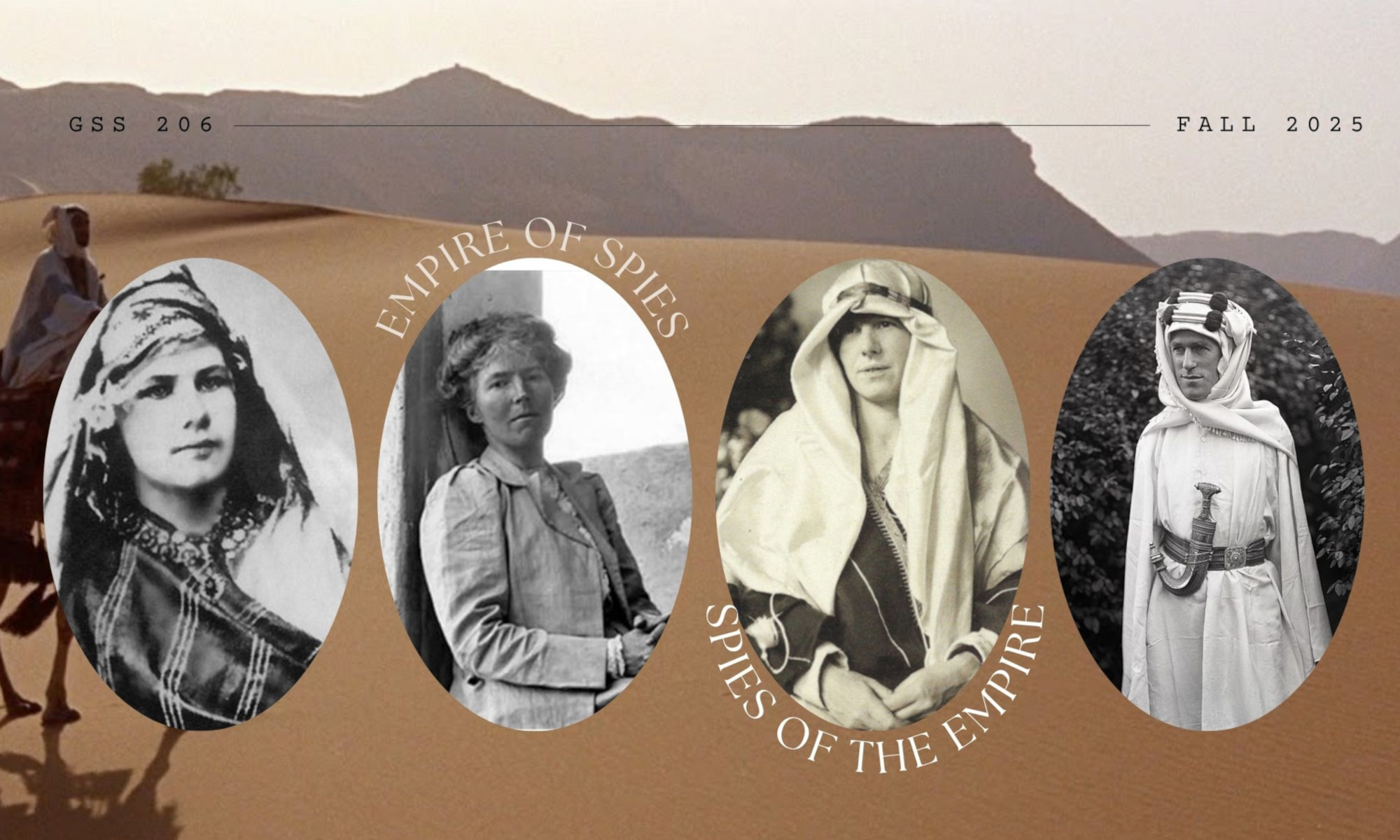
The Life of Gertrude Bell: a playlist with only good songs

Gertrude Bell is a complicated individual, as all these spies are turning out to be. I think what I found so fascinating about Bell is that despite her love for Iraq (however much was genuine, and not exoticized or orientalized), she was consistently loyal; loyal to her family and to Great Britain itself. This made reading her life as a narrative much simpler than Isabelle Eberhardt. I scoured my playlist to find (my best attempt at) the perfect mix of tragedy, beauty, the pull of discovery and power, and the split loyalties/love that define the life and spywork of Gertrude Bell. 

  1. Rebel Prince – Rufus Wainwright 

This song feels like Bell’s love for the British Empire. It is her master, her sordid and salacious lover. While it seems like a far-off, looming entity, the Empire is something dear to Bell. However, she must leave England precisely because of her love. She projects her loyalty into her spywork, leaving the room she knows so well, but always looking back at her far away master. “It was appropriate that the Bells’ family fortune was earned through… Britain’s great strength, after all […] they worked not only to enhance their own communities but to maintain Britain’s place in the sun. They took pride in the British Empire and its role as custodian of the universe” (Wallach; “Of Great and Honored Stock”). 

2. Blacklisted – Neko Case 

I interpret this song as Bell’s growing entanglement and work for the British Empire. Her job of perception is based in deception. She must deceive the Iraqi people she loves to further the aims of the country she answers to, the country she believes has the power to make the trees bend in welcome. Why does the fast train of imperialism rage on, where does it end? Where do the passengers, the colonized, wait, in the meantime? “Authority would remain in the hands of dignified Sir Percy and a group of British advisors. London was convinced that it would control Iraq until that undetermined and presumably distant day when the untutored Iraqis had learned to govern themselves” (Brian; Desert and Sown introduction).

3. Pearl Diver – Mistki 

Bell’s love for Iraq and loyalty to England is paradoxical. She follows the tide to the beautiful that she wanted so badly, with the monster of imperialism over her shoulders. She occupies a middle space, a space of no feeling, and must continue diving deeper, becoming more entangled in life in Iraq and loyalty to Britain. Ironically, her loss of power towards the end of her life also mirrors the death of the song’s treasure hunter. “The work has been so interesting that as far as I am concerned I couldn’t have experienced better or even as good, a destiny” (Bell; Letters II 658-659). “She employs her growing competence of Arabic to describe a backward country in the flux of change” (Brian; Desert and Sown introduction). 

4. Shooting the Moon – OK Go

I see Bell as this song’s Big Hero. With her eventual loss of power, what is there to show? A country divided and kings made by a name no one seems to remember. Her time in Iraq was not exactly true, but it can’t be discounted because she did truly love the people she met (in her own, perhaps infantilizing, belittling way). She can only deliver love to (or perhaps exert power over) Iraq by caring for her museum. Despite all her lies and deception, she would still wish them well in some (British-controlled) way. “Seven years I’ve been at this job of setting up an Arab State. If we fail it’s little consolation to me personally that other generations may succeed, as I believe they must…” (Bell; Letters II 664).

5. Ghir Enta – Souad Massi 

I imagine this as Bell’s love letter to Iraq before she dies. Today, Iraq is with her and the British, but tomorrow, who knows? Iraq has become her home, it’s a place she cannot live with as is, but cannot live away from. It’s tragic and beautiful! Iraq is her true love, perhaps because it’s the place she was able to leave her mark. Souad Massi’s Algerian, but the song is in Arabic, so I think Bell would appreciate the song for its exotic Arab aesthetic. “They never elect any other European. That’s the sort of thing that makes it difficult to leave” (Bell; Letters II 667). “I love seeing [Iraqi visitors] and they are most useful for purposes of information” (Bell; Letters I 407). 

6. Hey Hey Hey – Eilen Jewell

Gertrude Bell did sleep off her regret in a very literal way. Whether her death was a true suicide or not, she was undoubtedly sad and lonely. I see this song as Bell’s tired goodbye to her beloved Iraq, the place she couldn’t quite keep a grasp on. “There are long moments when I feel very lonely… I am aware that I myself have much less control over my emotions than I used to have” (Bell; Letters II 658, 662). “Gertrude Bell took an overdose of sleeping pills. All of Baghdad attended her funeral, along with an honor guard of sheiks from her beloved desert” (Brian; Desert and Sown introduction). 

The Mirror Trick

The Mirror Trick

In Marie-Odele Delacour and Jean-René Hulue’s “Introduction: The Game of ‘I’”, they draw special attention to the rhetorical and thematic use of perspective in Eberhardt’s writing. In “The Mirror,” a short prelude to the rest of her short story collection, the first-person narrator is Mahmoud Saadi. He is a male wanderer who becomes the vessel for Isabel’s writing, though in the text he is not named, and without further inspection his role is mostly passive. The more active subject is Mohammed, who is described to be of “perfect masculine beauty.”. Mahmoud observes Mohammed looking at himself in a little penny mirror and speculates at his interiority — at the end Mohammed closes the mirror and smiles, and the reader is left unsure as to whether Mohammed was using the mirror to spy upon the spying on Mahmoud.

While reading this passage, I remembered a quote that’s been pinging itself around in my head recently. Margaret Atwood says: “Male fantasies, male fantasies, is everything run by male fantasies? Up on a pedestal or down on your knees, it’s all a male fantasy: that you’re strong enough to take what they dish out, or else too weak to do anything about it. Even pretending you aren’t catering to male fantasies is a male fantasy: pretending you’re unseen, pretending you have a life of your own, that you can wash your feet and comb your hair unconscious of the ever-present watcher peering through the keyhole, peering through the keyhole in your own head, if nowhere else. You are a woman with a man inside watching a woman. You are your own voyeur.” While this refers more to heterosexual objectification, it nevertheless provides an interesting perspective on Eberhart’s superfluous and intersectional identity as a woman who often disparages women, a woman who travels as a man, and a white person who claims a middle-Eastern identity and inheritance. 

In their reading of “The Mirror,” Delacour and Hulue claim Eberhardt as an incredibly active participant; through their description, it’s easy to mistake her as a character in the narration itself. With this supportive interpretation, the question that the Atwood reference then invokes is whether or not there is such a thing as an internal, uncorrupted female gaze. The fact that Eberhardt is the female puppeteer behind these two male figures is a significant reverse-power play considering the context of her time, but that logic is marred when taking into account the privilege of her whiteness in shaping ethnic stories. The infinite “spying” aspect of the mirror trick also relates to Atwood’s quote as it is unclear if Mohammed is reflecting internally within himself, if it is only Mahmoud is spying on Mohammed, if it is Mohammed is spying on Mahmoud spying on Mohammed, or, to get really rhetorical, if Mohammed is piercing the veil of Mahmoud to lay his eyes on Eberhardt; Atwood’s quote is less about separate male and female gazes, but and more that they are inevitably melded within a woman. Is Eberhardt, this double agent of politics and identity, just living an amped up version of this psychosis?