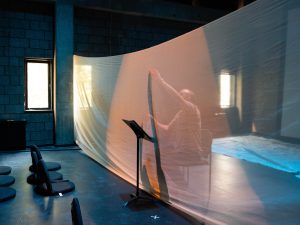
Image of Fargo Nssim Tbakhi, The Book of Dust
After our exhaustive discussion of Herzog’s Queen of the Desert, I found myself floundering to imagine the narrative landscape of its antidote. A film rife with sentimental orientalisms of the Berlin variety is of course a dime a dozen, but when attempting to deconstruct and reform it, we still found ourselves stymied when contemplating interformal revisions in any order. For example, the choice to use Arabic when historically accurate, then provoked the question of a “revised” Queen of the Desert would require subtitles. From that, the question of who and what subtitles are comes into play, dominating and redominating our psyches with the realization that Craft — particularly one that is as ubiquitously Western as filmmaking — delineates an array of theoretical “choices” who, outside their nominative delineation, differ not at all. The choice to subtitle presents just as much possibility as the choice not to subtitle for a colonial dominion over the narrative form — it is this impossibility which guided me to (what I believe is) the conceit of our in-class discussions: whether or not Craft is an impossibility as a revolutionary mechanism.
Fargo Nssim Tbakhi’s 2023 “Notes on Craft: Writing in the Hour of Genocide” defines Craft as “the network of sanitizing influences exerted on writing in the English language: the influences of neoliberalism, of complicit institutions, and of the linguistic priorities of the state and of empire.” To Tbakhi, Craft exists to deny a nuanced reckoning with colonial mechanisms writ large. As an example, he points to Solmaz Sharif’s comments on a poem in which she erased a liberal protestor’s abetting of a staunch Republican’s anti-immigrant rhetoric in favor of highlighting only the absurdity of the former’s demands. This too is a Craft decision: the lucidity of a “good” poem implicitly requires a simplicity of forms and understanding. In this process, similarly complicit forces — such as establishment liberalism — are often ignored in favor of highlighting artistic spectacle as a function of craft. Thus, to exist in a necessary, constant state of revolt, like Palestinians have for the past 75 or so years, requires “that we poison and betray Craft at all turns.” While the conceit of Tbakhi’s argument is situated within the Intifada (for good reason), such required betrayals of Craft can be found all throughout the postcolonial world, from Kashmiri paper-maiche to Guyanaese music, in service of creating an anticolonial world order.
Two paragraphs into this blog post, you may be asking: “But Ayanna, how does this relate to the image you have chosen, and how does that image illustrate our unit’s readings?” In response, I’d like to first contextualize the image, which is from Fargo Nssim Tbakhi’s performance of The Book of Dust. While Queen of the Desert is a film, and The Book of Dust is a theatrical production, both are interformally entangled. In both, considerations of staging, casting, translation, and overall construction must be made — and that making must be undertaken in the context of colonialism. Queen of Desert, via both its subscription to Aristotelian narrative structures and orientalized aesthetic framing of the Near East, becomes a colonial tool. Rather than serving to rupture caricatures of the Middle East, instead it deepens them. And while it can be argued that many traditions within the film do exist, these arguments ignore what the film does with these traditions. Rather than theater, where spontaneous reality is often confronted by physical or imaginary constraint, film is a medium of curation. Thus, it matters not that these races do exist, but how Herzog crafts them. Here, the camel races create a background of an Othered world as Bell familiarly converses with the future kings, physically distancing the viewer from what is unfamiliar and consequently imbuing Bell — who seems completely at ease — with a messianic quality. We must understand that these camel races are not included for cultural posterity. Instead, they exist in the tradition of the traditions of the colonized world being made canon fodder for the narratives of colonizers.
The image I have chosen of Tbakhi stands in complete opposition to this. It subscribes to nothing of sort, instead navigating the theatrical realm with a dogmatic rejection of Craft. For instance, objects are normally fetishized in reproductions of the Oriental East (eg. the veil) are subverted in the physical theatrical space. In, The Book of Dust, rather than a barrier separating an “Oriental object” from the audience, the veil becomes a physical barrier between act and audience themselves. Consequently, the Craft practices of costuming are denied dominion over “othering” cultural garb. In a similar rejection of visual and narrative Craft, the image’s visual narrative ascends upward rather than moving from a decided end-to-beginning. Within this image, Tbakhi does not cede ground to Craft, and consequently avoids the pitfalls our revisions to Herzog’s Queen of the Desert found inevitable. In short, I find that the question born out of Tuesday’s discussion readings/viewings/discussions was: “How do you revise presentations of the Middle East after they have so long been steeped in coloniality?” This image, then, illustrates the answer.