Hi everyone!
This was my final project/lecture that Prof. Fawzia asked to be posted on the course blog!
Hope you all have a good look at it 🙂
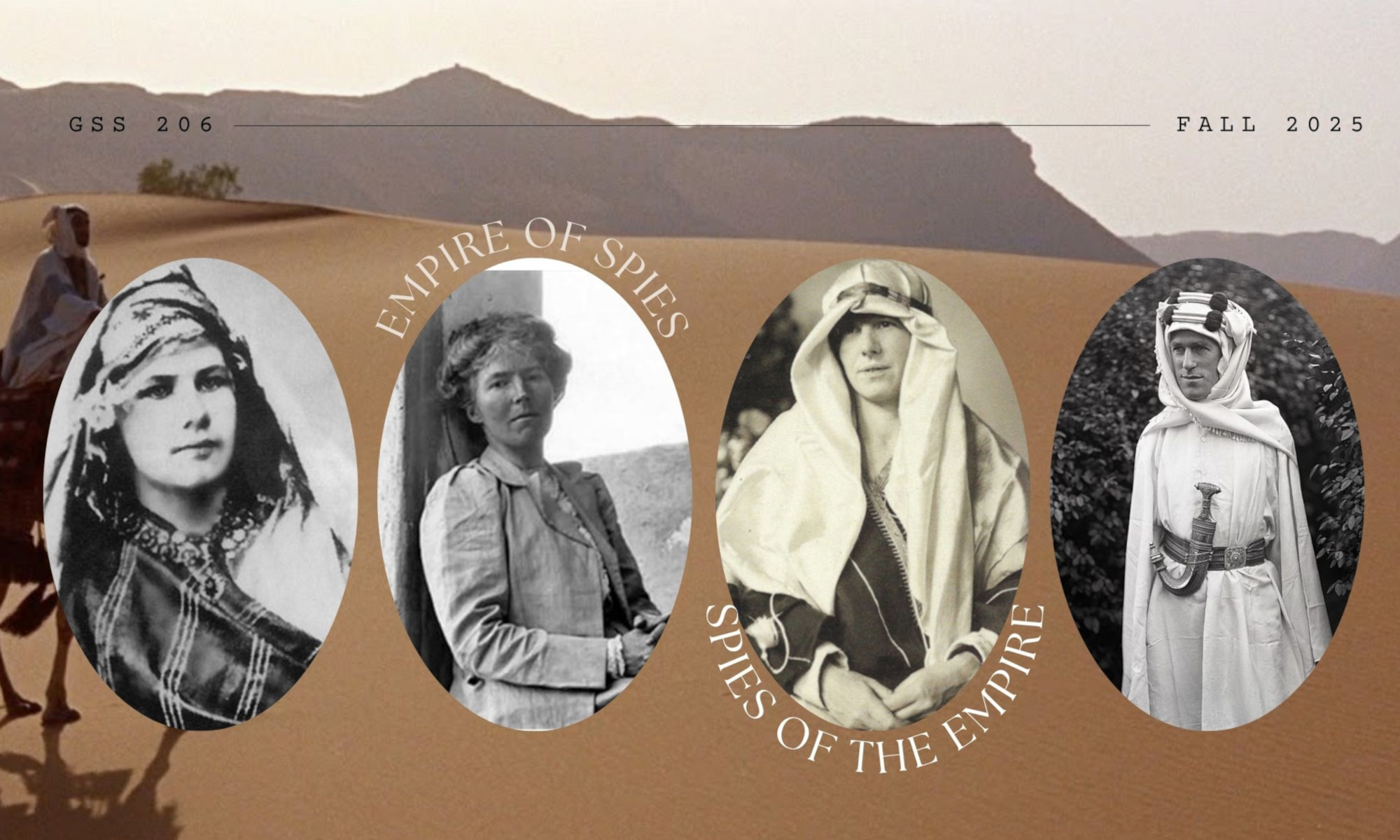
Spies of Empire/Empire of Spies
GSS206-NES204-THR214, Fall 2025
Hi everyone!
This was my final project/lecture that Prof. Fawzia asked to be posted on the course blog!
Hope you all have a good look at it 🙂
Something that immediately stuck out to me while watching Lawrence of Arabia was Alec Guinness’s performance as King Faisal and Anthony Quinns’ performance as Auda abu Tayi. While both actors were both obviously caucasian, both took lengths to appear more Oriental, with Guinness darkening his lashes with mascara and Quinn going as far to wear a fake nose prosthetic and darken his skin with dye. This was, of course, done instead of casting any native actors in major roles for the production. This immediately brought to mind a related study on the usage of yellowface in older Hollywood films (adjacent to this topic but still overall connected through the theory of Orientalism) that I had encountered in another class, particularly through the case study of Anna Mae Wong.
Anna Mae Wong, the first Asian American actress to make it to big Hollywood, often starred in Orientalized and hypersexualized roles in major blockbuster productions such as “Daughter of the Dragon,” and “The Thief of Baghdad” (the latter, interestingly, takes place in Baghdad where an entirely white cast plays Muslims while Anna Mae Wong plays the ambiguously Asian and scantily clad slave). She is situated in the unique position of being both a pioneer and a perpetrator/opportunist, as while she did open the doorway for Asians in Hollywood, she did so through an Orientalist lens. Notably, she was also passed up the main female lead O-Lan in The Good Earth in favor of a yellowface Luise Rainer, a film that snagged both best picture and best actress at the Oscars in 1938. Anna Mae Wong introduces an offshoot on Said’s Orientalism — Anne Anlin Cheng’s Ornamentalism, an essay that defines ornamentalism as a “conjoined presences of the oriental, the feminine, and the decorative.” With this definition there is a clear implication of the loss of power: if a woman is to be so drastically associated with an aesthetic that she “live[s] as an object,” then she must, by association, have the same power as that object. In essence, she lacks agency. Her presence is admired, yet it holds little power.
Anna Mae Wong perfectly fit into the framework of ornamentalism, and the legacy of Eastern representation can be understood through a relative comparison. Guinness and Quinn play Middle Eastern characters, but their power is excused by the fact that they are, ultimately, white. The same can be said of Peter O’Toole, but flipped. This can also be applied off the screen: Lawrence is neither a woman or Oriental, but it is fascinating that he is coded under both identities. His struggle with homosexuality, both inner and outer through other people’s perceptions, as well as his familiarity with the Bedouin, complicates his legacy as a man of great agency.

True Blood is set in a world where vampires have recently come out of hiding due to the scientific advancement of a synthetic blood, True Blood. Sookie begins the show as a beautiful, innocent town weirdo. Everyone knows she can read minds, and in fact, she hates the trait herself. However, she realizes she cannot read the minds of vampires, and thus begins her many dramatic vampire affairs. The lore eventually grows and it is revealed that Sookie is a mindreader because she is part fairy (the show’s getting really bad…), which makes her blood alluring to vampires. Here is where my parallel really begins.
Lawrence, perhaps more than our other spies, was able to manage a balance of being an insider-outsider. While he donned an Arab drag, he wasn’t pretending to be Arab. He was able to travel between worlds because of his “ability to penetrate the inner self of the Arab individual” (Mousa 5). In relation to Arabs then, Lawrence had to be different. He was not one of the in-group; his relationships with Arabs was rooted in individuality, the recognition of difference. Like he says, “I can understand it enough to look at myself and other foreigners from their direction, and without condemning it. I know I’m a stranger to them, and always will be: but I cannot believe them worse, any more than I could change their ways” (Lawrence quoted in Garnett 156). Strangely, Sookie mirrors this insider-outsisder paradigm in her relationships with vampires. She can easily slip into their world because she is different. She doesn’t want to become a vampire or adopt their lifestyle, but they give her a reference point of normalcy–what she finds alluring about them. Furthermore, Sookie uses her ability to mind read to spy for vampires. She occupies human space (she visually appears human, can daywalk, and her power is invisible), but can also traverse the vampire world because of her fairy powers (which are based in light, and can therefore hurt vampires), her connections to the in-group, and the promise of her allure. She is both sympathetic and aggravating. She uses others, but gets used, and treats herself as the center of the universe. Her favorite line is: “If our relationship ever meant anything to you, you’d do this for me.”
Lawrence is somewhat the same. Mousa’s An Arab View and Theeb portrayed Lawrence as much less powerful than other iterations of his tale. He was simply a man in the right place at the right time with the right connections. Whatever role he did play in the Arab Revolt, it was exaggerated. He made promises he could not keep and we’ll never know if he actually thought he could make them happen. He used the Arabs for his own psychosexual, sado-masochistic exploration of the self through the east. He was a vampire! In the same way Sookie is, at least. Sookie spies for vampires but because she cannot read their intentions, often finds herself in situations where she has been cornered, manipulated, and even extorted by the very vampires she is psychosexually, sado-masochistially obsessed with (think: biting and blood, vampires are inherently tied to the concept of pain/consumption, fine line of pleasure/pain). Like Lawrence, she is both spy and insider-outsider, although she’s generally the one who ends up losing. I’d also argue she is sexually exploited in a way Lawrence was able to exploit others because of his rank. His gay love letters are described by Norton as “love letters from a slave to his master.” It brings up the question, how much information can one relationship have before it becomes exploitative? Could Sookie ever have a relationship with a vampire that doesn’t have a ridiculous power imbalance? With a human? Could Lawrence ever do the same with Arabs he claimed to love and work for? With his beloved Dahoum?
Spying necessitates betraying others, but in that, it must be wondered if that also means betraying oneself. Can one really love a person (or people) they exploit? It might be a reach, but to some extent all spy stories are vampiric.
My Passage: “The woman in the baths possessed the inimitable quality of a ghost: blurred against the sun, swallowed by the horde of us congregating. A veil clung to her neck. Her bareness still seemed wanting. Outside the realm of novelty, there was not much explanation for what drew her to us but if one were to exist, it would be not how she looked as much as her looking. I understood her gaze was not a gaze as much as it was a way to see nothing. She was not French, at least not entirely. The woman in front of us was instead a stranger, at once cowed by her shadow and utterly at ease, leaning away from her guide to pronounce, with feeling, her answer to our nonverbal query — she was a Brit, a friend. This was as interesting to me as it was uninteresting. What had interested me most in this exchange was the unsaid: which end she sought fixed to the Damascan mean. Or maybe the unsaid remained something else entirely. After she took her formal photograph, she leapt the threshold. Her body swayed back but returned no looking. I did not know if she had ever been a girl. I did not yet know if she knew it was possible to love something so dearly and wrongly, that your body bent helplessly toward your beloved’s opposite end, with no will toward one’s own loving.”
Original Passage: “They had all come up so close to me and I thought them a villainous-looking crowd. Someone murmured to the old man: “French?” “English,’ said I hastily: “we are your people’s friends.” This had an extraordinarily soothing effect on the atmosphere. I asked if they would mind moving away from me for the picture, which they did in silence. When I had taken it I thanked the man who seemed master of the bath and turned to my old man to have the door unfastened: this also was done in complete silence, but just as I was stepping out two or three of them asked me to turn back and look over the baths. This you may imagine I did not do. I was very glad to have that door open, though I suppose it was all really quite all right. I wish now I had taken the picture with more care, for I don’t imagine any European has been in that particular place before.” (Letters from Syria, 76)
Analysis:
What I consider most essential in my transformation of Stark’s writing is the reorientation of perspective: centering the “villainous-looking crowd” rather than Stark herself. In doing so, the scene becomes a counter-expression of the original encounter, told through the eyes of a native who possesses equal power to observe and judge Stark, just as she admires and pities the Levant. This narrative choice preserves the single-person perspective of Stark’s writing while reconfiguring it to welcome the polyphonic voice of the colonial subjects she sought to describe. The counter-grammar of my palimpsest renders autonomous and singular the people who, in Stark’s words, exist only as a monolithic crowd.
Even more significantly, the unnamed colonial subject finds the ability to occupy Stark’s positionality — even to sympathize with her as he dissects her “dear and wrong love.” This reciprocity exposes what Stark’s narrative omits: the colonial asymmetry at the heart of travel writing, in which the Western traveler seeks to know “the people” but cannot imagine being equally known by them. The observer fever dreams the Orient while refusing to see it as a mirror reflecting the hypocrisy of her gaze. Yet the palimpsest is careful not to condemn her; the narrator pays attention to Stark’s hybrid identity — French or not, knowing or unknowing—and emphasizes the fluidity of selfhood in the colonist-colonized relation, along with the vulnerability inherent in human connection. Both are elements Stark’s original text leaves unaddressed (by design, of course) and thus my intervention fleshes out a response to these omissions.
In Passionate Nomad, Jane Geniesse ranges from implying to outright diagnosing Freya’s adult choices and tendencies as a result of her tumultuous childhood. Her desire to please? A consequence of being devoted to a narcissistic mother. Her love for the outdoors? Her father’s influence in making her walk through the woods alone. Her love for extravagances? A need to offset the poverty she grew up in. Her desire for freedom and exploration? The result of her helplessness while sequestered in Italy. The list goes on and on, and wrapped within the layers of her psyche appears to be an interlocking relationship between the Freudian idea of domesticity and childhood with the gendered fantasy of the East.
Alice in Wonderland, or originally, Through the Looking-Glass, and What Alice Found There by Lewis Carroll is largely regarded as a metaphor for a young girls’ psychosexual self-discovery. Written in 1871 and an instant literary classic, it feels a bit divinely coincidental when Freya writes in Perseus and the Wind, “Whatever the ultimate origins, the book of Genesis gives a summary of the repeated story: delight in external things, and then human hunger for truth beyond. Eve, Psyche, Pandora, they would look, not, like the Lady of Shalot, away home the mirror, but through it, to see what is hidden behind the moving show: until the face of things becomes an impedi- ment to them and a torment, a barrier to the simplicity of truth.” Here, Stark equates herself with mythical figures of creation and exploration, but the critical lens we’ve applied to her in class makes her out rather to be the young Alice: bumbling through Wonderland, running away from the confines of mundane life, chased by some fear and ghost of her childhood. This analogy sets up how, in the minds of female colonial explorers such as Stark, the East functioned as a psychosexual space of “self-discovery.” In a world where every action was policed, freedom only existed and fantasy, and the East was a living embodiment. On some level this mentality persists even today, with common tropes of mid-life crisis prompting a trip to India
Honestly, the more I read Freya Stark and watched the films about her, the more uneasy I felt. She’s clearly brilliant and bold (there’s no denying that) but something about her voice never sits right with me. She notices everything, but it’s like she never actually feels what she’s seeing. There’s a constant distance, as if she wants to understand the world, but only on her own terms, only while she’s still the one holding the map.
So I made this playlist to respond to what she couldn’t say, what she couldn’t feel.
1) Marcel Khalife – “Ummi (My Mother)”
(Linked to: Letters from Syria and Beyond Euphrates)
In Letters from Syria and Beyond Euphrates, Stark walks through Damascus and Baghdad describing every detail: the graveyards, the veils, the “three separate quarters.” She’s observant to the point of precision, but she never really steps inside what she’s seeing. When I listen to Khalife’s “Ummi (My Mother),” that distance completely disappears. His voice feels like warmth, like home. When he sings, “I long for my mother’s bread, my mother’s coffee,” it’s belonging. Khalife makes what Stark calls “the Orient” feel human again. He sings from within what she only describes. Reading her after hearing him, I realized how often she confuses curiosity for connection.
2) Ahmad Kaabour – “Ounadikum (I Call to You)”
(Linked to: Passionate Nomad, Chapter 19)
There’s one line from Passionate Nomad that stuck with me: “It hardly made sense to make the Palestinians pay with their homes and lands for injuries done to Jews by European Christians.” She’s right, but she says it like an observer writing a report, not someone grieving a people’s loss. Ahmad Kaabour’s “Ounadikum” is the exact opposite of that. When he sings, “I call to you, my people,” it’s urgent, not detached. His voice makes her writing feel distant, like moral language without emotion. Stark’s “they” never becomes “we,” and that’s the difference.
3) Fairuz – “Zahrat al-Madā’in (The Flower of the Cities)”
(Linked to: Passionate Nomad and her 1944 press comments)
When Stark writes about Jerusalem, she does it with a kind of calm that’s almost cold. She calls it “friction between Jews and Arabs,” as if she’s describing weather. Fairuz’s “Zahrat al-Madā’in” destroys that calm completely. When she sings, “Jerusalem, flower of cities,” it’s both a prayer and a cry. You can feel the heartbreak in every word. She aches, grieves, and feels (unlike Stark who seems to only be analyzing).
4) Tracy Chapman – “Talkin’ ’Bout a Revolution”
(Linked to: Freya Stark’s 1944 press tour comments)
During her 1944 press tour, Stark calls the Arabs “the rightful owners of Palestine,” which sounds bold until you realize she’s still speaking as part of the British machine that made the whole crisis possible. She names the problem but never challenges the power behind it. Tracy Chapman’s “Talkin’ ’Bout a Revolution” is like that silence finally breaking open. Chapman doesn’t stop at moral awareness; she pushes toward change. Her song says what I wish Stark had the courage to: not just this is wrong, but this must end.
5) Le Trio Joubran – “Masār”
(Linked to: Towards the Unknown Land – Nepal)
In Stark’s final film, she’s carried through the mountains of Nepal by a team of porters. She looks fragile but composed, smiling faintly as she says, “If it fails, it fails.” The moment is framed as graceful acceptance: an aging traveler facing limits with humility. However, to me, it felt like comfort disguised as wisdom. Even at the end of her life, she’s still being carried (literally) by others whose presence is unnamed. Le Trio Joubran’s “Masār” sounds like that scene. It’s beautiful, but it refuses peace. It feels like remembering something you can’t fix. When I listen to it, I imagine it filling the silence in Stark’s film: not judging her, but not forgiving her either. Just holding her quietness up to the light and asking what’s underneath it. It made me think about how reflection isn’t the same as reckoning. Stark reflects endlessly (on landscapes, people, herself) but her reflections never really cost her anything. Masār feels like what real reckoning would sound like: the moment when beauty stops protecting you, and you finally have to sit with what you’ve done.
*while writing this, I did take some creative liberties so this Freya is based on real Freya
If I had to choose a travel companion from our readings, I would pick Freya Stark herself. I do not think she would be pleasant company, but the discomfort would be instructive. I imagine u somewhere in contemporary Baghdad, a city she knew intimately in the 1930s, now transformed beyond her recognition.
We would share a talent for observation but diverge completely in what we do with it. Whereas Stark collected details about women’s jewelry and Bedouin customs, I would be watching her watch them. I would note her gaze even as she would be in casual conversation. She would probably find me frustratingly direct with the way I would keep asking her about her work with Stewart Perowne and Adrian Bishop. I would also ask her about those cocktail parties at South Gate while Iraq burned with nationalist fervor.
The tension would be palpable in the markets she once wandered through in disguise. She would want to show me the hidden corners she discovered, the nocturnal Ramadan celebrations she witnessed. There, I would keep pointing out the British Embassy, the old intelligence offices, and the sites of colonial violence. When she would try to romanticize the Bedouin “raw and traditional,” I would remind her of the cruel things she justified.
What we would have in common is curiosity. We both have a restless need to understand how societies work. Where her curiosity served empire, mine would serve its unraveling. She would probably recognize in me the same stubborn independence. But she would hate how I would use that independence to question everything she stood for.
The trip would end badly, I think. Maybe at one of those archaeological sites she loved to claim as “discoveries.” Those many ruins she bragged about visiting alone. I would ask her what gave her the right to “discover” places people had been living in for millennia. She would call me ungrateful, claiming that she had preserved so much knowledge. When we would part ways, we would each be convinced the other had missed the point entirely.
In the end, though, I would learn something valuable from traveling with her: how empire’s most effective agents are not the obvious villains, but the complicated and talented people who genuinely love what they are helping to control.
Freya Stark’s era of power overlapped with the life and work of Walter Benjamin, the Frankfurt School writer and thinker. I was especially reminded of Benjamin when I read about Stark’s deep involvement in the production and distribution of propaganda films. In “The Work of Art in the Age of Its Technical Reproducibility,” Benjamin argues that the film medium, though it carries some latent revolutionary/democratic potential, is especially suited to fascism; it’s part of a broader transition in art away from the cult value of a unique item situated in a particular, hallowed viewing space and toward a mechanically-reproduced image, all meaning and authenticity of which is diluted with reproduction. Film is an especially severe example because politics steps up to replace its cult/religious value. It replicates the real world and adheres to genre convention too precisely, such that all the work of interpretation is already done for the viewer. Stark’s propaganda films did the same and took it even further. They explicitly demonstrated the military might of the British Empire, with the express purpose of telling the subject of the film to think, whether they realized it or not: “these people are powerful, I should ally myself with them.” Her films were pure politics, in the sense that they were a honed tool of imperial power, not in the sense that any real dialogue occurred between the film/propagandist and the subject.
Benjamin would have hated her films, even as he fled the Nazi Germany the British were helping to defeat. He would have found them artless and fascistic; the colonial mechanism isn’t as different from the fascistic one as it seems imperialists of Freya’s era would like to think. This hypothetical opinion of Benjamin’s reflects how I feel, for the most part, about Stark’s life. She was interesting, but seems to have tried to do the work of interpreting her own life for us already, as Benjamin’s film does to the audience, with her re-wrought books, letters, and autobiographies; still these texts tell us little about the person Stark actually was, so we must turn to biographers, and even they are overly sympathetic at times. She was uncreative in her life’s mission and, while she appreciated the aesthetics of revolution and the East, she never broke from the Empire’s mission.
She, too, was subject to the controlling influence of the British Empire. Although personal circumstances made her unique, in a core way, she was a person “reproduced” under Benjamin’s model—brought up Britishly, made to memorize poems and love the Empire, repeatedly copied until there could be no original/authentic version of her type, not even Gertrude Bell. All she knew was this method of mechanically reproducing ideology, so it makes perfect sense that she would bring those propaganda films with her to Yemen—she was reproducing the model she knew.
Example of the type of film she might have carried (produced by the Ministry of Information, which she worked for): “WARTIME FACTORY” 1940 WWII BRITISH INDUSTRIAL INCENTIVE PROPAGANDA FILM XD82705
*I am going to do a different take on this prompt and imagine my vacation to Petra in Jordan with Gertrude Bell in the modern day. It imagines a portion of our day as we walk through the ruins. Italicized text was taken out of readings we did in class.
It’s a hot and windy day in Jordan. Gertrude and I are on the third day of our week-long vacation through the ruins of Jordan. We are currently in Petra. Gertrude refuses to wear modern-day dress, instead choosing to wear the same muslin gowns that her mother, Florence, had sent her throughout her time in Baghdad. Crowds of people surround us, tourists with their families. Men and women are dressed in over-the-top Oriental outfits, selling trinkets and camel rides to the tourists. It is safe to say that it was a typical day in Petra (at least in the modern day Petra). I am unfazed by the bustle, but when I look over to Gertrude her face tells a completely different story.
“This place used to be a fairy tale city, I camped amid a row of ornate tombs, three stories high, what has happened to this place?” she asked me with a disgusted look on her face. I laugh, telling her that this is normal. As we make our way through the crowd, Gertrude walks with her nose in the air, ignoring everyone around her. We are approached by a man dressed in bedouin attire. When he begins to speak to us in English Gertrude looks offended. Scoffing, she exclaims, “This is not the real East, I wish I was in Iraq. I like Iraq. It’s the real East”. The man, confused, walks away. I tell her that she shouldn’t talk to people like this. Her response was to glare and bustle away.
As I trail behind her, I hear her muttering, “Oh how degraded this place has become. All these people, the children, the women. The Arabs have ruined it with their greed. Their need for money and tourism. If the British were in charge this would never have happened. We would have kept it preserved. Only the best could visit, the bravest, certainly no women or children. Only the true explorers.” Once I catch up to her, she suddenly stops, clearly she did not want me to hear what she was saying. Those thoughts were only for herself. Instead, she comments on the weather “it’s breathlessly, damned hot”. I chuckle, telling her that if she didn’t refuse the modern fashion of shorts or light linen pants and a t-shirt she wouldn’t feel so hot. Brushing my comment off she walks away.
We make our way up the hike to the Monastery. I don’t blame her, it is hot. As we climb our way up the steps she remarks that when she had been in Petra last she made this hike on camelback, “Why do these people insist on walking? Camels are much more efficient!”. Laughing, I continue on without comment.
She can be a little bit stuck up. I think she would prefer I wasn’t here at all, that she was all alone in this place. Maybe with her servant Fattuh. She definitely doesn’t want any other tourists here. She would much rather cosplay a lone adventurer than be one of the many. Be the first European women to see these places. She is clearly knowledgeable and interested in our surroundings but would rather explore solitarily.
“Let’s go back to our hotel, maybe there we will be treated with the respect we deserve” she says, interrupting my thoughts. Knowing that I can’t change her mind, I agree to be done for the day. Hopefully some of the other places we visit will be more authentic for her.
Gertrude Bell demonstrated self-awareness in her role as an agent and as an instrument of empire. She wanted to play a useful role and, in her letters, mentions several times that when she feels she is busy and productive, she is happier, but when there is a lack of work to be done or her duties are minimized, she falls into frustration and sadness. She seems to find purpose in being part of a grand scheme, in her words, “It’s so nice to be a spoke in the wheel, one that helps to turn, not one that hinders.” What does it mean to romanticize one’s own work, especially when that work is being an intelligence officer for the British Empire? This ties too to Bell’s tendency to romanticize the local people and their culture, and the archaeology and history of the region.
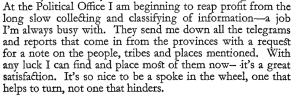
Bell emphasizes interpersonal networks, human intelligence, and building relationships, all of which are concrete ways to create and maintain imperial control, but she projects a sense of romantic adventure onto them. She frames herself not as an imperial oppressor, but as one who studies and interacts with local cultures to build relationships and foster positive developments for them. Was this how she justified her work internally? Does this affect the ethics of how her work played out, and how she was perceived by both sides (the local people and the British Empire)? Her relationship with the local people in some ways was ethical, and in other ways served imperial designs – the duality of Bell’s work is important to understanding her, because she did display a genuine appreciate and care for local people and heritage, but it does not negate the influence and the consequences of her role as an agent of the British Empire.

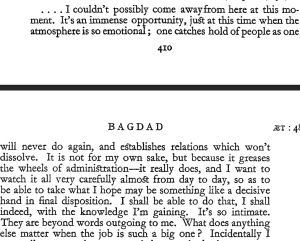
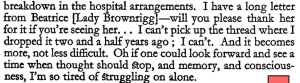
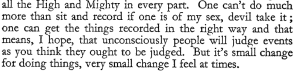
Bell’s work was also beset by a frustration over gendered constraints, and her own personal restlessness. She felt simultaneously thrilled by her work and trapped by limits imposed on her. She did not want to “sit and record”, she yearned to explore and be active – demonstrating the tension between her ambitions and the patriarchal, restrictive environment she grew up in and worked for. Through her letters, frequent references to minutia like the temperature, clothing, and accommodations all reveal her mounting agitation and a sense of containment, which she sought to escape. Her work also takes a toll on her personal life. She mentions loneliness and the difficulty in reconnecting with an old friend. Bell seeks to remain stoic, especially externally, and blames herself whenever this image falters. She sets high standards on herself, even to her own detriment. Her service of empire comes too at a high personal cost.
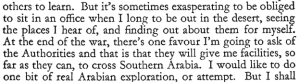
In closing, we might consider Bell’s fascination with the Near East. She was drawn to its ancient history and to its extant cultural traditions – yet paradoxically, in The Desert and the Sown, describes “the Oriental” (the Arab) as like an “overgrown child”. Does Bell fully buy into the imperialist British mindset of bringing civilization to the local people? She is fascinated with ancient Mesopotamia, while her daily work constructs a new, modern nation-state, designed to serve the British Empire’s regional interests. Her affection towards this land is inextricable from her own participation in destroying its capacity for independence. Her work as an archaeologist and in setting up a museum to maintain artifacts, as well as her insistence that the majority of them remain in Iraq rather than be sent abroad, show that she did genuinely value the cultural heritage of local people, and wanted them to maintain a degree of agency over their own relics. Today, in archaeology and in museology, provenance and cultural heritage are crucial factors. It is important to integrate respect both for the ancient aspects of a region and the modern people that this cultural heritage belongs to.
The following two quotes show the paradox of Gertrude Bell – on the one hand, as someone who appreciated the human connection she found with the local people, and on the other hand, as someone who proudly served the British Empire, and sought to further its dominion over the land and people of Iraq.
“But it’s a wonderful thing to feel this affection and confidence of a whole people around you.”
“…whatever our future policy is to be we cannot now leave the country in the state of chaos which we have created, no one can master it if we can’t.”
Letter excerpts from The Letters of Gertrude Bell Vol. 1 and Vol. 2.
The McGraw Center for Teaching and Learning
328 Frist Campus Center, Princeton University, Princeton, NJ 08544
PH: 609-258-2575 | FX: 609-258-1433
mcgrawdll@princeton.edu
A unit of the Office of the Dean of the College
© Copyright 2026 The Trustees of Princeton University