Touching on A Woman in Arabia: “The Person”, “The Lover”, & “The Courtier”

As we have spent a lot of time talking about Bell’s perception and how influential her actions have been towards both the Arabs and the British, we were unable to truly dive in deeper at specific chapters within A Woman in Arabia, so to provide some insight into why looking at “The ‘Person”, “The Lover”, and “The Courtier” is important to give us a holistic and deeper understanding of Bell and her beliefs/what she did in her life. As a recap: A Woman in Arabia was a recollection of Bell’s historical letters, military dispatches, diary entries, and travel writings to offer an intimate look at this woman who shaped nations.

The “Person”

Bell’s “antifeminism” wasn’t simple opposition to women’s rights, it was classed, contextual, and pragmatic. She came from an elite industrial family who believed in John Stuart Mill’s idea of women as rational “Persons”, but within a paternalist system. She shared her family’s view that suffrage required education and civic competence, and that women’s property laws had to change first. For her, it was a matter of readiness, not essence. Bell plays a double-coded role: too male for women, too female for men. She’s simultaneously insider and outsider, using her gender strategically in diplomacy. She’s performing masculinity to access power, while retaining femininity to humanize herself within male hierarchies. Her addressing the British wives of friends from Baghdad degradationally as in saying “A little woman” reaffirms how fractured she can also be as a woman in a predominantly male situated circumstances. Yet she also founded schools, hospitals, and women’s clubs in Baghdad and admired those who defied patriarchal restrictions. Always between categories Bell saw herself as a “Person” in the fullest Millian sense: self-directed, rational, and morally sovereign. Her feminism was paradoxical, personal rather than political, elitist yet emancipatory, compassionate but paternalistic.

The Lover

When Bell took up her post as “Major Miss Bell”, her work at the Intelligence Bureau was kept secret, much was omitted but letters was consistent. However there were a period of three days and three days in November 1915 where no letters came by aka love affair. Bell’s voice across diaries and letters is vivid, commanding, and self-scrutinizing: she organizes camps, nurses aides like Fattuh, curates social worlds, and narrates herself with both ironic wit and romantic candor. When soldier-diplomat Charles “Dick” Doughty-Wylie departs for Albania and secrecy tightens (destroyed letters, evasions to family), she chooses renunciation through motion, “the road and the dawn”, turning heartbreak into purpose as she heads back to the desert, converting private longing into a travel/work manifesto: if politics and society deny fulfillment, she will sublimate desire into maps, monuments, and manuscript pages addressed to him in everything but name.

This brings up the discussion where despite Bell’s likening towards the Arabs and taking their input and often defending them at times, wanting to unite them, as much a game or a way for her to move others around as a pawn for her own unfulfilled desires? Her espionage? Bell’s affection towards married men slowly turns her into an unreliable narrator, despite the plentitude of accounts of others writing on behalf of her and even through her own documented letters and words.

The Courtier

In her later Baghdad years, Gertrude Bell’s story becomes a meditation on power, gender, and the gaze of empire. Once central to Britain’s rule, her authority shrank with Iraq’s new constitution, and she redirected her energy toward archaeology (where she truly embraced becoming an archaeologist) writing the Law of Excavations, founding the Iraq Museum, and thus transforming personal loss of influence into cultural legacy. Her letters reveal both the intimacy and imbalance of her relationship with King Faisal: political dialogue shaded by affection, a romanticized vision of Arab nationhood melting into frustration at his “veering” character. Bell’s prose stages herself as both participant and observer, painting scenes of white robes, whirring fans, and emotional candor, asserting narrative control even as official control slipped away. Through her management of Faisal’s court, choosing Ghazi’s European suits, hiring an English governess, and instructing the queen’s household, she enacted a Western gaze that sought to civilize while sincerely admiring. Her “court-making” blended maternal guidance with imperial authority, a feminine performance of governance within male-dominated politics. As Stykes had once insulted her by calling her “A man woman”. Illness and financial worry “humanized” her final years, but she remained indomitable, writing, organizing, and advising until her health gave way. Within her letters, the commanding tone, vivid self-dramatization, and moral certitude construct a woman who, denied political freedom, found her version of “escape” and meaning in shaping memory of her devotion to the foundation of Iraq.


Furthermore, Bell’s letters and diaries (her life overall) reveal loneliness, yearning, and a fierce need to belong somewhere, neither accepted fully by the British establishment nor by the Arab world she loved. Faisal and others trusted her sincerity, even though her loyalty lay with Britain. She wrote about tribes and leaders with both fascination and condescension. Her letters often express admiration for Arab culture, yet they also reveal a belief that Arabs needed British guidance to “civilize” and govern themselves.

Zooming out–> is Bell truly the most “truthful” in her accounts of her life and life generally in Persia as well as with her travels and the founding of Iraq? Bell’s strategic elitism and anxiety about democracy leading to theocracy and also her imperial paternalism in balancing sects AND also being called “Enti Iraqiyah, enti badawiyah—you’re a Mesopotamian, a Beduin.” by King Faisal which was defining for her: a reassignment of identity, accepted as both insider and foreigner. However, not always is a reassignment of identity a positive concept, especially as a spy, whose job essentially is to balance both the “false” and the “truth” or their true beliefs/morals/values with the overall end game and goal of a alrger overarching empire. Bell also “archived” her present days through her photography and her documenting. Her gaze suspending the imperial colonialism, still seen true to this day in the Middle East through her choices, her actions, and her words.

At the very end, did Gertrude Bell die a hero of empire (a queen) or a victim of its contradictions?

Notes and post curated by: Nabiha
The Life of Gertrude Bell: a playlist with only good songs

Gertrude Bell is a complicated individual, as all these spies are turning out to be. I think what I found so fascinating about Bell is that despite her love for Iraq (however much was genuine, and not exoticized or orientalized), she was consistently loyal; loyal to her family and to Great Britain itself. This made reading her life as a narrative much simpler than Isabelle Eberhardt. I scoured my playlist to find (my best attempt at) the perfect mix of tragedy, beauty, the pull of discovery and power, and the split loyalties/love that define the life and spywork of Gertrude Bell. 

  1. Rebel Prince – Rufus Wainwright 

This song feels like Bell’s love for the British Empire. It is her master, her sordid and salacious lover. While it seems like a far-off, looming entity, the Empire is something dear to Bell. However, she must leave England precisely because of her love. She projects her loyalty into her spywork, leaving the room she knows so well, but always looking back at her far away master. “It was appropriate that the Bells’ family fortune was earned through… Britain’s great strength, after all […] they worked not only to enhance their own communities but to maintain Britain’s place in the sun. They took pride in the British Empire and its role as custodian of the universe” (Wallach; “Of Great and Honored Stock”). 

2. Blacklisted – Neko Case 

I interpret this song as Bell’s growing entanglement and work for the British Empire. Her job of perception is based in deception. She must deceive the Iraqi people she loves to further the aims of the country she answers to, the country she believes has the power to make the trees bend in welcome. Why does the fast train of imperialism rage on, where does it end? Where do the passengers, the colonized, wait, in the meantime? “Authority would remain in the hands of dignified Sir Percy and a group of British advisors. London was convinced that it would control Iraq until that undetermined and presumably distant day when the untutored Iraqis had learned to govern themselves” (Brian; Desert and Sown introduction).

3. Pearl Diver – Mistki 

Bell’s love for Iraq and loyalty to England is paradoxical. She follows the tide to the beautiful that she wanted so badly, with the monster of imperialism over her shoulders. She occupies a middle space, a space of no feeling, and must continue diving deeper, becoming more entangled in life in Iraq and loyalty to Britain. Ironically, her loss of power towards the end of her life also mirrors the death of the song’s treasure hunter. “The work has been so interesting that as far as I am concerned I couldn’t have experienced better or even as good, a destiny” (Bell; Letters II 658-659). “She employs her growing competence of Arabic to describe a backward country in the flux of change” (Brian; Desert and Sown introduction). 

4. Shooting the Moon – OK Go

I see Bell as this song’s Big Hero. With her eventual loss of power, what is there to show? A country divided and kings made by a name no one seems to remember. Her time in Iraq was not exactly true, but it can’t be discounted because she did truly love the people she met (in her own, perhaps infantilizing, belittling way). She can only deliver love to (or perhaps exert power over) Iraq by caring for her museum. Despite all her lies and deception, she would still wish them well in some (British-controlled) way. “Seven years I’ve been at this job of setting up an Arab State. If we fail it’s little consolation to me personally that other generations may succeed, as I believe they must…” (Bell; Letters II 664).

5. Ghir Enta – Souad Massi 

I imagine this as Bell’s love letter to Iraq before she dies. Today, Iraq is with her and the British, but tomorrow, who knows? Iraq has become her home, it’s a place she cannot live with as is, but cannot live away from. It’s tragic and beautiful! Iraq is her true love, perhaps because it’s the place she was able to leave her mark. Souad Massi’s Algerian, but the song is in Arabic, so I think Bell would appreciate the song for its exotic Arab aesthetic. “They never elect any other European. That’s the sort of thing that makes it difficult to leave” (Bell; Letters II 667). “I love seeing [Iraqi visitors] and they are most useful for purposes of information” (Bell; Letters I 407). 

6. Hey Hey Hey – Eilen Jewell

Gertrude Bell did sleep off her regret in a very literal way. Whether her death was a true suicide or not, she was undoubtedly sad and lonely. I see this song as Bell’s tired goodbye to her beloved Iraq, the place she couldn’t quite keep a grasp on. “There are long moments when I feel very lonely… I am aware that I myself have much less control over my emotions than I used to have” (Bell; Letters II 658, 662). “Gertrude Bell took an overdose of sleeping pills. All of Baghdad attended her funeral, along with an honor guard of sheiks from her beloved desert” (Brian; Desert and Sown introduction). 

Reflections on Isabella Eberhardt

I must say, I love a good adventure, Isabella Eberhardt’s adventure however, while wild and exciting, left a confused and hyper romanticized legacy that left a bad taste in my mouth. In looking back at the readings and discussion notes for writing this post, I noticed two major themes along which our study of Isabella Eberhardt fell.  The first theme was intentions and loyalties. Discussion of this theme revolved mostly around Eberhardt’s relationships with different people she came across, particularly, her relationship with the people of Algeria and her relationship with general Lyautey. While there is no definitive evidence which speaks to Eberhardt’s absolute allegiance to anyone but herself and the road, I believe that insight may be gained into her allegiances by analyzing two things. The first is Eberhardt’s own writings about topics surrounding the French and North African populations in both [INSERT TEXT} and [INSERT TEXT]. In [INSERT TEXT] she says “INSERT QUOTE”. Now, while this may have simply been an implication of Eberhardt’s personal admiration for Lyautey rather than her admiration for France’s colonial project, other evidence, such as her saying “INSERT QUOTE” on page [insert pg number] of [INSERT TEXT], suggests that she did, at least somewhat, buy into the French vision of North Africa, even if unintentionally.

The second thing that must be analyzed when attempting to decipher Eberhardt’s loyalties is her biographer’s outlooks on her journey. Now here, opinions do diverge, with some biographers, such as [THAT ONE COUPLE], who in my opinion were more so admirers than experts, claiming that Eberhardt’s allegiances were shifty, and that she was simply trying to survive wherever she went. [AUTHORS’ NAMES] appear to relay that Eberhardt was truly just a writer, a good one, and that if she was looped into French colonial projects, it was unintentional and cause by people taking advantage of her writings. For instance, on [insert pg] of their introduction, they say that Eberhardt “insert quote,” suggesting that Eberhardt was simply an innocent young adventurer trying to live out what she thought to be her purpose. These authors go on to build an what is, in my opinion, an overromanticized or maybe a glorified version of Isabella Eberhardt that focuses more on her allure as an adventurer than about the political motivations and implications of her adventure.

On the other end of the spectrum and just as essential to analyze when studying Eberhardt is [AUTHOR NAME]. [AUTHOR NAME] hints that Eberhardt was indeed mal-intentioned, saying things such as “quote” (cite) and “quote” (cite). These analyses, unlike those that came before, seem to build a more pragmatic version of Eberhardt that adopted the French cause intentionally, regardless of the reason. Since neither side presents definitive evidence, it is difficult to attach labels to Eberhardt, I find it difficult to believe however that someone with that many question marks around them and who has drawn so much attention across time is completely innocent of political involvement. Eberhardt was young, but she was mature and frankly, selfish, her decisions may not have been made in favor of any ideology, but in the pursuit of self-preservation, which for her may have meant walking on the edge between colonist and colonized. 

The second, and in my opinion, equally important theme was Eberhardt’s nonconforming gender practices. Understanding how Eberhardt acted as a man and as a woman, what each gender meant to her and how and where each gender got her is crucial to understanding her person and positionality. One particularly odd thing that stands out about Eberhardt taking on a male persona in Algeria is that she is simply accepted! Even I did not expect that, I was pleasantly surprised but also wondered whether she was accepted because she was a traveller…would a local woman attempting to do the same thing be equally embraced? Both Eberhardt’s own texts and the films which we watched convey her complex understanding of herself as both man and woman. In many texts, including for instance [INSERT TEXT] she refers to herself using male pronouns. Additionally, not only is she addressed by others as Mahmoud, but she also has, as we discussed in class, a male gaze through which she looks upon other women! For example in [INSERT TEXT] she says “quote” (cite), indicating that she views Algerian women in what one might call a typical orientalist light (although to be fair it isn’t quite clear whether she feels this way about European women as well). The conception of herself as a male only in the public space and as female in private and sexual settings is fascinating and is actually a theme in feminist literature. By being male, she is able to access the inner circles of religious orders and society. She is able to freely engage in her hoodlum behaviour with little protest or outright shaming. I wonder however whether she loses a piece of herself in this way…

In the films, Eberhardt is also seen as both man and woman. In the documentary style reflection on her life, people, mostly men, reflect on her as a woman, but also seem to understand and respect the role she held as a man, reflecting the importance of both personas in her legacy. In the recreation of her adventures, she is seen as Mahmoud outside her home and Isabella inside (although the general still refers to her as Mahmoud). Her role as Mahmoud in the film reflects how she was able to form relationships her female existence would have otherwise prevented, specifically her odd relationship with general Lyautey and of course her relationship with many Sufi men.

Tying all of this together is Isabella’s existence as a writer. Through writing, or maybe for writing, she makes sense of herself and the world around her. Her relationships and her positionality, her goals and her past, and much more. We discussed the possibility of her writing being a production of information that categorizes her as a spy…I think that while this may be true, it was not her intention. I believe, because of the passion and colorful language with which she wrote about her travels, that Eberhardt genuinely had a love for the unknown. Whether she got taken advantage of or eventually served the French after losing purpose is a different story. Essentially, I don’t know whether she was a spy or not, and I don’t know that I particularly care…to me she was a woman who defied norms, which in some ways is “cool” but in other ways is genuinely stupid. She was the original Transcendentalist and I am not a huge fan of transcendentalism. She chose to live a difficult but eventful life, a selfish choice, but one that I suppose satisfied her craving for discovery.


Birds and Freedom – Isabelle Eberhardt

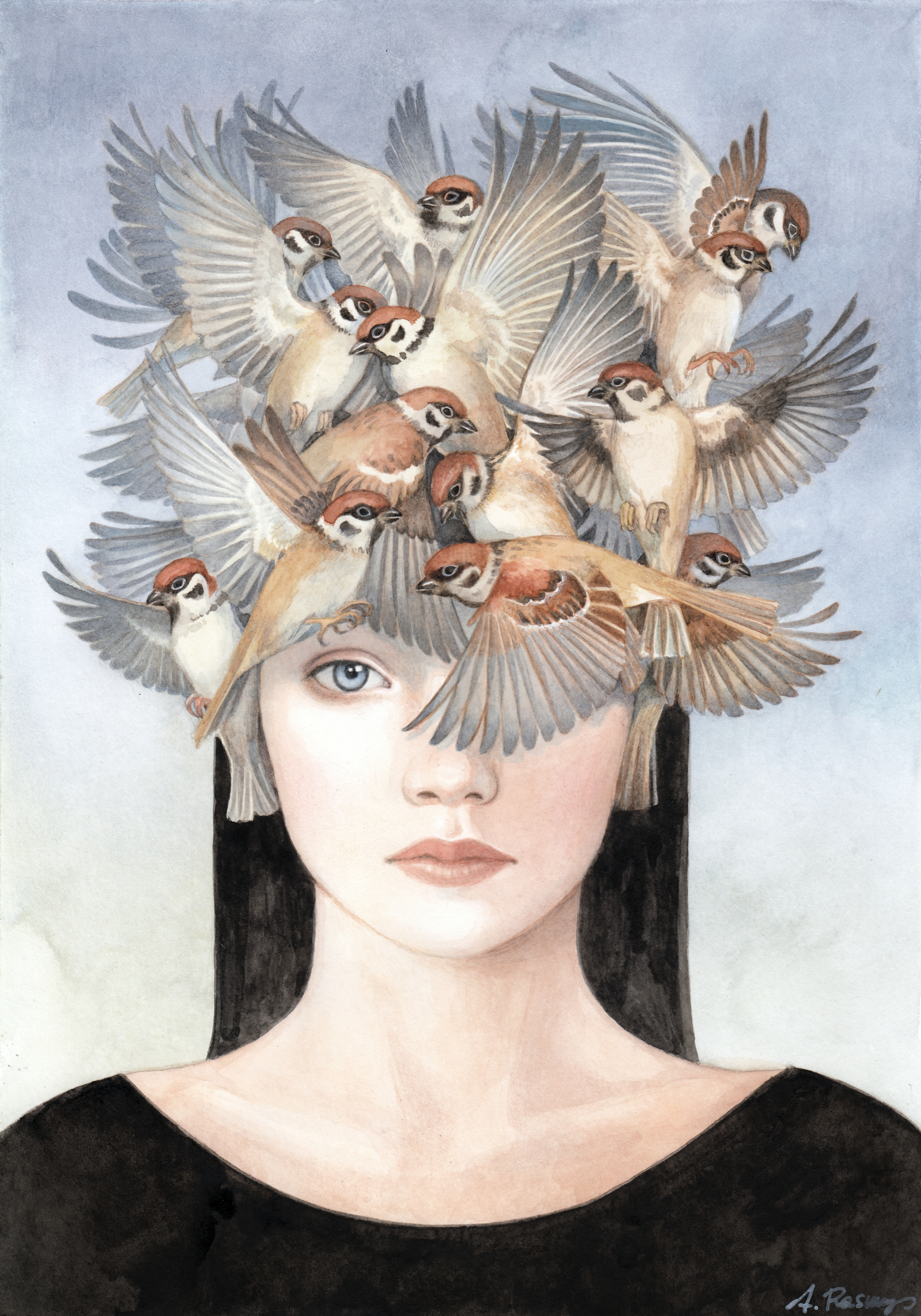
Nostalgia for Freedom I - Every Day OriginalNostalgia for Freedom I by Angelika Rasmus

Nostalgia, wanderlust, sadness, longing… obsession, encapsulation, fracture

“Nostalgia for a place for which I have no name” – Isabelle Eberhardt

This painting by Angelika Rasmus encapsulates the beauty and curse of Isabelle Eberhardt’s flight to Algeria through the unit’s readings on her and her adventures.

Writings from the Sand, Vol 1. An emerging theme was Eberhardt’s fragmentary and impressionistic prose, constantly shifting and exposing her fragmented state of mind. In the painting, the sparrows invoke a fleeting, ungraspable state, circling her consciousness as she juggles her “loyalty” to Algeria, to her Sufi brotherhood, to the French and Layuatey. No single narrative, very known to be a woman despite male-presenting.

Daily Journals, a recurring theme of where, when, what is my (Isabelle’s) inner peace. The tension and turbulence of her circumstances and the situation she puts herself in through her physical dilemma festering from her relations with others, her addiction to keif, her sense of identity and allegiance.  The calm face in the painting suggests her journalistic state, controlled, obedient, however detached from the fractionally expressed thoughts. The woman’s face mirrors the way her journals juxtaposes her self-expression and reflection of constant upheaval in her life through her family life to the conditions she lived in Algeria.

Passionate Nomad (Introduction) “She was a vagabond, a wanderer, not only because of frenzied boredom and innate restlessness, but because she had no real roots anywhere, and therefore belonged nowhere.” Like a bird, with no place to truly call home, constantly in flight, migrating to a place that may seem like a temporary home, but even then not exactly. Eberhardt is a paradox amongst a multitude of things: European-born yet Arabized at least in her “learning” of Islam and the Sufi brotherhood, a woman inhabiting male roles, and a romantic wanderer yet wickedly realist of her own experiences in colonial Algeria. In the painting, there is a sense of lulling calmness, chaos above, individuality of the lady yet multiplicity of the sparrows, and a sense of clarity vs obscurity. There is no stable interpretation of Eberhardt, as can be seen through her readings, her work, her writings.

Eberhardt can not be understood as a simple vagabond or a nomad, she is an anomaly, she is a flock of fractured selves pieced and held together by one strip of sanity in which for her would be the predestined fate that Islam decrees.  Her desires to locate a sense of feminism and being a westerner going into “exotic” lands and do “adventurous” things parallels a life of the sparrow (bird). The obscured eye within the painting suggests a partial blindness, and often noted by many, her using what she could understand to fuel her decisions to the best of her abilities as she grew up with a multifaceted sense of education. The way Eberhardt lives is in constant search for something, whether that be feminism, freedom, escape, a search for meaning, perhaps even a place to call her roots. 

I can’t help but also interpret the multitude of birds in conjunction to the symbolism of birds signifying not only freedom, but depending on the bird, sometimes death, allusion to danger, destruction. Sparrows, in particular, can portray a persistent and obsessive quality. To which Eberhardt was most if not all at certain points of her life in Algeria, especially in the way she was obsessed with Algerian culture and was trusted into the Qadiriyya, and thus not only using Islam as her one string of sanity, but also compelling her mother to also convert (obsession becoming contagious). Her obsession with the male-perspective of Islam allowed her justification to a lot of her decisions, despite her fracturing mental and physical health. Liberation but imprisonment within her own self.

Hello world!

Hello Students of Spies of Empire!

Lets have some fun interrogating the machinery of Empire as it reveals itself through the shenanigans of some of its more famous–or infamous!—writer-spies-archeologists-travelers: spies one and all!

We will think about what “spying” means” and whose interests it serves–and ask when it can be a force for good or evil, control or being controlled.

More to follow….for now, welcome to the course!