Final Post: A Reflection

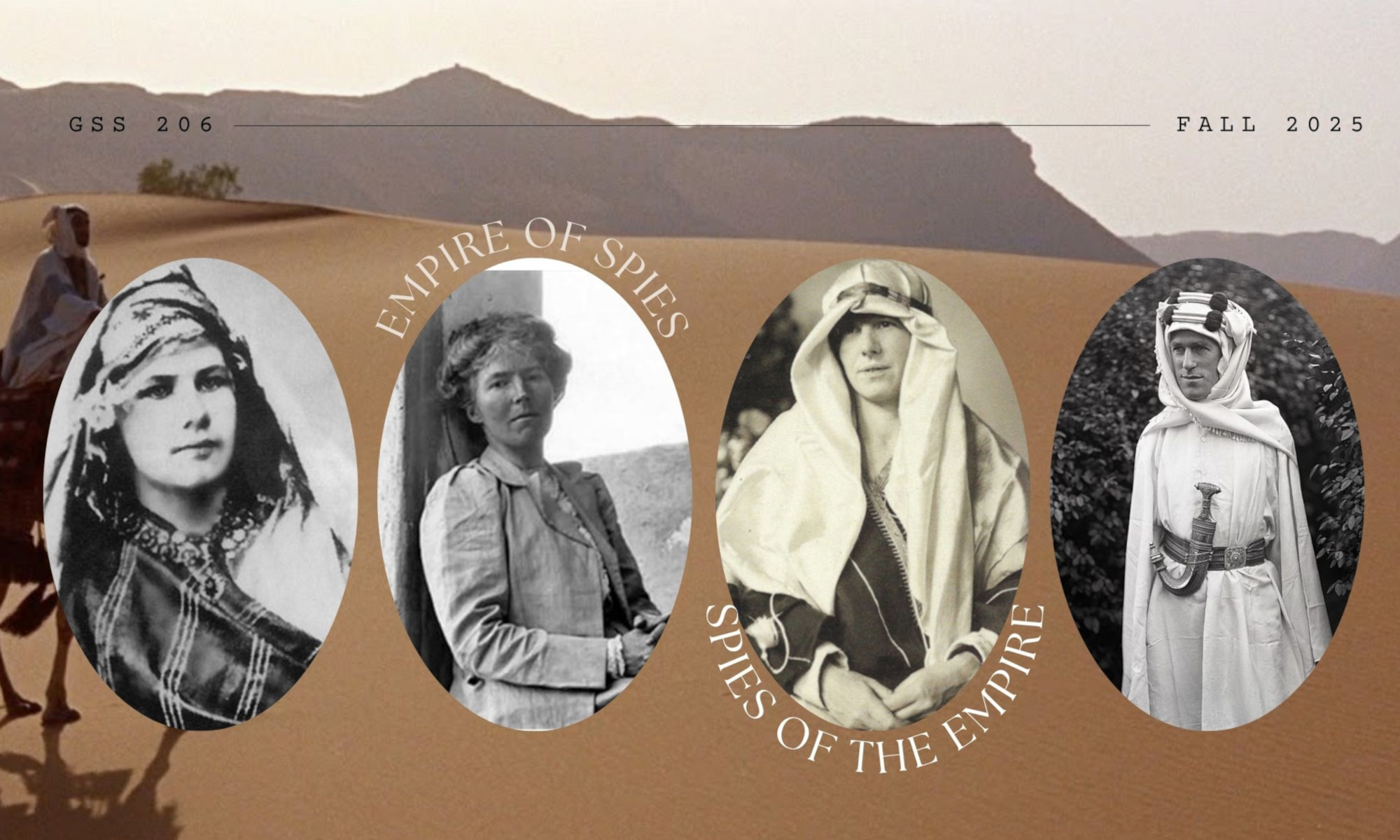
I’m very glad I enrolled in this course. The description stood out as unique, in that it wasn’t a conventional history class, and that it focused on four individuals. I think this was the most entertaining and fun course I’ve had so far because of the exciting topics we covered each week and the spirited discussions we developed together. Initially, my understanding of the course was that we would learn about each spy’s life and activities, and very quickly this deepened into an awareness that the course would address lots of interconnecting, layered aspects that are often not conventionally addressed when looking at historic figures and events – questions of internal motivation, struggle, psychoanalysis, tensions in the spies home environments that pushed them abroad, overarching imperialism that existed before and after their lifespans, and developed their worldviews, and the chief question of morality in espionage: can a spy ever be moral, or morally self-aware?

Why did Eberhardt, Bell, Stark, and Lawrence all deeply love the people they met and lived alongside, while also actively working against their best interests? I question too, how difficult it is to extricate oneself from a dominant empire that one is raised in, and how deep the dedication goes to convincing oneself (and others, and perhaps too in perpetuity through one’s writing) that you are on the right side of history, and that all of your surveillance, information brokering, and political intrigue has been really to help the empire help the local people – to bring some dream of stability and order and “civilization” to a perceived uncivilized place. Operating in this mental frame, which all four of them certainly grew up in, and the tension against their personal difficulties fitting into conventional society (three being confident, independent women in a man’s world, and one being a homosexual man in a heteronormative world), deepened the axes of conflict between individual and empire – they had to serve societies that oppressed them too, and they reclaimed some sense of power by participating in a grand machine (empire) that oppressed foreign peoples, because it validated their need to fit in, to contribute, to go on an “adventure”, to really write their names in the history books and be praised and remembered by their home society which very well might have otherwise discarded them and labelled them as outcasts, had they not turned their passions and obsessions with languages, cultures, writing, and travel to the art of espionage.

Before taking this course, I didn’t really understand what Postcolonial Studies were, or why it was a relevant academic shift to turn to postcolonial analysis. I feel that I’ve gained a significant understanding of what it is and the many ways it is highly useful and important to integrate into how we understand history, politics, culture, and other fields, both in the past and in the present. As we moved through the semester, I began to consider strongly the perspectives and voices (though suppressed in the Western corpus) of the “other side”, that is, the people facing imperialism, and how it changes our interpretation of history when we seek to understand their history and context, rather than only the angle dominated by the colonizing force. I enjoyed how as a class we began linking the figures together, and thinking about similar motives and patterns that connected them, as well as critiquing them and the (often detrimental) long-lasting effects they had upon foreign peoples. I thought as well about contemporary imperialism and overreach, and how while imperialism today is not identical to the imperialism of the late 19th and early 20th centuries, it is very much still present, as is Orientalism (the fantasy of exoticising the foreign, and commodifying it). A lot of our topics intersected with film and TV tropes I had seen, with these fantasies of an imagined Arabia, Persia, Mesopotamia, which all collapse the moment you examine any real history.

Something too that stuck out to me was the concept that empire survives only when an “other” is invented from a real group of people, an “other” which must be civilized and converted, educated, changed, in order to fix them, and to perpetuate the economy, military, and cultural engines of the colonizing imperial state. The empire feels superior when it makes the “other” exist, and the empire remains superior when the “other” is forced to serve its ends. But our four spies interacted so heavily with the “other” that their empires named, and they seemed genuinely to be fascinated and drawn to them, learning their languages, reading their histories and classical literature, traveling everywhere, observing and partaking in traditions, trying to preserve artefacts, making maps, and documenting and photographing places no other Westerners bothered spending time with.

So then, I’m left with this… A whirlwind of a semester, and a lot of unanswered questions – but to me, this doesn’t feel like a conclusion. It feels like I’ve been equipped with a lot of frameworks, tools, and ideas with which to approach everything else. And for that I’m very, very grateful.

Beyond the Lawrence Myth: Gaining Insight into the Distortion of Narrative

If I could assign this unit’s readings to anyone, I would assign them to my girlfriend Nikola. Her curiosity about Lawrence in Lahore sparked an interest in understanding the real T.E. Lawrence, but most portrayals present him as a mythologized hero of the British Empire. Our unit’s readings complicate that heroic image and provide a fuller sense of Lawrence as a complex, at times contradictory, figure.

A central text to begin with would be Seven Pillars of Wisdom, which reveals Lawrence’s contemplative voice and the internal contradictions he carefully constructs and performs. Pairing that with Raili Marling’s “Masculinity in the Margins” would show how Lawrence struggled to fully embody the masculine, heteronormative ideals of his era. Together, these readings would sharpen her understanding of the tension dramatized in Lawrence in Lahore, especially the gap between the public-facing, confident Lawrence and the private Lawrence, whose letters (including The Gay Love Letters of Lawrence of Arabia) describe shame, self-punishment, and discomfort with the heroic narrative imposed on him.

More broadly, reading about Lawrence, an accomplished figure, might make her feel empowered to leave her comfort zone and embark on “adventure”, as Lawrence himself did, and as a queer person, she would appreciate seeing how his time viewed homosexuality – a way of understanding the emotional cost of navigating queer identity within rigid imperial structures. Further, understanding empire from a different perspective (the British Empire, and its interactions with the Middle East), would provide insight on why this region remains unstable today, and a perspective outside of the typical Eurocentric narrative.

By studying Lawrence’s writings alongside biographies and media which re-interpret him, it becomes clear how imperial icons are constructed, edited, and continually developed for new audiences. Nikola often asks me how people “can be so stupid” as to fall for political cults of personality, and the Lawrence myth offers a concrete example of this process. His myth was manufactured and commodified during his lifetime by figures like Lowell Thomas, then posthumously spun by later biographers and filmmakers, who each built their own portrait of Lawrence to suit various political and cultural ends. Overall, I think that the Lawrence readings would be a compelling experience for her, and help her investigate questions about contemporary media and politicizing – and especially, how narratives are twisted and changed long after their creators are gone.

Examining an Archaeologist – Freya Stark’s Actions in Luristan

Excerpt from The Valleys of the Assassins by Freya Stark, p. 47:

I bought the jar, collected the skull — which broke into pieces in my hand and required careful packing — and came away none too pleased with the morning’s result, for I had hoped for a grave of the Bronze Age, and it was now quite useless to expect the tribe to dig again. Their misgivings as to the permissibility of carrying away people’s bones had been allayed by the fact that the skeleton had obviously not been laid in the direction of Mecca; but they were still nervous about the Persian law of antiquities, which has brought punishment for illicit dealing in bronzes on to several of the tribes. The government occasionally send spies and then get the chiefs to pay fines, and are really making praiseworthy efforts to save what is left of the graves in Luristan. I knew that what I was doing went directly against this law: but there were some extenuating circumstances.

My rewrite, changing from first to third-person:

Stark purchased the jar and collected the ancient skull, which came to pieces in her hands. She packed the fragments carefully away and regarded the morning with an air of disappointment. She had hoped to find a proper Bronze Age grave. Furthermore, she was fully in the belief that the tribe would not excavate again, despite the richness of archaeological potential here. They were displeased with the idea of walking off with human remains, though they were placated somewhat with the finding that the ancient skeleton had not been faced towards Mecca. Yet the tribesmen remained nervous about the Persian antiquities law, which had already punished several tribes for the blackmarket trading of bronzes. Now, the government did, on occasion, dispatch spies and force the tribal chiefs to pay fines – a noble effort to save the remnants of the Luristan graves. Stark was rather aware that her own actions were in violation of the antiquities law, but she had her reasons. The circumstances justified it.

The effect of the changes:

By removing the passage from Stark’s own POV and voice and shifting it into novel-style third-person narration, the rewrite distances the reader from Stark’s personally-motivated justifications and broadens the scope of issues addressed: placing more weight on the antiquities law, local tribes, and the ethics of archaeology, rather than on Stark’s desire to make archaeological discoveries from the perspective of an outsider. The narration preserves Stark’s private thoughts and attitude towards the activities and the tribes, but leaves to the reader to judge whether she is correct. The final line, “The circumstances justified it.”, is a more terse rewrite of “but there were some extenuating circumstances” (and from later in the paragraph, “I felt that one was justified in trying to discover as much as possible while one was on the spot.”). By stating this in a factual tone, the narration appears to agree with Stark, but the overall tone is critical.

When reading texts in the first-person, it is hard to divest oneself from the internal narrative of the author. Inherently, such texts are more personal, more emotional, and we identify with the human fears and desires of the writer. By removing a text from the first-person, the same emotions and internal dialogue can be captured, but the reader is empowered in a heightened sense to question each character encountered. While Stark remains the main character of the passage, the reader wonders about her affect on the others present, and if this rewrite had a broader scope, the reader would also be able to criticize or root for other characters beyond Stark, and gain perspective into their motivations and feelings about situations Stark engages with.

 Gertrude Bell’s Letters: Paradox and Imperial Entanglement

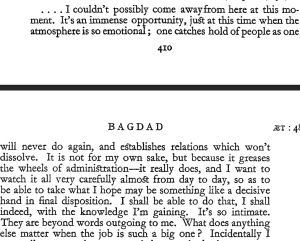
Gertrude Bell demonstrated self-awareness in her role as an agent and as an instrument of empire. She wanted to play a useful role and, in her letters, mentions several times that when she feels she is busy and productive, she is happier, but when there is a lack of work to be done or her duties are minimized, she falls into frustration and sadness. She seems to find purpose in being part of a grand scheme, in her words, “It’s so nice to be a spoke in the wheel, one that helps to turn, not one that hinders.” What does it mean to romanticize one’s own work, especially when that work is being an intelligence officer for the British Empire? This ties too to Bell’s tendency to romanticize the local people and their culture, and the archaeology and history of the region.

Bell emphasizes interpersonal networks, human intelligence, and building relationships, all of which are concrete ways to create and maintain imperial control, but she projects a sense of romantic adventure onto them. She frames herself not as an imperial oppressor, but as one who studies and interacts with local cultures to build relationships and foster positive developments for them. Was this how she justified her work internally? Does this affect the ethics of how her work played out, and how she was perceived by both sides (the local people and the British Empire)? Her relationship with the local people in some ways was ethical, and in other ways served imperial designs – the duality of Bell’s work is important to understanding her, because she did display a genuine appreciate and care for local people and heritage, but it does not negate the influence and the consequences of her role as an agent of the British Empire.

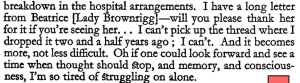
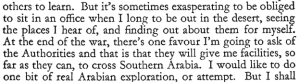
Bell’s work was also beset by a frustration over gendered constraints, and her own personal restlessness. She felt simultaneously thrilled by her work and trapped by limits imposed on her. She did not want to “sit and record”, she yearned to explore and be active – demonstrating the tension between her ambitions and the patriarchal, restrictive environment she grew up in and worked for. Through her letters, frequent references to minutia like the temperature, clothing, and accommodations all reveal her mounting agitation and a sense of containment, which she sought to escape. Her work also takes a toll on her personal life. She mentions loneliness and the difficulty in reconnecting with an old friend. Bell seeks to remain stoic, especially externally, and blames herself whenever this image falters. She sets high standards on herself, even to her own detriment. Her service of empire comes too at a high personal cost.

In closing, we might consider Bell’s fascination with the Near East. She was drawn to its ancient history and to its extant cultural traditions – yet paradoxically, in The Desert and the Sown, describes “the Oriental” (the Arab) as like an “overgrown child”. Does Bell fully buy into the imperialist British mindset of bringing civilization to the local people? She is fascinated with ancient Mesopotamia, while her daily work constructs a new, modern nation-state, designed to serve the British Empire’s regional interests. Her affection towards this land is inextricable from her own participation in destroying its capacity for independence. Her work as an archaeologist and in setting up a museum to maintain artifacts, as well as her insistence that the majority of them remain in Iraq rather than be sent abroad, show that she did genuinely value the cultural heritage of local people, and wanted them to maintain a degree of agency over their own relics. Today, in archaeology and in museology, provenance and cultural heritage are crucial factors. It is important to integrate respect both for the ancient aspects of a region and the modern people that this cultural heritage belongs to.

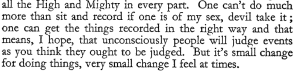
The following two quotes show the paradox of Gertrude Bell – on the one hand, as someone who appreciated the human connection she found with the local people, and on the other hand, as someone who proudly served the British Empire, and sought to further its dominion over the land and people of Iraq.

“But it’s a wonderful thing to feel this affection and confidence of a whole people around you.”

“…whatever our future policy is to be we cannot now leave the country in the state of chaos which we have created, no one can master it if we can’t.”

Letter excerpts from The Letters of Gertrude Bell Vol. 1 and Vol. 2.


The Expatriate Mindset – Eberhardt and the Contemporary Era

The world “expatriate” is defined by Merriam-Webster as:

expatriate (verb):
1. banish, exile
2. to withdraw (oneself) from residence in or allegiance to one’s native country
3. to leave one’s native country to live elsewhere
also: to renounce allegiance to one’s native country

expatriate (adjective): living in a foreign land

expatriate (noun): a person who lives in a foreign country

The idea of expatriates (“expats”) in the contemporary era is one of digital nomads, international businessmen, and passport bros. To be an expatriate is more serious than vacation – to be an expatriate is to choose to be away from home, for a very prolonged, even permanent amount of time, and to refute your home nation for various personal reasons in favor of the foreign.

When studying Isabelle Eberhardt’s life, I considered what I shared with the travelers, writers, archaeologists, and adventurers of the 19th to early 20th century who felt this sense of the expatriate mindset, the Germanic sense of “Fernweh” – a severe desire to wander, travel, and be distanced from their homeland. I found it sad in Eberhardt’s life that she was raised in a difficult, abnormal home, could not reconcile herself with Geneva or Europe in general, and attempted to seek peace in Morocco and Algeria, to the great detriment of her physical health and ultimately her life. In the introduction to Writings from the Sand, Vol. 1, the editors Marie-Odile Delacour and Jean-René Huleu write that she left Geneva “in hopes of never returning” (Eberhardt, 2012).

My parents are both mentally unwell and I also had a difficult, abnormal upbringing. It caused me to associate my geographic constraints with intense negativity. As a child, I fantasized about moving abroad. Later, in the military, I requested an overseas duty station and was out of the United States for four years.

The internet is currently rife with a shared sentiment among many Americans (and those of other nationalities, too), who desire to voluntarily leave their homeland for somewhere else on the grounds of political instability, lack of belonging, safety, better opportunities, and myriad other reasons. My friends echo these desires, with some having successfully relocated abroad, and others unable to do so.

A line that has always stuck with me is from the film, The English Patient: “We are the real countries. Not boundaries drawn on maps with the names of powerful men. I know you’ll come carry me out to the Palace of Winds. That’s what I’ve wanted: to walk in such a place with you. With friends, on an earth without maps.” (Minghella, 1996). Despite collective urges to travel, whether temporarily or permanently, to pursue the foreign, to imagine that it is perhaps better than what is at home (even if this is a falsehood or merely a half-truth – no place is perfect, and exoticizing another nation does not make it a solution to one’s domestic problems) – in the end, nation-states and logistics rule over us. They rule over the expatriate and therefore shape the expatriate mindset itself. Eberhardt contended with such difficulties in her travels, including with finances, physical hardship, and the need to straddle the fine line between appeasing the French occupying force and building friendship with the Arab peoples she so strongly identified with.

The English Patient imagines a hypothetical “earth without maps” with true freedom. However, nation-states cannot exist without borders. What would a border-less world, a dream for a self-described vagabond like Eberhardt look like? How would it function, and would such a mode of existence even be remotely feasible, or does it go against human nature? Would a border-less world serve to answer the anxieties of this generation’s expatriates?

References

Merriam-Webster. (n.d.). Expatriate. In Merriam-Webster.com dictionary. Retrieved September 21, 2025, from https://www.merriam-webster.com/dictionary/expatriate

Minghella, A. (1996). The English Patient: A Screenplay. http://ci.nii.ac.jp/ncid/BA34785462

Eberhardt, I. (2012). Writings from the Sand, Volume 1: Collected Works of Isabelle Eberhardt. U of Nebraska Press.