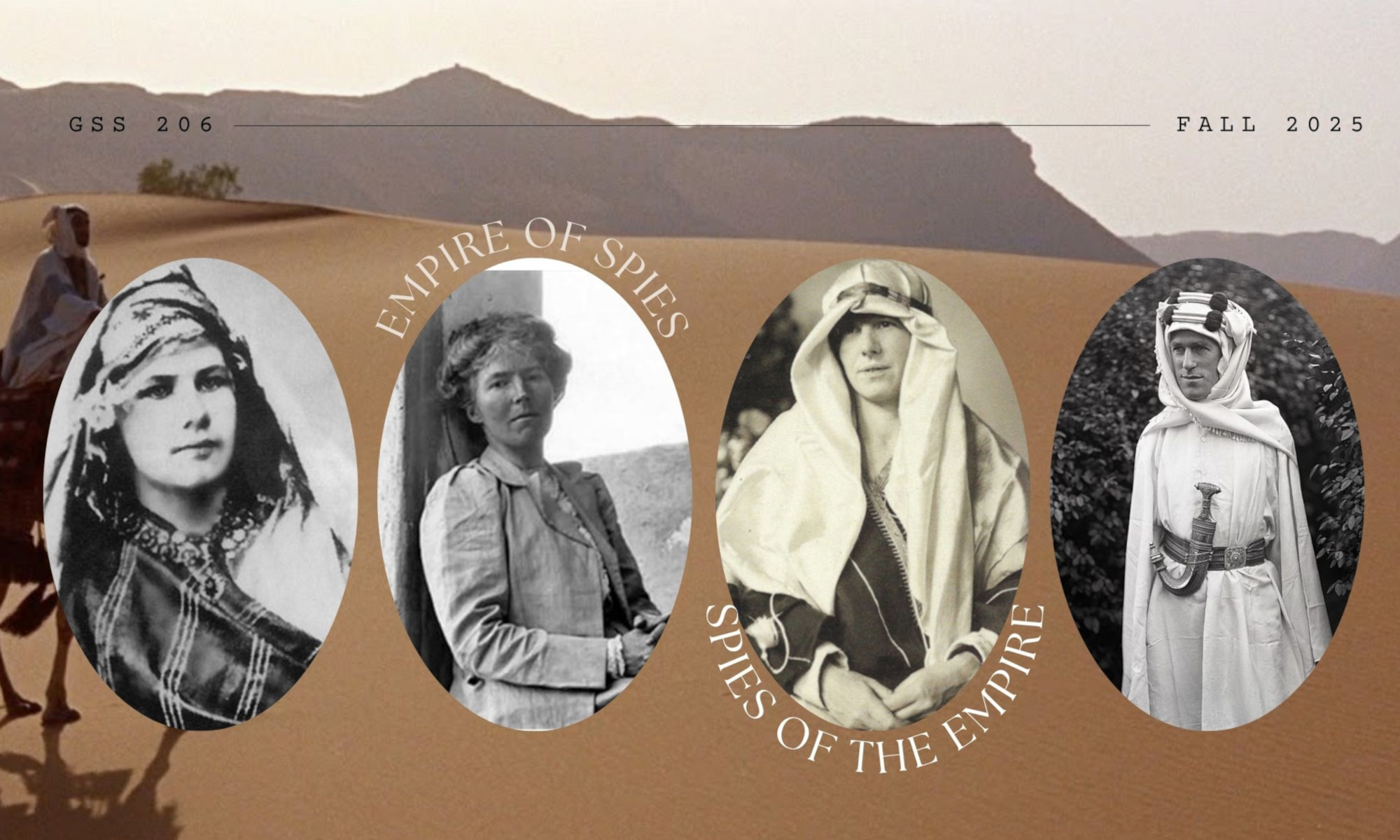
Am I a Spy? Is this an Empire? (Extra Credit Reflection)

On my first day of class, I remember reading the course code for the first time. My exact thought s were, “Huh, I wonder what GSS stands for?” As the room became full of woman, I quickly came to realize what it meant. I had never taken a gender studies class before. So, honestly, I was a little worried. However, after completing the class, I can confidently say it was a meaningful experience.

I want to start off with my biggest takeaway from the course. Due to this class, I will forever be more cognizant of how women feel in male dominated spaces. Perhaps unsurprisingly, I was the only man in our class. The class started off with three, but one guy couldn’t last ten minutes and the other was gone by week two. Then, we had Keletso, but we all know how that went. As the only guy, I often felt like my words and actions were under a microscope. There were multiple times where I refrained from speaking as I felt it wasn’t really my place. As a black man from Kentucky, I am used to being a minority in some capacity. Even still, this was a unique experience. While I know my experience doesn’t fully compare to what a lot of woman go through, it was close enough to make me more aware.

I also gained something from every spy we encountered. Eberhardt was such a free spirit. To some extent all of our spies were free, but let’s be honest, none of them were quite like Isabelle. When reading about her life, I felt called to adventure. It was so frustrating talking about her in class some times. I would think, “Why are we sitting here talking about this lady instead of going on a cool adventure? She would want us to go on an adventure.” As much as I adored her freedom, I never really envied her. She was clearly suffering from something. I wish I could have meet her. I think we would have been great friends, and I lowkey think I could have “fixed” her (This is 99% a joke, not sure it came across correctly over text). From Eberhardt, I learned to never let your circumstances stop you from making life an adventure. I also learned that I should definitely not get into smoking. Gertrude Bell taught me a very important lesson about religion. She made me realize that, more matter what they claim, everyone has a “god.” For Gertrude Bell it was her family and her country. Above everything else she worshipped those two things. This is a similar sentiment to everyone being a slave to something. The difference being that we willing and happily serve these vices. This lesson gave me a deeper understanding of how people’s actions. No matter how much someone says they love or will prioritize you, there is likely something most people will put ahead of you (just as Bell always placed Empire first). With Freya Stark, I learning about desire. I related to Stark’s pursuit of love heavily. While I am not personally chasing a relationship, I understand pursuing an objective only to fail countlessly. Experiencing Freya’s struggle brought me a weird sense of comfort. Finally, through T.E. Lawrence, I was taught lessons about fame. As someone who would love to be famous, I found Lawrence’s distain for fame peculiar. However, it made me think about the amount of responsibility people will place on you due to your notoriety. Suddenly, your words are no longer just good intentions and niceties, they are promises you must make good on. While I still want to be famous, Lawrence recontextualize the weight of the crown.

As for assignments, two stuck out the most: the play and the final. I won’t lie, I was not the biggest fan of our production. I felt awkward preforming and it was a stressful process. That does not mean it was a meaningless experience. Through the performance, I was able to engage with the material from class in a unique way. The script along with the actors’ mannerisms and delivery presented Lawrence and others in a particular way which informed my preconceived notions on these individuals. It was interesting to see how these notions were either reinforced or dismantled as I later engaged with the readings. On the other hand, I loved making my final video. Outside of just enjoying making videos, I really liked learning about Josephine Baker. In my opinion, she was more interesting than any of our other spies. Putting her and Lawrence in conversation with each other through the lens of their fame was a particular memorable exercise. My final video was the first time I felt as though I was able to fully buy in to all the aspects of the class.

Now, there are some overarching themes I want to touch on. Are we all spires? This question was brought up multiple times throughout the semester. While I now see it as a more respectable question, my answer is still no. I do not think “creating” knowledge is inherently espionage. Additionally, I think equating the type of knowledge I gather to say that of a journalist is reductive (to the journalist). While astrophysics is super interesting and actually very useful, it does not challenge systems in the same as journalism, film, politics, etc. Additionally, I want to briefly touch on the topic of Empire. While I do not think any of us really thought empire had fully come to an end, this class brought me to the realization that systems that essentially operate as empire are even more present than I initially thought. It also put into perspective just how close in history we still are to traditional empire. I urge you to remember, Freya Stark died one year before Toy Story.

One thing I wish we got to discuss in class is how modern “history” will be preserved. Whether it was autobiographies or letters, for all of our spies, there was a plethora of their own writing historians, biographers, and students can go through. After decades, these writings are essentially who Eberhardt, Bell, Stark, and Lawrence are in the modern day. I think about my generation and wonder how will we leave a presence for the future. While we don’t write letters there is obviously still social media, emails, text etc. But, are these really as representative as a collection of letters. Since the first day of my junior year of high school, I have recorded a one second video every single day. I have no intention of stopping. Even I still wonder, though, if someone could truly get a deep look at me as a person from these videos. Just something to think about.

Overall, I had fun.

T.E. Lawrence’s Problem with Fame

In class, we often discussed to what extent Lawrence truly despised his fame. It seemed that our class’s  general consensuses was that Lawrence likely enjoyed the notoriety that he received from his exploits. As time passed, though, he came to have a great distain for said fame. This resentment likely coming from a place of shame over his inability to secure Arab independence. However, I disagree with the general consensuses. I believe that Lawrence likely always had, at least, some aversion to any sort of stardom. My opinion is largely based in the writing of Lowell Thomas. This may come off as surprising, because Lowell is know for saying that Lawrence “had a genius for backing into the limelight.” At first, this quote might seem to imply that Lawrence always unintentionally found himself in the spotlight. Describing this tendency as a genius, however, implies that to some degree it was intentional. I find this assertion to directly contradict statements Lowell made in the Foreword and Chapter 1 of this book With Lawrence of Arabia. In the Foreword Lowell states:

“During the time that Mr. Chase and I were in Arabia, I found it impossible to extract much information from Lawrence himself regarding his own achievements. He insisted on giving the entire credit to Emir Feisal and other Arab leaders, and to his fellow-adventurers, Colonel Wilson, of the Sudan, Newcombe, Joyce, Dawney, Bassett, Vickery, Cornwallis, Hogarth, Stirling, etc., all of whom did magnificent work in Arabia.”

Additionally in Chapter 1, Lowell comments:

“Even concerning his connection with the Arabian army he would say nothing, except to give the credit for everything that happened in the desert campaign to the Arab leaders, or to Newcombe, Joyce, Cornwallis, Dawney, Marshall, Stirling, Hornby, and his other British associates.”

From these quotes it is evident that, even while in Arabia, Lawrence did not desire to receive any credit. At this time, Lawrence still likely believed that he could secure Arab self-determination. In fact, he was likely aware that his level of influence was directly correlated to his notoriety. Yet, he still kept fame at an arms distance.

Despite these dismals, Lowell would still go on to make the aforementioned comment on Lawrence’s genius for backing into the spotlight.  Why would he do this? I think Lowell’s words likely stemmed from circumstance. Lawrence criticized Lowell for apparently exploiting his image in the latter’s films. So, in order to abstain himself,  Lowell likely played into the idea of Lawrence covertly finding the limelight.

Freya Stark and the Seven Sisters

The Pleiades is an open star cluster in the constellation Taurus. (Image credit: Manfred_Konrad via Getty Images)

Around ninety-seven years ago, Cornhill Magazine would publish an article about the French imperium in Syria. The author of this work went by the name of Tharaya. We now know that this was only a pseudonym for the legendary Freya Stark. The name Tharaya is actually the Arabic name for the open star cluster commonly referred to as the Pleiades. This cluster contains seven stars and can be found to the right of the Orion constellation.  The above image— or rather the stories and meaning that humanity has ascribed to the stars whose majesty this picture tries to replicate— manages to capture a fair amount of Ms. Stark’s essence.

The fact that Freya Stark even chose the name Tharaya is itself insightful. As previously mentioned, Tharaya was and is still more commonly known as The Pleiades. Most of Stark’s western audience would likely not even know that the two names referred to the same stars. However, as someone who prided themselves in truly assimilating with Middle Eastern culture, it is unsurprising that she would adopt an Arabian moniker despite the culture dissonance it may have caused. Moreover, Tharaya’s literal English translation is “She Who Illuminates the World.” This is quite a heavy title to impose on oneself. While some may see this as arrogance on the part of Stark, it may be more accurate to interpret this as her having an understanding of the gravity of her work. In an age before the internet, most people’s perception of the world came from the experiences and writings of adventures like Freya Stark. As a result, Stark likely felt a duty to shine a light on and shape the narrative of the Arab world she came to love.

Further connections between Freya Stark and these stars can be seen when considering their significance to the Greeks. In Greek mythology, the Pleiades were seven sisters who, due to their immense beauty, were chased by Orion the Hunter. This chase continued until Zeus turned the sisters into stars in order to escape. However, Orion would eventually also be turned into a constellation, and continue to chase the sisters through space. It would not be unreasonable to assume that Stark wished to be desired and pursued in a similar way to the Pleiades. When referring to her adventurous life, Passionate Nomad asserts, “In the beginning she did not have a specific goal, other than wanting to be a writer—and, above all, to be loved. Yet in the end love was the one thing at which she failed…” While Freya Stark had attachments to various men, she always felt as though the injury she sustained diminished her looks so severely that she would truly never be desired.

Some may have noticed that the Passionate Nomad refers to Tharaya as “the dazzling star at the center of the constellation Pleiades.” So, why did I discuss the Pleiades as a whole? Upon doing my own research, it seems that when people mention Tharaya they are almost universally referring to all seven stars. Within the same sentence, Passionate Nomad also refers to the Pleides as a constellation instead of a star cluster, so they may just need a general astronomy lesson. With that being said, even if we take Tharaya to be the central star of the Pleiades, we still see a desire for love. The central star of the Pleiades is called Alcyone. In Greek mythology, outside of being part of the Pleiades, Alcyone is best known for her love stories with Poseidon and Ceyx, The particulars of these stories are of lesser importance. What is noteworthy is that, as a mythological figure, Alcyone is deeply associated with a lover. This association is one that, for previously mentioned reasons, Freya did not have yet desired greatly.

For my anime fans, Alcyone is what Neo Genesis Evangelion (Eva) was originally going to be titled. Without going into too much detail, Eva, at its core, is a story about self-acceptance and the importance of loving yourself even without external validation (whether that be from lovers, parents, etc.). Seeing as Eva released in 1995, Freya Stark obviously had no idea this story would be created, let alone almost be named Alcyone. Regardless, she struggled with many of the problems that Eva tackled, and I believe could have really benefitted from experiencing the show. To be honest, I just thought it was a cool connection.

Gertrude Bell’s “Religion”

There is a line from chapter five of Janet Wallach’s Desert Queen that has stuck with me for weeks. It states, “She, an atheist, had faith only in her family and the British Empire. Her doctrine lay in the righteous destiny of England, her conviction in the belief that the British were chosen to lead the world.” This line is filled with so much contradiction and complexity that it could not be described as anything other than human.

For starters, as stated, Gertrude Bell was a staunch atheist. Despite this, the line is overtly religious in tone, littered with words like faith and belief. While this wording is not used to describe a relationship with any sort of god, I find it strange to apply this language to a person who subscribes to a worldview built on the absence of faith. Moreover, I have kept wondering where this belief that the British were chosen came from. If you do not believe in a god, who exactly chose you? It would not make much sense to assign nature as the chooser. Biologically and even phenotypically, there is no real difference between the French, Germans, British, etc. Yet, Bell was certain the rulers of the world had to be British.

As I continued to think over this line and its seemingly uncharacteristically religious nature, I began to think about how Bell could reject the choice to observe a personal religion but could not escape the religious world she inhabited. The time period that Bell was more religious by far. In Western Europe, specifically, Christianity was so ingrained in society that many of what were considered social norms were directly from the religion. Considering her already high standards, I wonder, if Bell were born today, would she even have any desire to marry.

My Adventure with Isabelle

While it is no secret that I often ridicule, slander, and even mock Ms. Eberhardt, there is no one else I would rather vacation with than her. Unlike her status as a spy, Isabelle Eberhardt’s ability to have a good time should not be up for debate. Through the readings, it became clear that Isabelle possessed a quality that far too many people lack nowadays: a sense of adventure. One moment she’ll be worshiping in a mosque and in the next she’ll be indulging at a brothel. It takes a special kind of existence to live a life as full as hers within the constraints of twenty-eight years. I admire the spontaneity that characterized her way of life. Admittedly, I have not gone full vagabond and thrown away all my responsibilities and alliances; however, I too live a life littered with exploits and antics. When referring to her time in Northern Africa, Rana Kabbani claimed, “It provided a way of attaining experiences more varied than those she could have expected in suburban Geneva. ” Growing up in suburban Kentucky, I can relate to the alluring call of the distant and unknown.

The destination for our vacation could not be any where else except for Algeria. While I was very tempted to choose Nigeria, the familiarity the Isabelle has with the people and culture of Northern Africa cemented the choice (I am assuming  that this vacation is during her era and that I can speak Arabic). I think our vacation would go almost perfectly. I can see us riding horses through the desert, discussing her unique practice of Islam, etc. Additionally, I think our personalities would mesh really well with each other. The only type of people I struggle to vibe with are those who are extremely type A. Fortunately, Eberhardt is the exact opposite. She was the definition of “go with the flow.” It has even been said that “She did not make decisions.; she was impelled to take action.” My only worries are that her narcotic and sexual desires would impede our fun. Nothing sounds worse than having to derail our entire vacation so that Isabelle could beg for kief or pine over a man (or God forbid she does both).