Hi everyone!
This was my final project/lecture that Prof. Fawzia asked to be posted on the course blog!
Hope you all have a good look at it 🙂
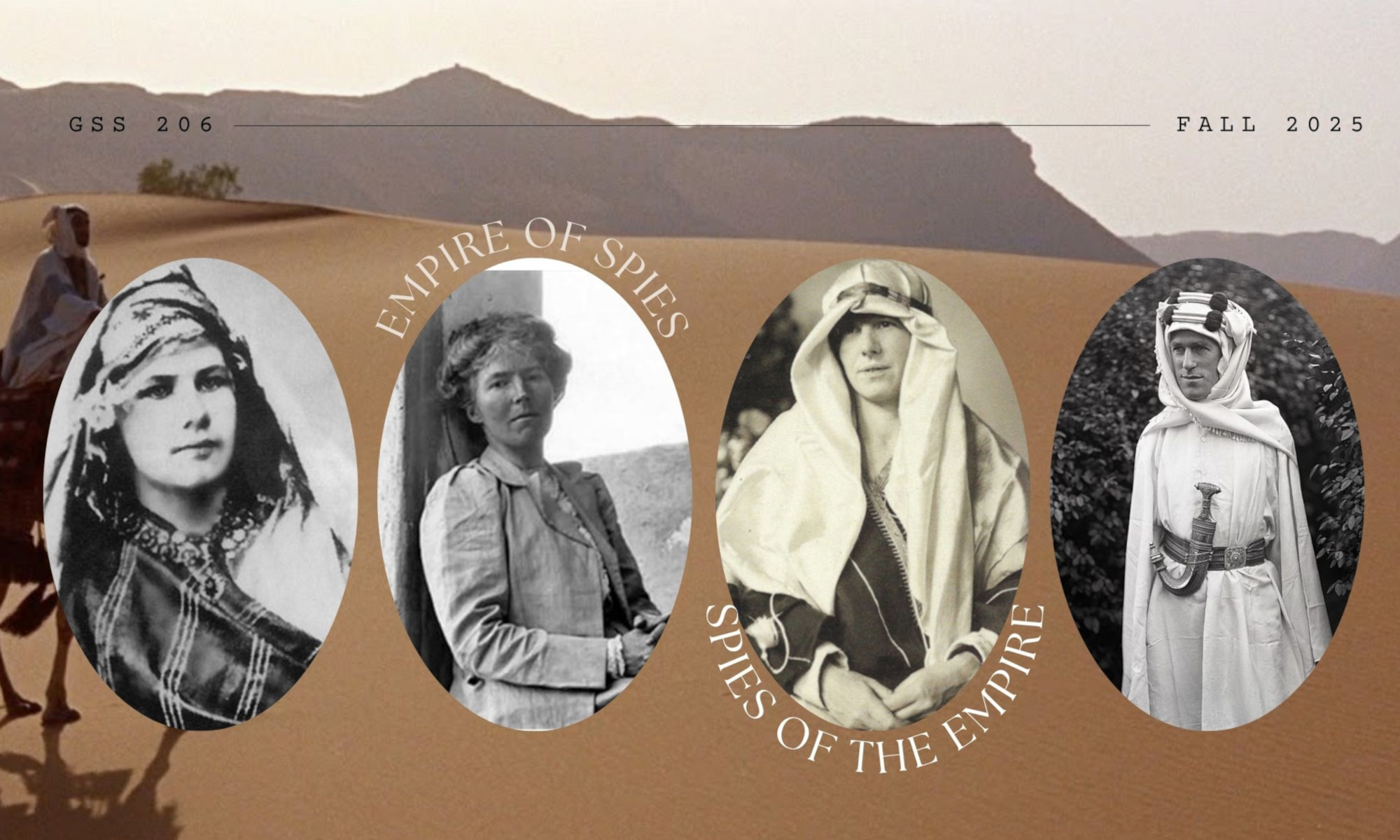
Spies of Empire/Empire of Spies
GSS206-NES204-THR214, Fall 2025
Hi everyone!
This was my final project/lecture that Prof. Fawzia asked to be posted on the course blog!
Hope you all have a good look at it 🙂
Over the semester, my blogposts evolved from a close reading to a gradual thematic overview of understanding espionage, identity, and travel writing and my own theological frameworks.
My writing overall became a culmination of the myths our historical figures have curated for themselves:
My earliest post on T. E. Lawrence centered on self-punishment and self-erasure. At first, I focused on Lawrence as a singular figure: a man fragmented by trauma, trying to remake himself through suffering. But even in that last piece, I began reaching beyond biography, linking his self-discipline to modern forms of identity pressure, even comparing it to the lives of university students. By the time I wrote about Stark and Bell, I was no longer treating personal contradictions as isolated oddities. As the course progressed, that reflex, to trace connections outward, became more intentional and structured. I learned to use individual cases to diagnose broader phenomena about empire, loyalty, narration, and gender. In the Stark playlist, I tried to think about the moral world Stark believed she was living in and what world she actually created. The musical curation forced me to think about tone, the environment, the emotional cadence and how these shape our perspectives in understanding a historical figure. In finding an image for Eberhardt, birds represented her well in her relentless freedom and seeing her as multiple pieces of a whole person brought internal reflection forward.
Some of my favorite ideas that have emerged have been feminine ethics of observation and the use of gender in diplomacy, birds as metaphors for fragmentation, spying as someone suspended between truth and myth, self-invention.
I would like to know more about the ethics of travel writing such as what responsibilities do figures have when representing cultures and when does it cross boundaries and what do those boundaries look like? What suffices? How would modern day spying shift conversations of gender, mobility, and sexuality working within political spheres?
Overall, this class made me go deep into the inner workings of state-building, helping recognize the ins and outs of political entities, but also letting me challege and questions the different stigmas, social work, and politics in play.
An idea or concept that has stuck with me since it was mentioned was the way T. E. Lawrence describes his own self-punishment and self-erasure in Seven Pillars of Wisdom. The idea that Lawrence took it upon himself to punish himself for his account of assault in Dera. I keep thinking about it because it makes me think about our other spies and how despite how difficult times got, they pushed themselves to be this figure, to become someone that sheds their past life similar to how a snake sheds its skin. Other spies embrace the danger and adventure as a second skin. Lawrence’s, in specific, self-discipline and self-destruction as more than just responses to trauma but attempts to overwrite who he is with a part of himself that he can’t (or won’t) reconcile with. He frames his suffering not just as something done to him, but as something he must continually enact on himself to maintain the persona he has constructed. I also think about his somberness and how that one scene in Lawrence in Arabia where King Feisal was holding his hands and the tension that was occurring, but it for a split second looked like he was going to draw back perhaps as a form of self infliction? This further sparks my interests of how espionage narratives often revolve around not just an external conflict but an internal fracture of self, no longer self preservation but searching for familiarity. The spies or intelligence official’s work becomes a punishment once you get attached to where you are, perhaps even a opportunity to discipline or reinvent the self. I think it’s really compelling to think about how much of identity is based off building what they are trying to escape. When I also think about narratives I think about how Lawrence constantly positions himself as an outsider also as a way of punishment. In Seven Pillars of Wisdom, he is suspended between identities, British but doubts the British, fights with the Arabs but cannot truly be one of them. He becomes a legendary figure, but internally he feels deeply fractured. Pain as punishment both to rectify his wrongs and to be purified. An interesting concept to think about that I have been pondering. The myth Lawrence creates of self-inflicted punishment demands sacrifice, and the pain he embraces becomes the proof of that myth. In trying to control his story and elevate himself into a heroic figure, he also destroys parts of himself to maintain that image. When I pivot to modern day as we see the duality between present-day current events, especially in university. I actually see this same kind of duality in a lot of college students. We’re constantly juggling who we really are with who we think we’re supposed to be, academically, socially, professionally. It reminds me of Lawrence because so many students end up shaping themselves around an image or expectation, sometimes to the point of burning out or feeling disconnected from their own interests. While it’s not self-punishment, it can feel suffocating to be in a pressure cooker that ultimately can get over burdened with all the different aspects of college life there is.
Freya Stark has been the (if not one of) most intellectually stimulating, accomplished, and devoted spies that we have encountered thus far in our seminar. This playlist will be curating some songs that echo this moral and emotional landscape of Freya Stark’s writings and discussions we’ve had over the last 3 weeks, especially towards her ambivalent stance between devotion and exile as well as humility and power. These songs will be reflecting her own cross-cultural sympathies and her layered identity. I think Freya Stark is a really interesting individual, her loyalties will ultimately is always towards Great Britain, but her complexities in how she sees the Arab World and her seeing faith as beauty in everyday life rather than a dogma makes me view her with a more ethical and reliable lens (although we do have our critiques). Her ability to craft her own story through her own choosing and focusing on her travels makes her a great person to analyze.
“Aaj Jane Ki Zid Na Karo” – Farida Khanum (1960s, poet was Fayyaz Hashmi)
This ghazal’s entreaty “Don’t insist on leaving today” encapsulates the sorrow of transience that permeates Letters from Syria and Perseus in the Wind. In our class discussions, we explored how Stark’s existence fluctuates between belonging and departure, between service and solitude. Khanum’s voice embodies that same duality: restraint, longing, and quiet dignity. Similar to Stark’s prose, it avoids sentimentality while brimming with emotion. The song’s languorous rhythm reflects Stark’s evenings in Damascus or Baghdad, moments caught between closeness and distance, faith and exile. It transforms into an anthem for her moral restlessness: desiring to remain, yet aware that she must perpetually move forward.
“El Helwa Di” – Sayed Darwish
The class emphasized Stark’s admiration for “ordinary service”, her belief that empire fails when it strips people of dignity or agency. Darwish’s song about Cairo’s morning workers gives life to that idea. “Empire redeemed through care.” In Baghdad Sketches, Stark likewise finds holiness in ordinary acts: women baking bread, men sweeping courtyards at dawn. The song reflects her conviction that service ennobles the human spirit and that true civilization is measured not by empire, but by small kindnesses. The song’s gentle strings embodies the grace present within empire as seen through Stark’s eyes, strength for the Arab world lies in its humanity and hospitality not its politics the way the British does. However, Stark still uses moral language to critique empire from within. In Passionate Nomad, Geniesse captures this tension: Stark defends Britain’s Arab policy while privately empathizing with Arabs betrayed by the post-WWI settlement.
“Desert Rose” – Sting ft. Cheb Mami
Cheb and Sting’s English and Arab duet creates the same cultural duality as seen through Letters from Syria. This song represent the constant back and forth with the East and the West, reasoning and reverence. Stark is noted to be “morally exiled”, too Western to belong to the East and too “Eastern”/changed in her perspectives to return and be content at home. This song is the exile to everything she is, perfectly framing Stark as sensual, distant, yearning, yet still patriotic. Stark once wrote, “The desert does not separate; it teaches us the beauty of distance.” Stark’s fascination with Arab “service” and her writings that accustomed affectionate realism rather than Orientalist distance, however she still had her 1930s British views as seeing British’s roles as a moral tutor of the Arabs.
“Riverside” – Agnes Obel
Reflective, quiet, sorrowful, mirroring the tone of Perseus in the Wind where Stark is contemplating beauty, life, aging, and faith. Solitude of travel, the river representing her travels and what she’s saying. Obel sings how she “sees how everything is torn in the river deep. And I don’t know why I go the way down by the riverside..” analogous to Stark and her travel writings and her “feminine ethics of observation”. “The world’s beauty,” Stark wrote, “is the highest service a soul can render.” “Riverside” sounds like the stillness of that service. Stark’s gender and her perspective is very much seeing feminine virtues redeeming imperial contact and this process of her continuing to embody empathy and service through her stops and in conjunction with this song, the analogy of her travels to being along the river.
“Arrival of the Birds” – London Metropolitan Orchestra
While this song is purely instrumental, it is fitting for it to be regarded as Freya Stark’s ultimate life theme song. Stark’s numerous writings can be regarded as the lyrics as her writings have been grand, full of rich text to be deciphered, ultimately mimicking the feeling of returning home changed. The tone of the song is very grand, dignified, tapered right as it would approach arrogance. The song invokes discovery, wonder, and the quiet till of achievement. In Perseus in the Wind, she wrote that “the human spirit grows only when challenged,” and this song embodies that belief. It’s not victory by domination, but victory through understanding. This piece encapsulates her quiet ventures from her childhood struggles to her early travels to her dignified later years as Dame Freya Stark.
As we have spent a lot of time talking about Bell’s perception and how influential her actions have been towards both the Arabs and the British, we were unable to truly dive in deeper at specific chapters within A Woman in Arabia, so to provide some insight into why looking at “The ‘Person”, “The Lover”, and “The Courtier” is important to give us a holistic and deeper understanding of Bell and her beliefs/what she did in her life. As a recap: A Woman in Arabia was a recollection of Bell’s historical letters, military dispatches, diary entries, and travel writings to offer an intimate look at this woman who shaped nations.
The “Person”
Bell’s “antifeminism” wasn’t simple opposition to women’s rights, it was classed, contextual, and pragmatic. She came from an elite industrial family who believed in John Stuart Mill’s idea of women as rational “Persons”, but within a paternalist system. She shared her family’s view that suffrage required education and civic competence, and that women’s property laws had to change first. For her, it was a matter of readiness, not essence. Bell plays a double-coded role: too male for women, too female for men. She’s simultaneously insider and outsider, using her gender strategically in diplomacy. She’s performing masculinity to access power, while retaining femininity to humanize herself within male hierarchies. Her addressing the British wives of friends from Baghdad degradationally as in saying “A little woman” reaffirms how fractured she can also be as a woman in a predominantly male situated circumstances. Yet she also founded schools, hospitals, and women’s clubs in Baghdad and admired those who defied patriarchal restrictions. Always between categories Bell saw herself as a “Person” in the fullest Millian sense: self-directed, rational, and morally sovereign. Her feminism was paradoxical, personal rather than political, elitist yet emancipatory, compassionate but paternalistic.
The Lover
When Bell took up her post as “Major Miss Bell”, her work at the Intelligence Bureau was kept secret, much was omitted but letters was consistent. However there were a period of three days and three days in November 1915 where no letters came by aka love affair. Bell’s voice across diaries and letters is vivid, commanding, and self-scrutinizing: she organizes camps, nurses aides like Fattuh, curates social worlds, and narrates herself with both ironic wit and romantic candor. When soldier-diplomat Charles “Dick” Doughty-Wylie departs for Albania and secrecy tightens (destroyed letters, evasions to family), she chooses renunciation through motion, “the road and the dawn”, turning heartbreak into purpose as she heads back to the desert, converting private longing into a travel/work manifesto: if politics and society deny fulfillment, she will sublimate desire into maps, monuments, and manuscript pages addressed to him in everything but name.
This brings up the discussion where despite Bell’s likening towards the Arabs and taking their input and often defending them at times, wanting to unite them, as much a game or a way for her to move others around as a pawn for her own unfulfilled desires? Her espionage? Bell’s affection towards married men slowly turns her into an unreliable narrator, despite the plentitude of accounts of others writing on behalf of her and even through her own documented letters and words.
The Courtier
In her later Baghdad years, Gertrude Bell’s story becomes a meditation on power, gender, and the gaze of empire. Once central to Britain’s rule, her authority shrank with Iraq’s new constitution, and she redirected her energy toward archaeology (where she truly embraced becoming an archaeologist) writing the Law of Excavations, founding the Iraq Museum, and thus transforming personal loss of influence into cultural legacy. Her letters reveal both the intimacy and imbalance of her relationship with King Faisal: political dialogue shaded by affection, a romanticized vision of Arab nationhood melting into frustration at his “veering” character. Bell’s prose stages herself as both participant and observer, painting scenes of white robes, whirring fans, and emotional candor, asserting narrative control even as official control slipped away. Through her management of Faisal’s court, choosing Ghazi’s European suits, hiring an English governess, and instructing the queen’s household, she enacted a Western gaze that sought to civilize while sincerely admiring. Her “court-making” blended maternal guidance with imperial authority, a feminine performance of governance within male-dominated politics. As Stykes had once insulted her by calling her “A man woman”. Illness and financial worry “humanized” her final years, but she remained indomitable, writing, organizing, and advising until her health gave way. Within her letters, the commanding tone, vivid self-dramatization, and moral certitude construct a woman who, denied political freedom, found her version of “escape” and meaning in shaping memory of her devotion to the foundation of Iraq.
Furthermore, Bell’s letters and diaries (her life overall) reveal loneliness, yearning, and a fierce need to belong somewhere, neither accepted fully by the British establishment nor by the Arab world she loved. Faisal and others trusted her sincerity, even though her loyalty lay with Britain. She wrote about tribes and leaders with both fascination and condescension. Her letters often express admiration for Arab culture, yet they also reveal a belief that Arabs needed British guidance to “civilize” and govern themselves.
Zooming out–> is Bell truly the most “truthful” in her accounts of her life and life generally in Persia as well as with her travels and the founding of Iraq? Bell’s strategic elitism and anxiety about democracy leading to theocracy and also her imperial paternalism in balancing sects AND also being called “Enti Iraqiyah, enti badawiyah—you’re a Mesopotamian, a Beduin.” by King Faisal which was defining for her: a reassignment of identity, accepted as both insider and foreigner. However, not always is a reassignment of identity a positive concept, especially as a spy, whose job essentially is to balance both the “false” and the “truth” or their true beliefs/morals/values with the overall end game and goal of a alrger overarching empire. Bell also “archived” her present days through her photography and her documenting. Her gaze suspending the imperial colonialism, still seen true to this day in the Middle East through her choices, her actions, and her words.
At the very end, did Gertrude Bell die a hero of empire (a queen) or a victim of its contradictions?
Notes and post curated by: Nabiha
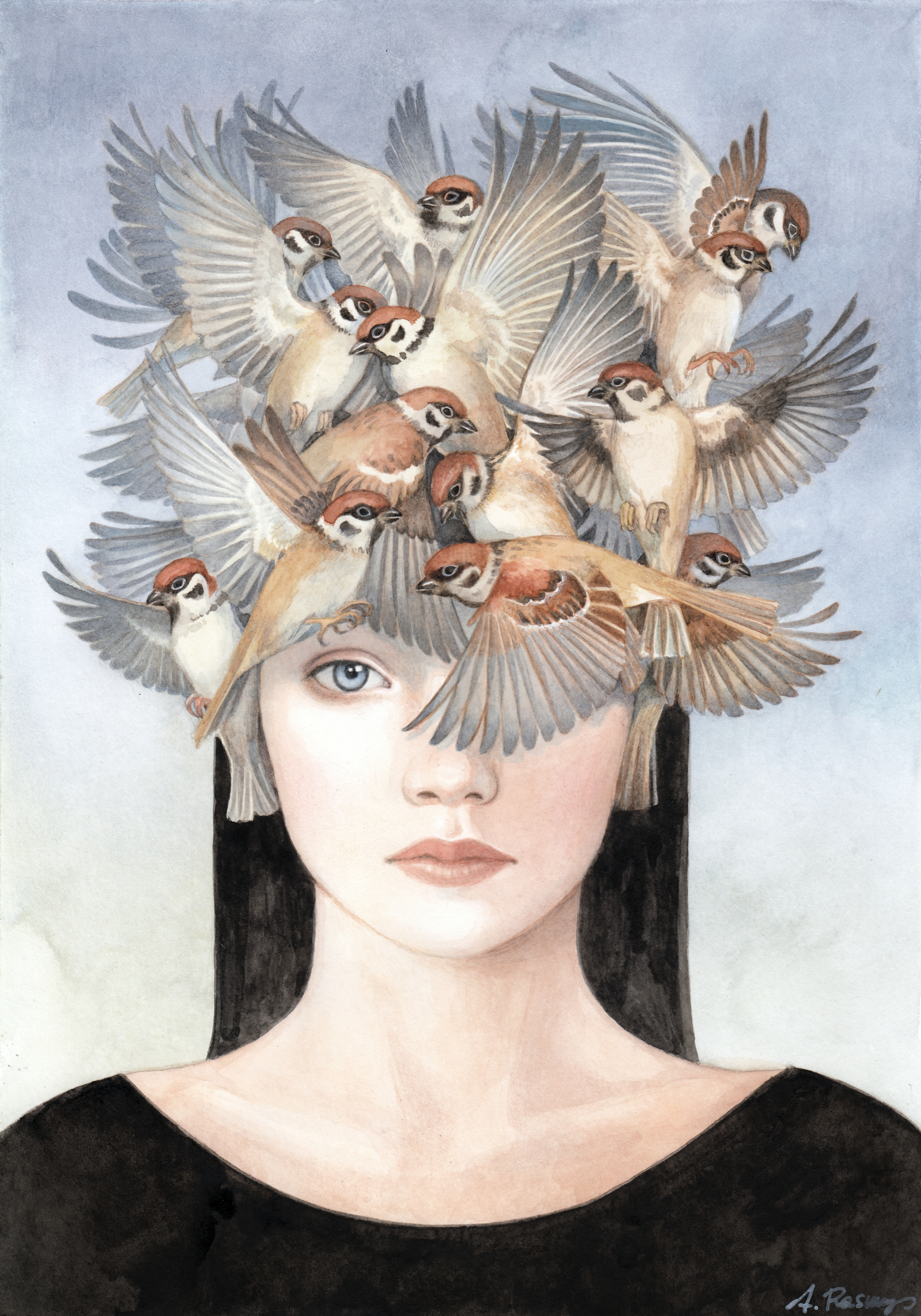 Nostalgia for Freedom I by Angelika Rasmus
Nostalgia, wanderlust, sadness, longing… obsession, encapsulation, fracture
“Nostalgia for a place for which I have no name” – Isabelle Eberhardt
This painting by Angelika Rasmus encapsulates the beauty and curse of Isabelle Eberhardt’s flight to Algeria through the unit’s readings on her and her adventures.
Writings from the Sand, Vol 1. An emerging theme was Eberhardt’s fragmentary and impressionistic prose, constantly shifting and exposing her fragmented state of mind. In the painting, the sparrows invoke a fleeting, ungraspable state, circling her consciousness as she juggles her “loyalty” to Algeria, to her Sufi brotherhood, to the French and Layuatey. No single narrative, very known to be a woman despite male-presenting.
Daily Journals, a recurring theme of where, when, what is my (Isabelle’s) inner peace. The tension and turbulence of her circumstances and the situation she puts herself in through her physical dilemma festering from her relations with others, her addiction to keif, her sense of identity and allegiance. The calm face in the painting suggests her journalistic state, controlled, obedient, however detached from the fractionally expressed thoughts. The woman’s face mirrors the way her journals juxtaposes her self-expression and reflection of constant upheaval in her life through her family life to the conditions she lived in Algeria.
Passionate Nomad (Introduction) “She was a vagabond, a wanderer, not only because of frenzied boredom and innate restlessness, but because she had no real roots anywhere, and therefore belonged nowhere.” Like a bird, with no place to truly call home, constantly in flight, migrating to a place that may seem like a temporary home, but even then not exactly. Eberhardt is a paradox amongst a multitude of things: European-born yet Arabized at least in her “learning” of Islam and the Sufi brotherhood, a woman inhabiting male roles, and a romantic wanderer yet wickedly realist of her own experiences in colonial Algeria. In the painting, there is a sense of lulling calmness, chaos above, individuality of the lady yet multiplicity of the sparrows, and a sense of clarity vs obscurity. There is no stable interpretation of Eberhardt, as can be seen through her readings, her work, her writings.
Eberhardt can not be understood as a simple vagabond or a nomad, she is an anomaly, she is a flock of fractured selves pieced and held together by one strip of sanity in which for her would be the predestined fate that Islam decrees. Her desires to locate a sense of feminism and being a westerner going into “exotic” lands and do “adventurous” things parallels a life of the sparrow (bird). The obscured eye within the painting suggests a partial blindness, and often noted by many, her using what she could understand to fuel her decisions to the best of her abilities as she grew up with a multifaceted sense of education. The way Eberhardt lives is in constant search for something, whether that be feminism, freedom, escape, a search for meaning, perhaps even a place to call her roots.
I can’t help but also interpret the multitude of birds in conjunction to the symbolism of birds signifying not only freedom, but depending on the bird, sometimes death, allusion to danger, destruction. Sparrows, in particular, can portray a persistent and obsessive quality. To which Eberhardt was most if not all at certain points of her life in Algeria, especially in the way she was obsessed with Algerian culture and was trusted into the Qadiriyya, and thus not only using Islam as her one string of sanity, but also compelling her mother to also convert (obsession becoming contagious). Her obsession with the male-perspective of Islam allowed her justification to a lot of her decisions, despite her fracturing mental and physical health. Liberation but imprisonment within her own self.
The McGraw Center for Teaching and Learning
328 Frist Campus Center, Princeton University, Princeton, NJ 08544
PH: 609-258-2575 | FX: 609-258-1433
mcgrawdll@princeton.edu
A unit of the Office of the Dean of the College
© Copyright 2026 The Trustees of Princeton University