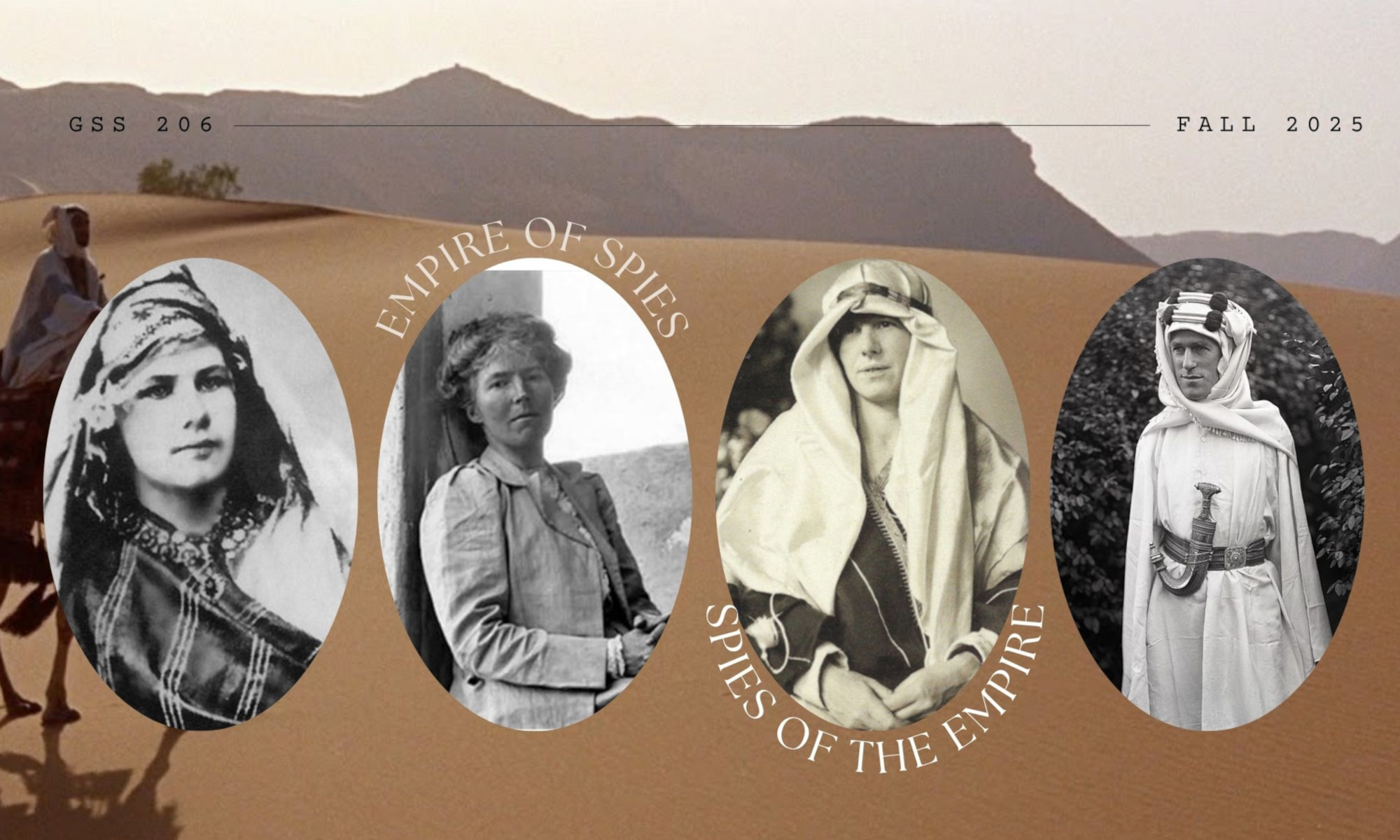
Writing blogposts for this class has been very different than for Transnational Feminisms in a REALLY fun way. I’ve enjoyed thinking of our spies in a more creative lens and pulling from MY world around me. In Transnational Feminisms sometimes I just wrote about whatever I wanted LOL, but this time, I always found a way to connect the two. It actually worked really well in forcing me to think of my daily life analytically as well as encouraging me to let some creativity into my studies. It became like an English class in that way, which was SUPER fun. I really enjoyed making the playlist for Gertrude Bell, which I spent HOURS poring over. Writing about her through music helped me understand her life and espionage almost literarily, and also begrudgingly made me feel less biased against her. Same with Lawrence! By seeing these spies as, yes, actors, but also human beings, I think my notes became less critique/taking a strong stance (which is sort of what studying English has trained me to do) and more understanding/connecting dots in the lives of the spies as well as to the modern world. It was always shocking because I’d come to a conclusion, craft an idea about each spy, then go back and connect it through the class readings. Maybe it’s just a lack of confidence, but I was always shocked to find evidence that supported my non-academic connections. I was also shocked at just how much using non-academic sources to fine tune my thinking helped my academic perspectives (ESPECIALLY Lawrence as Sookie LOL). In general, I’d like to know more about modern-day spies, or keep building on the research skills I used to write my midterm play. In class and in Lawrence in Lahore, we talked a lot about everything being interconnected, but as I did my own research on more modern politics, I was shocked to find just HOW true it is. Overall, I want to continue to learn creatively and research with an artistic lens because it opens up entire worlds of thinking that my English-influenced instinct to always take an arguable stance prevents me from doing.
TE Lawrence & True Blood’s Sookie Stackhouse: Love Bites!

True Blood is set in a world where vampires have recently come out of hiding due to the scientific advancement of a synthetic blood, True Blood. Sookie begins the show as a beautiful, innocent town weirdo. Everyone knows she can read minds, and in fact, she hates the trait herself. However, she realizes she cannot read the minds of vampires, and thus begins her many dramatic vampire affairs. The lore eventually grows and it is revealed that Sookie is a mindreader because she is part fairy (the show’s getting really bad…), which makes her blood alluring to vampires. Here is where my parallel really begins.
Lawrence, perhaps more than our other spies, was able to manage a balance of being an insider-outsider. While he donned an Arab drag, he wasn’t pretending to be Arab. He was able to travel between worlds because of his “ability to penetrate the inner self of the Arab individual” (Mousa 5). In relation to Arabs then, Lawrence had to be different. He was not one of the in-group; his relationships with Arabs was rooted in individuality, the recognition of difference. Like he says, “I can understand it enough to look at myself and other foreigners from their direction, and without condemning it. I know I’m a stranger to them, and always will be: but I cannot believe them worse, any more than I could change their ways” (Lawrence quoted in Garnett 156). Strangely, Sookie mirrors this insider-outsisder paradigm in her relationships with vampires. She can easily slip into their world because she is different. She doesn’t want to become a vampire or adopt their lifestyle, but they give her a reference point of normalcy–what she finds alluring about them. Furthermore, Sookie uses her ability to mind read to spy for vampires. She occupies human space (she visually appears human, can daywalk, and her power is invisible), but can also traverse the vampire world because of her fairy powers (which are based in light, and can therefore hurt vampires), her connections to the in-group, and the promise of her allure. She is both sympathetic and aggravating. She uses others, but gets used, and treats herself as the center of the universe. Her favorite line is: “If our relationship ever meant anything to you, you’d do this for me.”
Lawrence is somewhat the same. Mousa’s An Arab View and Theeb portrayed Lawrence as much less powerful than other iterations of his tale. He was simply a man in the right place at the right time with the right connections. Whatever role he did play in the Arab Revolt, it was exaggerated. He made promises he could not keep and we’ll never know if he actually thought he could make them happen. He used the Arabs for his own psychosexual, sado-masochistic exploration of the self through the east. He was a vampire! In the same way Sookie is, at least. Sookie spies for vampires but because she cannot read their intentions, often finds herself in situations where she has been cornered, manipulated, and even extorted by the very vampires she is psychosexually, sado-masochistially obsessed with (think: biting and blood, vampires are inherently tied to the concept of pain/consumption, fine line of pleasure/pain). Like Lawrence, she is both spy and insider-outsider, although she’s generally the one who ends up losing. I’d also argue she is sexually exploited in a way Lawrence was able to exploit others because of his rank. His gay love letters are described by Norton as “love letters from a slave to his master.” It brings up the question, how much information can one relationship have before it becomes exploitative? Could Sookie ever have a relationship with a vampire that doesn’t have a ridiculous power imbalance? With a human? Could Lawrence ever do the same with Arabs he claimed to love and work for? With his beloved Dahoum?
Spying necessitates betraying others, but in that, it must be wondered if that also means betraying oneself. Can one really love a person (or people) they exploit? It might be a reach, but to some extent all spy stories are vampiric.
Freya Stark: Empire of Loneliness in Edwards Hopper’s ‘Morning Sun’
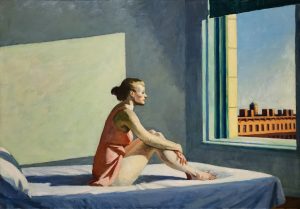
Edward Hopper was a painter who explored American solitude and loneliness more broadly. While Hopper depicts scenes that are rather simple, they still evoke so much emotion. They force the viewer to face emptiness head-on. In Morning Sun, a woman sits on her bed, stares out the window to the sky. But somehow, it feels lonely. Is it the emptiness of the room? Bare walls, a solo figure, a cloudless sky, a simple bloc of buildings, the look on the subject’s face? While studying Freya Stark, it seemed to me that loneliness also permeated her narrative. Stark, perhaps more than the other spies we’ve studied, makes travel seem exceedingly beautiful. Her travel writing stands on its own and would successfully cover her trail (but not dissolve ALL suspicions of her) if we did not know she was a spy. It’s both relaxing and meaningful, adventurous and eye-opening. This makes her spywork particularly captivating and sinister. Quotes like “And if our Empire melts away I think it will not be because we have lost the love of serving but because we have been denying that love to other people, so depriving them of a chance to practise virtues that could make them happy as much as they do us” (Perseus in the Wind, 15) and “It was the fashionable thing to be anti-British in Baghdad at that time” (Baghdad sketches 42) take on a new light. No longer is Stark a judgemental and hoity-toity British traveler, she is an invested patron and benefactor of empire itself. Psychoanalytically, I think much of this is rooted in her low-class (and therefore racialized) upbringing. Her life was deeply nontraditional: a confused family unit, unloving proto-feminist mother, romantically deviant father figure. All of this contributed to her desire to not only be accepted, but to belong to something, to Britain and its empirical values. She took on the identity of a foreigner, despite being British. “She spoke English with a slight foreign accent, [which] made her an immediate object of suspicion to the British authorities,” even though as she writes, “It makes me feel a kind of pariah from my own kind, and awfully disgusted… I am not even pro-native certainly as much of an imperialist as any of the people here” (Ruthven 152, 153). Imagining Hopper’s figure as Stark, in this way, feels significant to me. If the figure is read as Stark, she looks out to the horizon in a trap of loneliness, empty space behind and before her. She works towards empire because of her desire for belonging, but to what end? The room is empty, but so is the view outside the window. All that shows is one bloc of buildings, not even the ground it stands on. This takes on the significance of the consequence of empire: a building with no (or at least an uncertain) foundation. While the sun shines on the subject, the room itself is not warm-toned. It’s cool blue and cold, like a solitary hospital room, evocative of Stark’s nursing experience and her time being ill. The subject’s eyes are dark, perhaps contemplative, her mouth straight and serious. Is she lonely, sad, regretful? What does it mean to her to look away from the presumed comfort of the bed she sits on? She has no cushioning behind her back, despite there being a pillow within reach. Instead, her only comfort seems to be a self-soothing hold. Furthermore, we only see one side of the figure’s face, much like how Stark presents herself (literally and metaphorically): a seemingly innocuous figure with the incredible ability to hide what is underneath the surface. The figure is an incongruity, the only vibrant pink of the piece, yet shadow covers parts of her. Her color is diminished and she almost blends in with the wall behind her. Hopper captures, if read in the context of Freya Stark, the loneliness of empire, its shaky foundation, and the consequence to (not only its victims, but also) its perpetrators. Empire is inherently empty: a sun with no warmth, a bed with no comfort, a room where one is forced to always look ahead, but never successfully move forward.
The Life of Gertrude Bell: a playlist with only good songs
Gertrude Bell is a complicated individual, as all these spies are turning out to be. I think what I found so fascinating about Bell is that despite her love for Iraq (however much was genuine, and not exoticized or orientalized), she was consistently loyal; loyal to her family and to Great Britain itself. This made reading her life as a narrative much simpler than Isabelle Eberhardt. I scoured my playlist to find (my best attempt at) the perfect mix of tragedy, beauty, the pull of discovery and power, and the split loyalties/love that define the life and spywork of Gertrude Bell.
This song feels like Bell’s love for the British Empire. It is her master, her sordid and salacious lover. While it seems like a far-off, looming entity, the Empire is something dear to Bell. However, she must leave England precisely because of her love. She projects her loyalty into her spywork, leaving the room she knows so well, but always looking back at her far away master. “It was appropriate that the Bells’ family fortune was earned through… Britain’s great strength, after all […] they worked not only to enhance their own communities but to maintain Britain’s place in the sun. They took pride in the British Empire and its role as custodian of the universe” (Wallach; “Of Great and Honored Stock”).
I interpret this song as Bell’s growing entanglement and work for the British Empire. Her job of perception is based in deception. She must deceive the Iraqi people she loves to further the aims of the country she answers to, the country she believes has the power to make the trees bend in welcome. Why does the fast train of imperialism rage on, where does it end? Where do the passengers, the colonized, wait, in the meantime? “Authority would remain in the hands of dignified Sir Percy and a group of British advisors. London was convinced that it would control Iraq until that undetermined and presumably distant day when the untutored Iraqis had learned to govern themselves” (Brian; Desert and Sown introduction).
Bell’s love for Iraq and loyalty to England is paradoxical. She follows the tide to the beautiful that she wanted so badly, with the monster of imperialism over her shoulders. She occupies a middle space, a space of no feeling, and must continue diving deeper, becoming more entangled in life in Iraq and loyalty to Britain. Ironically, her loss of power towards the end of her life also mirrors the death of the song’s treasure hunter. “The work has been so interesting that as far as I am concerned I couldn’t have experienced better or even as good, a destiny” (Bell; Letters II 658-659). “She employs her growing competence of Arabic to describe a backward country in the flux of change” (Brian; Desert and Sown introduction).
I see Bell as this song’s Big Hero. With her eventual loss of power, what is there to show? A country divided and kings made by a name no one seems to remember. Her time in Iraq was not exactly true, but it can’t be discounted because she did truly love the people she met (in her own, perhaps infantilizing, belittling way). She can only deliver love to (or perhaps exert power over) Iraq by caring for her museum. Despite all her lies and deception, she would still wish them well in some (British-controlled) way. “Seven years I’ve been at this job of setting up an Arab State. If we fail it’s little consolation to me personally that other generations may succeed, as I believe they must…” (Bell; Letters II 664).
I imagine this as Bell’s love letter to Iraq before she dies. Today, Iraq is with her and the British, but tomorrow, who knows? Iraq has become her home, it’s a place she cannot live with as is, but cannot live away from. It’s tragic and beautiful! Iraq is her true love, perhaps because it’s the place she was able to leave her mark. Souad Massi’s Algerian, but the song is in Arabic, so I think Bell would appreciate the song for its exotic Arab aesthetic. “They never elect any other European. That’s the sort of thing that makes it difficult to leave” (Bell; Letters II 667). “I love seeing [Iraqi visitors] and they are most useful for purposes of information” (Bell; Letters I 407).
Gertrude Bell did sleep off her regret in a very literal way. Whether her death was a true suicide or not, she was undoubtedly sad and lonely. I see this song as Bell’s tired goodbye to her beloved Iraq, the place she couldn’t quite keep a grasp on. “There are long moments when I feel very lonely… I am aware that I myself have much less control over my emotions than I used to have” (Bell; Letters II 658, 662). “Gertrude Bell took an overdose of sleeping pills. All of Baghdad attended her funeral, along with an honor guard of sheiks from her beloved desert” (Brian; Desert and Sown introduction).
Isabelle Eberhardt: Radically un-Transgressive
As a Kabyle-American, I found all of Eberhardt’s journeys quite fascinating. In a lot of the ways I’ve experienced and understood Algeria, she is transgressive if understood as a woman. While I use the pronouns “she” and “her” for Eberhardt, this is done only for linguistic clarity. I think her gender was far more complicated than just being a woman traveler in drag. Is it fair to even consider her a woman when her gender/religious/cultural expressions were entirely male? If Eberhardt is understood as a man, then really, all she did was not very transgressive. I think I’m inclined to read her this way because the very few times she refers to herself in her daily journals, masculine pronouns are used. So, she is then a masculine European figure, trying to (quasi-)disguise herself as an Arab. Once again, this is very surface level transgressive, and instead further reinforces what Mohamed Boudhan calls “France’s Arabizing function.”
Let me explain! “These Berber assemblies are tumultuous. Passions have free rein; violent, they often end in blood. However, the Berbers always remain protective of their collective rights. They defend themselves against autocracy by suppressing those who dare aspire to it. In Kenadsa the Arab theocratic spirit has triumphed over the republican confederative Berber spirit” (Eberhardt 307; Oranese South II). Essentially, Eberhardt establishes an ethnic hierarchy of her experiences in Algeria. The (often French-associated) Arabs act as enlightened Muslims, much better and more civilized than their primitive, Indigenous counterparts. While her fascination with Arab identity may be read as transgressive from a western lens, when Eberhardt is understood as someone in the lived reality of North Africa, she instead implicates herself with a fellow ruling, dominating class. She, as a native European, is understood as a qualified speaker on civilization, and she knows the Arabs have it where the Berbers don’t. It completely reinforces the French colonial tactic of dividing and conquering. Arabs and Berbers are SO different, and if you can’t be European, it’s much better to be a civilized Arab!
Despite the interesting and somewhat controversial history of Amazigh marabouts, Eberhardt associates this caste of people with Arabo-Islamic civilization. “The marabouts’ influence on Kenadsa has been so profound that Berbers and Kharantine have forgotten their languages, no longer using anything but Arabic. Their behavior has softened and become civilized” (Eberhardt 308; Oranese South II). Eberhardt then believes in a cultural/linguistic homogeneity, a precursor to the aftereffects of French colonialism on North Africa. While Eberhardt claims to be a neutral passerby on her journey to self-discovery in the exotic east, she claims to have “never played any kind of political role” (Bowles 87; Eberhardt’s letter to the editors of La petite Gironde). Yet, just a few sentences later, she admits, “whenever possible, I make a point of trying to explain to my native friends exact and reasonable ideas, explaining to them that French domination is far preferable to having the Turks here again, or for that matter, any other foreigners. It is completely unjust to accuse me of anti-French activities” (Bowles 87; Eberhardt’s letter to the editors of La petite Gironde).
Overall, Eberhardt is an incredibly interesting character, but perhaps for the exact opposite reasons western media lauds her as a transgressive, anti-racial, proto-feminist. To me, she is the perfect example of Europe’s ability to separate, class, and racialize their colonial subjects, as well as setting the stage for the postcolonial Arabization of North Africa. Eberhardt’s views were perhaps more progressive than the average European of the era, however, it wasn’t anything particularly revolutionary, despite how impressive her story was. Like Kabani says, “[Eberhardt] became a mouthpiece for patriarchy, voicing traditional male views on sex, culture, religion and politics” (Kabani ix). It’s like the kids say: fork was found in kitchen!