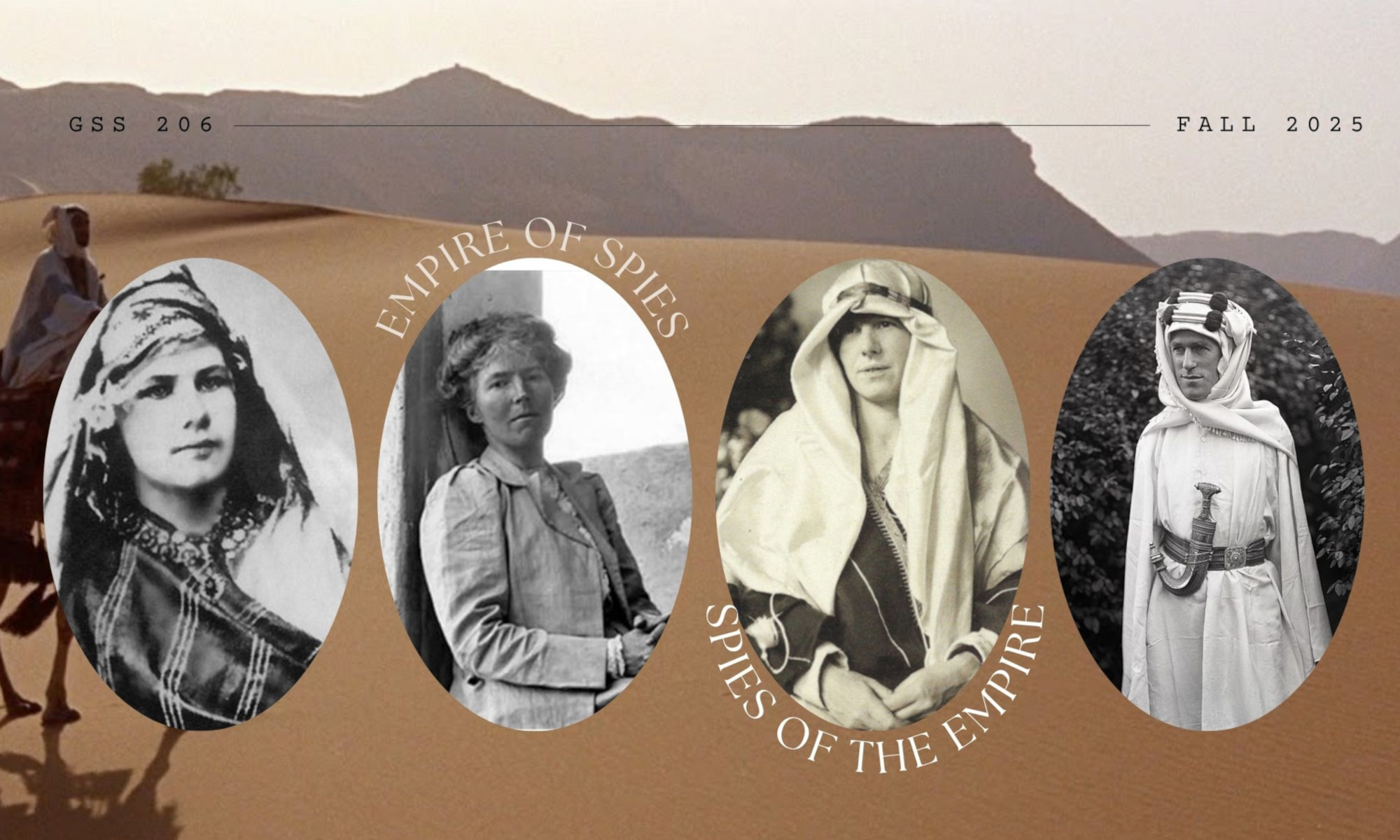
End of Semester Reflection (Extra Credit)

Reviewing my blog posts, I can trace a gradual shift in the way I approached questions of narrative power, authorship, and the ethics of representation. What began as close reading of individual writers steadily developed into a broader philosophical investigation: How does a narrative assert authority? What kinds of knowledge and what kinds of erasure does it produce? And what does responsible reading look like when the texts themselves emerge from imperial contexts?

My first post on Isabelle Eberhardt started from a sense of discomfort with her conflicting origin stories. At first, I treated these contradictions as unusual biographical details, but the more I examined them, the more they pointed toward a deeper issue: the deliberate construction of the self as a form of power. Her shifting accounts were not evidence of confusion but a method of controlling access to herself and shaping the responses of others. Writing that post pushed me to consider narrative instability not as failure, but as strategy.

By the second post on the Balfour Declaration, my focus moved from individuals to the political force of language itself. The distinction between “a national home” and “the national home” revealed how grammatical choices can carry enormous ethical consequences, allowing ambiguity to mask responsibility and justify domination. As I analyzed the document, I became increasingly aware that my frustration with its wording reflected a larger concern about how vagueness operates as an instrument of power. Language in these contexts helps construct reality, and sometimes erase it.

The playlist response to Freya Stark allowed me to approach her writing from a different angle. Her observational precision is impressive, yet I found myself more attuned to what her narrative style consistently avoided: emotional involvement, reciprocity, or genuine recognition of the people she wrote about. Using music to frame my critique helped me articulate the tension between aesthetic appreciation and ethical engagement. It made me think seriously about the limits of empathy in travel writing and about how beauty can sometimes obscure the violence embedded in a narrative stance.

By the time I reached T. E. Lawrence, I was more attuned to the rhetorical habits that run through many of these writers. Lawrence’s early admission of his own bias, rather than destabilizing his authority, effectively strengthens it. His self-awareness allows him to preempt critique and maintain control over the narrative. This led me to consider how a text constructs epistemic authority not only through what it includes, but through the way it anticipates and absorbs objections. Confession becomes another technique of consolidation rather than a gesture of vulnerability.

Across all four posts, I see my writing shifting from description to analysis of the underlying logics that shape these texts: imperial frameworks, narrative ownership, aesthetic distance, and the subtle but consequential operations of grammar. I hope to study more explicitly how empires produce and regulate knowledge, and how marginalized voices challenge or reconfigure those epistemic structures. I am especially drawn to the question of when storytelling becomes an ethical practice and when it becomes a form of harm.

Lawrence’s Self-Made Authority

As I read Seven Pillars, a few sentences stood out because they exposed the contradictions and self-shaping that Lawrence leans on throughout the book. One of the clearest examples is his early admission that this is a “self-focused narrative…unfair” to the soldiers and even to his British colleagues. On the surface it sounds humble, almost like he’s trying to be transparent, but I think it was more like a pre-emptive shield. By naming his bias up front, he gives himself permission to center his own experience anyway. And honestly, that annoyed me. It’s like he wants to claim subjectivity when it suits him, but still make his perspective the emotional and intellectual anchor of the entire revolt. He gets to frame the story while acting like he’s too self-aware to be blamed for it.

In Chapter I, when he says the campaign stripped fighters of “ordinary morality, pity, and a sense of individual responsibility,” I noticed how quickly the revolt became a stage for his inner psychological drama. The way he talks about moral decay and alienation overshadows everything else. He’s choosing which emotions to foreground, and they almost always circle back to him. Instead of exploring the broader ethical or political meaning of what’s happening, he turns the whole desert into a metaphor for his own unraveling. The chapter ends up feeling less like a collective wartime experience and more like Lawrence working through an existential crisis. How much of this “suffering” is something everyone felt? How much is part of the persona he’s building: half heroic, half damaged philosopher-soldier?

Then in Chapter II, when he defines “the Arabs” mostly through language and shared social structures. He’s drawing a giant map, dividing people into neat categories, and presenting all of it like it’s objective fact. His descriptions sound academic, but they flatten real differences and turn whole populations into abstractions. This reminded me how quickly ethnographic writing, especially by someone who already sees himself as a cultural interpreter can slip into essentialism without ever admitting that’s what’s happening.

Basically, all of this made me way more aware of how Lawrence sets himself up as the voice we’re supposed to trust. He admits things, sure, but then he turns around and uses that to frame everything on his terms.

Freya Stark Playlist: What She Missed

Honestly, the more I read Freya Stark and watched the films about her, the more uneasy I felt. She’s clearly brilliant and bold (there’s no denying that) but something about her voice never sits right with me. She notices everything, but it’s like she never actually feels what she’s seeing. There’s a constant distance, as if she wants to understand the world, but only on her own terms, only while she’s still the one holding the map.

So I made this playlist to respond to what she couldn’t say, what she couldn’t feel.

1) Marcel Khalife – “Ummi (My Mother)”

(Linked to: Letters from Syria and Beyond Euphrates)

In Letters from Syria and Beyond Euphrates, Stark walks through Damascus and Baghdad describing every detail: the graveyards, the veils, the “three separate quarters.” She’s observant to the point of precision, but she never really steps inside what she’s seeing. When I listen to Khalife’s “Ummi (My Mother),” that distance completely disappears. His voice feels like warmth, like home. When he sings, “I long for my mother’s bread, my mother’s coffee,” it’s belonging. Khalife makes what Stark calls “the Orient” feel human again. He sings from within what she only describes. Reading her after hearing him, I realized how often she confuses curiosity for connection.

2) Ahmad Kaabour – “Ounadikum (I Call to You)”

(Linked to: Passionate Nomad, Chapter 19)

There’s one line from Passionate Nomad that stuck with me: “It hardly made sense to make the Palestinians pay with their homes and lands for injuries done to Jews by European Christians.” She’s right, but she says it like an observer writing a report, not someone grieving a people’s loss. Ahmad Kaabour’s “Ounadikum” is the exact opposite of that. When he sings, “I call to you, my people,” it’s urgent, not detached. His voice makes her writing feel distant, like moral language without emotion. Stark’s “they” never becomes “we,” and that’s the difference.

3) Fairuz – “Zahrat al-Madā’in (The Flower of the Cities)”

(Linked to: Passionate Nomad and her 1944 press comments)

When Stark writes about Jerusalem, she does it with a kind of calm that’s almost cold. She calls it “friction between Jews and Arabs,” as if she’s describing weather. Fairuz’s “Zahrat al-Madā’in” destroys that calm completely. When she sings, “Jerusalem, flower of cities,” it’s both a prayer and a cry. You can feel the heartbreak in every word. She aches, grieves, and feels (unlike Stark who seems to only be analyzing).

4) Tracy Chapman – “Talkin’ ’Bout a Revolution”

(Linked to: Freya Stark’s 1944 press tour comments)

During her 1944 press tour, Stark calls the Arabs “the rightful owners of Palestine,” which sounds bold until you realize she’s still speaking as part of the British machine that made the whole crisis possible. She names the problem but never challenges the power behind it. Tracy Chapman’s “Talkin’ ’Bout a Revolution” is like that silence finally breaking open. Chapman doesn’t stop at moral awareness; she pushes toward change. Her song says what I wish Stark had the courage to: not just this is wrong, but this must end.

5) Le Trio Joubran – “Masār” 

(Linked to: Towards the Unknown Land – Nepal)

In Stark’s final film, she’s carried through the mountains of Nepal by a team of porters. She looks fragile but composed, smiling faintly as she says, “If it fails, it fails.” The moment is framed as graceful acceptance: an aging traveler facing limits with humility. However, to me, it felt like comfort disguised as wisdom. Even at the end of her life, she’s still being carried (literally) by others whose presence is unnamed. Le Trio Joubran’s “Masār” sounds like that scene. It’s beautiful, but it refuses peace. It feels like remembering something you can’t fix. When I listen to it, I imagine it filling the silence in Stark’s film: not judging her, but not forgiving her either. Just holding her quietness up to the light and asking what’s underneath it. It made me think about how reflection isn’t the same as reckoning. Stark reflects endlessly (on landscapes, people, herself) but her reflections never really cost her anything. Masār feels like what real reckoning would sound like: the moment when beauty stops protecting you, and you finally have to sit with what you’ve done.


The Violence of Grammar: A Tool of Power

One idea that’s been stuck with me since our discussion on the “a” vs. “the” in the Balfour Declaration is how language can decide the fate of an entire people. When Gertrude Bell argued for the use of “a national home” rather than “the national home” for the Jewish people, it might have sounded like a technical adjustment, but to me, it felt like a warning. That “a” became a way to avoid responsibility, to promise without actually promising, to escape accountability. 

As a Palestinian, I have seen this same strategy used before. For example, in the Oslo Accords, the language used to describe Palestinian lands referred to them as “a territory” rather than “the territory which was a choice that allowed Israel to expand settlements and claim land that was never clearly defined as ours in the first place. The ambiguity wasn’t accidental; it was strategic. This showed me that grammar can be violent. A simple “a” can erase and dispossess just as much as bullets or bulldozers.

the use of “a” as a tool of strategic vagueness can be looked at in the broader sense such as in the U.S. Constitution. The way amendments are worded, especially those supposedly guaranteeing “equal protection” or “freedom”, have been deliberately open-ended and therefore leaves space for those in power to interpret justice however they want. Vagueness here is used as a kind of shield: it allows the state to claim moral authority while maintaining the ability to exclude and discriminate. 

I’ve always known that language is never neutral. The smallest choices in phrasing can determine whose lives are protected and whose aren’t. We (the oppressed) tend to celebrate treaties, declarations, and laws as “wins” the moment they’re signed, and it makes sense. These moments usually come after long periods of pain, loss, and struggle, so we cling to any sign of recognition or progress. I would never blame anyone for holding onto hope. But history shows that the real danger lies in the fine print like the indefinite articles, the open-ended clauses, and the carefully chosen ambiguity that gives room to manipulate. We need to look closely at what exactly we’re being offered, and what is being withheld in the wording itself. Because sometimes what looks like a step forward quietly includes the loopholes that will be used against us later.

Inventing Her Origins

“The story of her birth is a novel in itself … Did she know who her father was? Did she invent one while disowning her parent? … A mystery never cleared up” (xvi from Introduction)

I couldn’t help but think about the variations of stories Isabelle told about her father. I believe Eberhardt deliberately crafted conflicting accounts about her father as a strategy of reinvention. These contradictions were not simply “personal confusion,” rather they became a tool she used to manipulate perception, gain trust, and adapt to different audiences. I think by revising her origin story again and again, she controlled her narrative, positioning herself to navigate new spaces and extract what she needed from others.

The mechanism here, I think, was subtle but powerful. By presenting one version of her father as noble or intellectual, she could invite admiration and open the door for others to share details about their own family backgrounds or cultural pride. By telling another story where her father was absent, illegitimate, or mysterious, she could evoke pity or curiosity, emotions that often lead people to reveal more about themselves in an effort to comfort or advise. Each story about her origins worked like bait: it caught people off guard just enough to open them up and draw them into conversation. In these moments of sympathy or intrigue, people likely gave up information they would not have shared in a straightforward exchange. The more uncertain they were about who she really was, the more they filled the gaps with their own disclosures. In that way, her stories didn’t just hide her, they actively pulled information from others.

This is part of what led me to a broader conclusion about Eberhardt: she was clearly a spy. She didn’t randomly decide to go to Algeria as a nomad; she was sent there with a purpose. While she may have developed genuine attachments to Islam and to Arabs along the way, these feelings do not erase her collaboration with the French government near the end of her life. In fact, her shifting emotions such as doubt, love, hatred, belonging, etc. fit the profile of someone working under cover. Her calculated and constant reinvention as well as her extreme efforts to gain trust all align more with her being a spy. If she were truly only a vagabond, she would not have needed to so carefully craft her identity or perform these elaborate acts of belonging.

That “unresolved mystery” and the way she weaponized narrative itself as both a mask and a weapon really sticks with me. She wasn’t just hiding the truth of her origins, she was performing, shifting her story to keep people off balance and stay in control. And it’s wild how much people have become obsessed with that. They romanticize her because she never let herself be pinned down, because she lived in that blur between truth and invention. At this point, “the myth” of Isabelle Eberhardt almost feels bigger than the woman herself and that’s exactly what she set up by turning her life into a story others couldn’t stop chasing.

-Givarra Azhar Abdullah