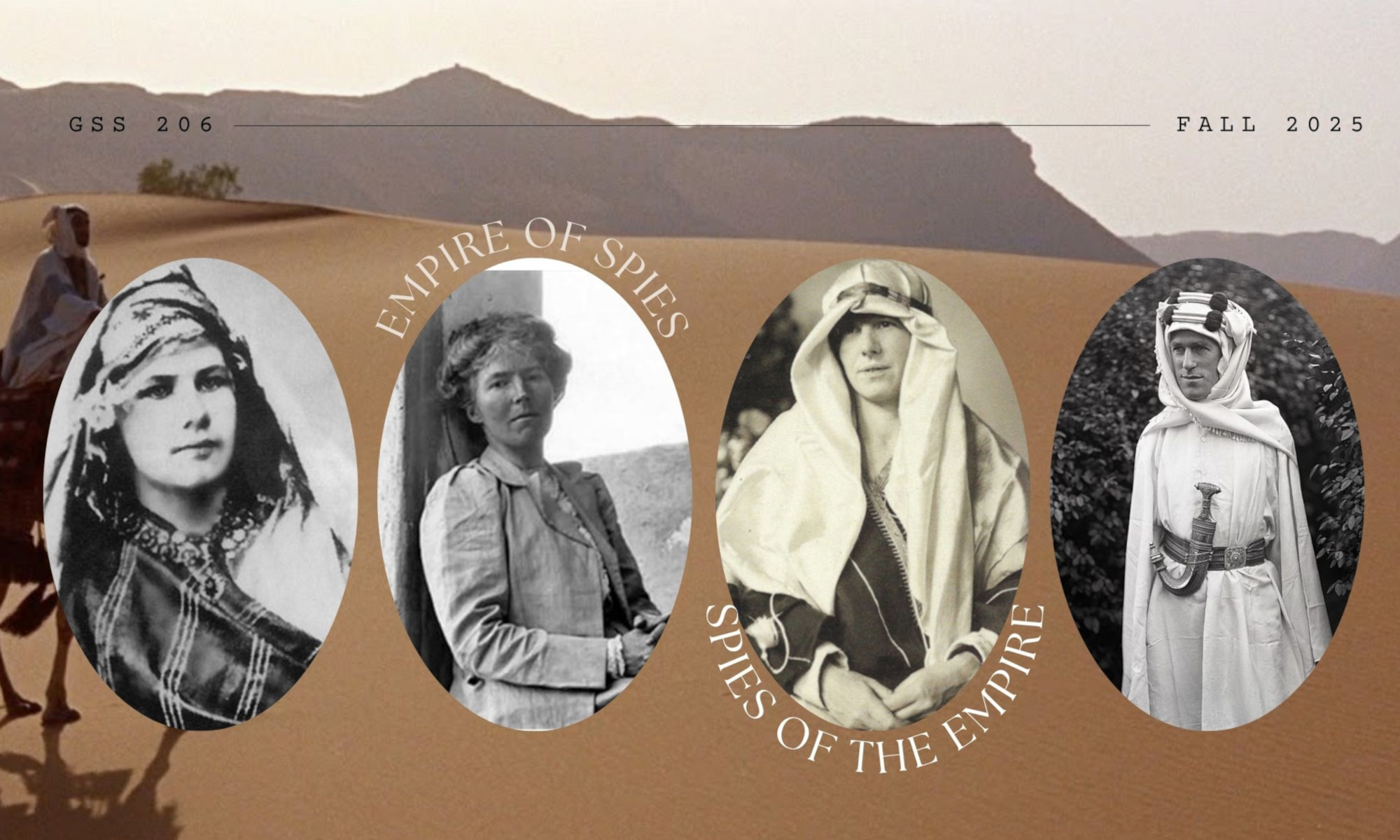
My biggest takeaway from this class, I believe, is a more nuanced and comprehensive understanding of historical figures and historiography, particularly in the imperial/colonial context. I can’t say I’ve ever before spent so much time deconstructing the kinds of narratives I’ve taken for granted since childhood—the intrepid, mystical traveler, like Eberhardt, or the fierce woman kingmaker, like Bell, or the prodigal soldier in a strange land, like Lawrence. When we began, with Eberhardt, I was ready to dig in and take apart her approach to Algeria—and while I did find some elements of her behavior and worldview to criticize, I also realized that I needed to be more generous with her, since her story, especially in its transgressions of class, race, sexuality, and gender, also carries terrific revolutionary potential. I was stunned, too, by how beautiful I found her writing, even when it glossed over the Northern African political climate of her time or hid her sometimes-condescending view of Arabs.
In some ways, I was more inclined to appreciate Bell, since she at least was a straightforward imperialist. In the same way I was surprised by how much I appreciated Eberhardt, however, I was surprised by how little I appreciated Bell. Her accomplishments, impressive as they were, meant little to me, and I found her personality and writing uncompelling. Still, it was enlightening to learn just how much of the historical processes I tend to assume just happen, like the ascensions and descents of certain figures, or the emergence of certain groups, could actually be engineered by someone like Bell. It’s put me on the lookout for manufactured events now and in my studies of history, and it’s made me more careful in how I talk about how past events came to be.
While I admired Stark’s writing style more than Bell’s, I found her, in a lot of ways, a weaker version of her. Especially in her case, I was struck by how nonlinear political/historical trends can be; her logic of anti-Zionism in her letters and US tour was not unlike current arguments against Zionism in lots of ways, even though Zionism persists today. I appreciated that Stark wasn’t aristocratic or classed in the same way Bell and even to some extent Lawrence and Eberhardt were; it made her feel more real, and in a way more approachable. She was also the only spy who wrote about the other spies (Lawrence and Bell), which I found fascinating—I liked seeing what she thought of their history, since she was so much closer to it in time than I could be.
As for Lawrence, he really made me think critically about how historical narratives are formed, and how historical characters are just that—characters, and not necessarily accurate reflections of real people. Mousa’s work was especially interesting in this regard. I knew that history as I knew it could be inaccurate, but somehow, I saw the historiographical process as something that just happened, not as something influenced by the character of the very historical figures it follows, as with Lawrence’s work in forming his history to his desires. Prof. AK’s interventions, too—allowing us to remember why we can be so attracted to the myth/story of Lawrence, and making sure we understand why/why that is fine but also worthy of investigation—helped me form a skeptical view of history that didn’t totally disregard the attractions of conventional historical narratives.