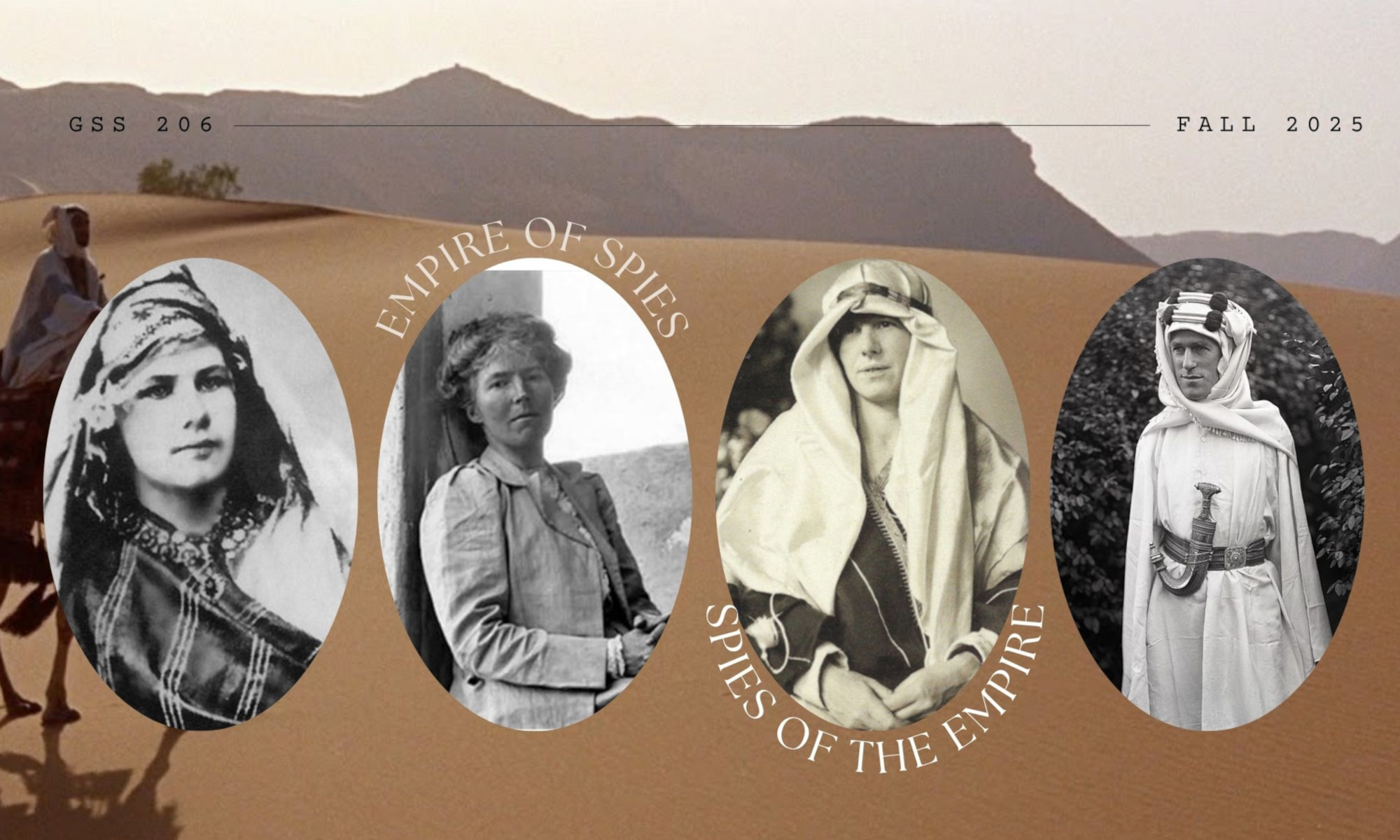
Final Reflection? Final Blog Post?

When I decided to write about Isabelle Eberhardt as a “nomad” at the beginning of the semester, I was still preoccupied by questions about goodness (and maybe colonial self-definition). What I wondered was along the lines of: how can Eberhardt escape her colonial positionality through desire? Is her identification with Arab Islamic culture genuine or just another form of appropriation? I spent the entire post wrestling with whether the nomad and the spy could coexist, and genuinely puzzling over whether her attachments were proof of complicity or evidence of something more complex at work underneath the waves. Looking back now, I realize I was trapped in the same framework as Eberhardt herself when she wrestled over her identity in Algeria: implicitly positing via my argumentation that individual intention could transcend the material reality of empire. 

Yet, a shift happened somewhere between Bell and Stark specifically, I believe, with our discussion of Herzog. Discussing a figure who fell so firmly into an imperial stereotype yet also commanded the respect of those around her, Arab and non-Arab alike, I think I started realizing that “goodness” or intentionality couldn’t truly capture what was at play in her imperial exploits. With Bell, I began not just to see how narrative forms operate as colonial technologies, but to also treat them with the urgency required in a world order saturated with them. For example, I realized Herzog’s Queen of the Desert succeeded at what colonial craft is designed to do: orient the viewer, create messianic figures, and turn the traditions of colonized peoples into narrative fodder. In such an analysis, drawn from FNT’s criticisms of “craft,” I was not inquiring as to whether individual colonizers were good or bad. Instead, I was asking how the structures they belonged within function: how they produce certain subjects, certain narratives, and certain ways of seeing that make empire inevitable.

By the time I wrote about Stark and Lawrence, I think I’d fully moved into analyzing the material mechanisms of colonial narrative production. With Stark, I experimented with a counter-perspective not to redeem her but to expose what her original narrative structurally excludes such as reciprocity, the possibility of being equally known by colonial subjects, and the colonial asymmetry of travel writing. With Lawrence, I traced how imperial narrativization operates as an obliterative force, the flattening of his fragmentation all served the empire’s material needs. The question I asked this time around wasn’t whether Lawrence was complicit (yes, duh) or whether he felt bad about it (probably) because ultimately, those questions are not helpful in understanding what Lawrence did to Arabia. The question I asked this time around was about how the empire required him to be mythologized differently than Bell, Stark, or Eberhardt because he carried different symbolic weight. This had nothing to do with anyone’s individual goodness and everything to do with how imperial narrative machines function.

What I understand now, looking across these four posts, is that my initial focus upon individual morality was a distraction from actually understanding Empire. The spy figures we studied this semester were all caught in structures that exceeded them, formal mechanisms that shaped what they could write and how they would be remembered. My thinking moved from asking “were they good people?” to asking “how do these structures work, and what would it take to actually betray them?” That shift from individual judgment to structural analysis feels most pertinent in tracing not only my intellectual development this semester, but also in doing the sort of analysis that is useful to the decolonial project as a whole.

P.S. I’m sorry but I hope this can apply for extra credit too…sorry…thank you for the lovely classes!!!!! 

Lawrence, Empire, and the Violence of Mythmaking

There’s a peculiar paradox that stood out to me in our discussion of T.E. Lawrence compared to his female contemporaries in colonial exploration such as Gertrude Bell, Freya Stark, Isabelle Eberhardt. Lawrence seemed most opportunistically positioned, the spy in the right place at the right time, and yet our discussions of him always required going back to the myth of Lawrence. While the women in our texts are frequently discussed not as cultural figures but personal ones (i.e. the forewords to their letters), Lawrence has been calcified into a central figure of the long-lost “Orient,” and as such cannot be discussed outside of this myth. More accurately, if one seeks to discuss the “real” Lawrence, you must first navigate the myth of Lawrence—which is likely to leave you with more questions than answers, after all. It is important to understand that this is a buy-in Lawrence makes to some extent in his lifetime. This narrativization was not a choice made posthumously by stuffy Oxfordites, but rather one he consciously played into on some levels, and was haunted by on others. The result? Lawrence of Arabia: the unified hero, the sovereign self, and ultimately the kind of man who traded in certainties of the imperial hours. The imperial narrative required him to be more than human, and in doing so, made him less.

This is where the critical work on masculine autobiography becomes urgent, particularly Leigh Gilmore’s observation about how men are framed as “autonomous individuals with inflexible ego boundaries who write autobiographies that place the self at the center of the drama.” This framework isn’t just embedded throughout our depictions of male self-reflexivity. It’s also essential to colonial narratives that desperately need for self-maintenance. In essence, empires require their male heroes to be monuments, not men (especially if in the vein of Greco-Roman tradition). It required them to embody unified selfhood because fragmentation, doubt, and relationality would undermine the justification for colonial authority.

But as Marling notes, this “inflexibility of male ego boundaries” is a cultural ideal, not a cultural reality. The obliterative force of imperial narrativization reduces Lawrence to this ideal rather than allowing him to exist as he actually wrote himself: fragmented, anxious, and ambivalent about his role in the Arab Revolt. The Seven Pillars of Wisdom is not the confident autobiography of a unified colonial subject, regardless of its publisher’s intent; it’s far more nuanced. While Lawrence (or maybe even his publishers) attempt to dress the book in the garb of imperial wisdom, the images of violence he can’t help but return to (such as the torture of a prisoner) haunt him. Like all our other spies, Lawrence is implicitly responsible for furthering the European colonial project. But he, perhaps, is something even more tortured: an imperial figurehead. Thus, the imperial project couldn’t afford readings of The Seven Pillars that account for the nuances in Lawrence’s thought. In 1922, exhausted and disappointed by the outcome of the Arab revolt, his friends encouraged him to write an abridged version of The Seven Pillars to secure income. What was left out of this subscriber’s edition was a foreword in which Lawrence discussed his heartfelt shame in the Arab Revolt’s betrayal by colonial powers and his own contentions with his complicity. The fact that so few copies of this chapter remain in existence that the last one was auctioned for £65,000, exactly a 100 years after its publication says much about the crafting of Lawrence’s literary persona. Namely, that (in the West, at least) it needed Lawrence the myth more than it needed Lawrence the person.

Women in colonial spaces are implicitly condemned to subversion: they can be eccentric, complex, even contradictory, because they aren’t carrying the symbolic weight of the empire itself, unless representing its virtue or fragility. They are exceptions to the rule, which expects female subordination to the maintenance of the colonial empire at home or on the settlement via childcare, housekeeping, etc. but never intellectual and physical participation. No easy mythological narrative can be bound together from these contradictory shards of their lives. But Lawrence was not subject to these stereotypes to such a degree, and thus his identity had an ability to be rendered “coherent” even if through false pretenses. He had to be the hero. His narrative had to be one of mastery and certainty because the alternative—a British officer colonized by doubt, unable to maintain the boundaries of his own selfhood, victimized by sexual violence yet reenacting it in order to somehow shed himself of guilt as the assaulted and as the colonizer—would have been a dangerous admission that the men running the empire were as fragmented and uncertain as everyone else.

To read Lawrence with attention to fragmentation and ambivalence is to resist that obliteration. It’s to recognize that the myth of unified masculine selfhood was always a lie that served the empire’s purposes, not a truth about how men actually experienced their lives or wrote their stories. If one seeks to discuss the “real” Lawrence, you must first navigate the myth of Lawrence. But is it a greater boon or tragedy that Bell, Stark, and Eberhardt were never afforded myths in the first place? They were allowed complexity by default because they were never expected to be heroes. Lawrence’s fate, and the fate of masculine figures within the project of imperial mythmaking more broadly, is simple: to be chosen as a hero means losing the right to be understood on human terms. It’s a trade-off, as unsettling as it is to make.

Okay, now that that’s done: mandatory viewing material…Lawrence/Ali edit to Olivia Rodrigo…do you guys feel the love!!!!!!

Rewriting Stark

My Passage: The woman in the baths possessed the inimitable quality of a ghost: blurred against the sun, swallowed by the horde of us congregating. A veil clung to her neck. Her bareness still seemed wanting. Outside the realm of novelty, there was not much explanation for what drew her to us but if one were to exist, it would be not how she looked as much as her looking.  I understood her gaze was not a gaze as much as it was a way to see nothing. She was not French, at least not entirely. The woman in front of us was instead a stranger, at once cowed by her shadow and utterly at ease, leaning away from her guide to pronounce, with feeling, her answer to our nonverbal query — she was a Brit, a friend. This was as interesting to me as it was uninteresting. What had interested me most in this exchange was the unsaid: which end she sought fixed to the Damascan mean. Or maybe the unsaid remained something else entirely. After she took her formal photograph, she leapt the threshold. Her body swayed back but returned no looking. I did not know if she had ever been a girl. I did not yet know if she knew it was possible to love something so dearly and wrongly, that your body bent helplessly toward your beloved’s opposite end, with no will toward one’s own loving.”

Original Passage:  They had all come up so close to me and I thought them a villainous-looking crowd. Someone murmured to the old man: “French?” “English,’ said I hastily: “we are your people’s friends.” This had an extraordinarily soothing effect on the atmosphere. I asked if they would mind moving away from me for the picture, which they did in silence. When I had taken it I thanked the man who seemed master of the bath and turned to my old man to have the door unfastened: this also was done in complete silence, but just as I was stepping out two or three of them asked me to turn back and look over the baths. This you may imagine I did not do. I was very glad to have that door open, though I suppose it was all really quite all right. I wish now I had taken the picture with more care, for I don’t imagine any European has been in that particular place before.” (Letters from Syria, 76)

Analysis:

What I consider most essential in my transformation of Stark’s writing is the reorientation of perspective: centering the “villainous-looking crowd” rather than Stark herself. In doing so, the scene becomes a counter-expression of the original encounter, told through the eyes of a native who possesses equal power to observe and judge Stark, just as she admires and pities the Levant. This narrative choice preserves the single-person perspective of Stark’s writing while reconfiguring it to welcome the polyphonic voice of the colonial subjects she sought to describe. The counter-grammar of my palimpsest renders autonomous and singular the people who, in Stark’s words, exist only as a monolithic crowd.

Even more significantly, the unnamed colonial subject finds the ability to occupy Stark’s positionality — even to sympathize with her as he dissects her “dear and wrong love.” This reciprocity exposes what Stark’s narrative omits: the colonial asymmetry at the heart of travel writing, in which the Western traveler seeks to know “the people” but cannot imagine being equally known by them. The observer fever dreams the Orient while refusing to see it as a mirror reflecting the hypocrisy of her gaze. Yet the palimpsest is careful not to condemn her; the narrator pays attention to Stark’s hybrid identity — French or not, knowing or unknowing—and emphasizes the fluidity of selfhood in the colonist-colonized relation, along with the vulnerability inherent in human connection. Both are elements Stark’s original text leaves unaddressed (by design, of course) and thus my intervention fleshes out a response to these omissions.

To Craft or Un-Craft: A Response to Western Depictions of the Eastern World

Image of Fargo Nssim Tbakhi, The Book of Dust

After our exhaustive discussion of Herzog’s Queen of the Desert, I found myself floundering to imagine the narrative landscape of its antidote. A film rife with sentimental orientalisms of the Berlin variety is of course a dime a dozen, but when attempting to deconstruct and reform it, we still found ourselves stymied when contemplating interformal revisions in any order. For example, the choice to use Arabic when historically accurate, then provoked the question of a “revised” Queen of the Desert would require subtitles. From that, the question of who and what subtitles are comes into play, dominating and redominating our psyches with the realization that Craft — particularly one that is as ubiquitously Western as filmmaking — delineates an array of theoretical “choices” who, outside their nominative delineation, differ not at all. The choice to subtitle presents just as much possibility as the choice not to subtitle for a colonial dominion over the narrative form — it is this impossibility which guided me to (what I believe is) the conceit of our in-class discussions: whether or not Craft is an impossibility as a revolutionary mechanism. 

Fargo Nssim Tbakhi’s 2023 “Notes on Craft: Writing in the Hour of Genocide” defines Craft as “the network of sanitizing influences exerted on writing in the English language: the influences of neoliberalism, of complicit institutions, and of the linguistic priorities of the state and of empire.” To Tbakhi, Craft exists to deny a nuanced reckoning with colonial mechanisms writ large. As an example, he points to Solmaz Sharif’s comments on a poem in which she erased a liberal protestor’s abetting of a staunch Republican’s anti-immigrant rhetoric in favor of highlighting only the absurdity of the former’s demands. This too is a Craft decision: the lucidity of a “good” poem implicitly requires a simplicity of forms and understanding. In this process, similarly complicit forces — such as establishment liberalism — are often ignored in favor of highlighting artistic spectacle as a function of craft. Thus, to exist in a necessary, constant state of revolt, like Palestinians have for the past 75 or so years, requires “that we poison and betray Craft at all turns.” While the conceit of Tbakhi’s argument is situated within the Intifada (for good reason), such required betrayals of Craft can be found all throughout the postcolonial world, from Kashmiri paper-maiche to Guyanaese music, in service of creating an anticolonial world order. 

Two paragraphs into this blog post, you may be asking: “But Ayanna, how does this relate to the image you have chosen, and how does that image illustrate our unit’s readings?” In response, I’d like to first contextualize the image, which is from Fargo Nssim Tbakhi’s performance of The Book of Dust. While Queen of the Desert is a film, and The Book of Dust is a theatrical production, both are interformally entangled. In both, considerations of staging, casting, translation, and overall construction must be made — and that making must be undertaken in the context of colonialism. Queen of Desert, via both its subscription to Aristotelian narrative structures and orientalized aesthetic framing of the Near East, becomes a colonial tool. Rather than serving to rupture caricatures of the Middle East, instead it deepens them. And while it can be argued that many traditions within the film do exist, these arguments ignore what the film does with these traditions. Rather than theater, where spontaneous reality is often confronted by physical or imaginary constraint, film is a medium of curation. Thus, it matters not that these races do exist, but how Herzog crafts them. Here, the camel races create a background of an Othered world as Bell familiarly converses with the future kings, physically distancing the viewer from what is unfamiliar and consequently imbuing Bell — who seems completely at ease — with a messianic quality. We must understand that these camel races are not included for cultural posterity. Instead, they exist in the tradition of the traditions of the colonized world being made canon fodder for the narratives of colonizers. 

The image I have chosen of Tbakhi stands in complete opposition to this. It subscribes to nothing of sort, instead navigating the theatrical realm with a dogmatic rejection of Craft. For instance, objects are normally fetishized in reproductions of the Oriental East (eg. the veil) are subverted in the physical theatrical space. In, The Book of Dust, rather than a barrier separating an “Oriental object” from the audience, the veil becomes a physical barrier between act and audience themselves. Consequently, the Craft practices of costuming are denied dominion over “othering” cultural garb. In a similar rejection of visual and narrative Craft, the image’s visual narrative ascends upward rather than moving from a decided end-to-beginning. Within this image, Tbakhi does not cede ground to Craft, and consequently avoids the pitfalls our revisions to Herzog’s Queen of the Desert found inevitable. In short, I find that the question born out of Tuesday’s discussion readings/viewings/discussions was: “How do you revise presentations of the Middle East after they have so long been steeped in coloniality?” This image, then, illustrates the answer.

In Response to “Is there an idea or image or line from our readings that has stuck with you for more than the week or unit when it was discussed? What are you continuing to think about it? Why do you think it has had this effect?”

In the records of Isabelle Eberhardt’s life I find neither the vagabond nor the nomad she so fondly self-references. Instead, I find a woman at odds with her colonist’s background, yet who finds herself wedded to it again and again — no matter the landscape. This turn of events may have always caught Eberhardt by surprise, but its cause is really quite simple. A “nomad” must not only shed all attachment to the material forces around them (oppositional and otherwise), and, consequently, shed all loyalties. The spy, however, is a figure of multiple loyalties: their attachments not disavowed, but instead participated in with even more vigor than the common person. As such, a spy cannot be a vagabond, nor a vagabond a spy — no matter how much Ian Fleming’s romantic storytelling attempts to conflate the two. 

Still, why does the role Isabelle occupies (spy) seem to correspond so frequently to the role she wishes to occupy (nomad)? The answer lies on page 213 of Julia Kristeva’s Powers of Horror

“On close inspection, all literature is probably a version of the apoc-

alypse that seems to me rooted, no matter what its socio-historical

conditions might be, on the fragile border (borderline cases) where

identities (subject/object, etc.) do not exist or only barely so—

double, fuzzy, heterogeneous, animal, metamorphosed, altered, abject.”

It is important to understand that border enforcement, in the context of the nation-state, are largely a modern innovation. It draws on the colonial demand for dominion over the Earth, segmenting it into individual pieces that individuals or communities claim to “possess.” For many colonial subjects, the imposition of border regimes stoked more terror than direct violence from colonizers, as the false imposition of ill-defined borders led not only to violence from those meant to enforce them but also from the oft-disparate cultures and societies now forced to occupy the same “nation.” It is only in this world, where the horror of borders and their fragility is stark naked, that we can understand the blurring between Isabelle’s lived and desired roles. 

Spies and nomads share one commonality: the ability to permeate borders. Nomads because they have unattached themselves from nation-states and all that they entail, and spies because they are attached to multiple of these colonial projects intending to redesign the world. Eberhardt, over and over again, confuses her ability to occupy the contradictory worlds of colonial Algeria as proof of her “nomadic” lack of attachment to the way of things. However, Isabelle’s ability and desire to occupy these worlds is a direct result of her many attachments — her eroticized fascination with Arab Islamic culture sublimated in her operative work for the French Empire. Unable to let go of either attachment, she finds a way to manipulate them in her favor: allowing her access to a “foreign frontier” all while refusing to renounce her colonial background.

The nomadic life she details living, then, is revealed to us: a tower of dust.