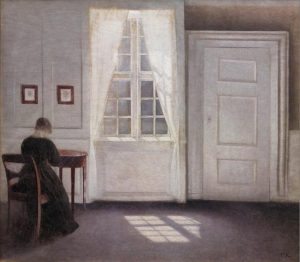
Interior from Strandgade with Sunlight on the Floor
By Vilhelm Hammershoi
Throughout the unit, I noticed a lot how Gertrude Bell had moments of seasonal depression as well as just regular depression. Specifically, in The Letters of Gertrude Bell Volume 1, she exhibited a great amount of seasonal depression while working in Basrah. The transition from being satisfied with her work in December to experiencing physical hardship, illness, strain, and depression in January is reminiscent of this painting and how the woman in it seems sad and reserved. The light in the painting fills the room but it somehow does not warm it which is similar to how the cold feels. Furthermore, when Bell talks about her feeling “limited” by her gender, it feels like how the woman in the painting is alone, cornered, and also “limited” in the way by the artist. I also imagine that the girl in the painting is writing and persevering, similar to how Bell had a sort of quiet endurance despite the inner fatigue she kept feeling when she worked.
Beyond her seasonal depression, Bell deeply mourns the loss of her lover Henry Cadogan. After his death, all her writing is filtered through a lens of grief. If you do a side by side comparison of The Letters of Gertrude Bell with Persian Pictures, you can see that her outlook of the beautiful regions she is visiting is much more grim. Like, in Persian Pictures, she says “Sunshine – sunshine! tedious, changeless, monotonous! Not that discreet English sunshine which varies its charm with clouds… here the sun has long ceased trying to please so venerable a world.” Bell is starting to hate the weather and environment she is in. Although she expresses similar distaste for the weather in the Letters of Gertrude Bell, it is not all encompassing. Just like the woman in the painting, Bell feels colder.

I really enjoy your emphasis on sunshine as monotony — in what ways does this monotony backlight Hammershoi’s work, and thus illustrate the particulars of Bell’s life? Furthermore, if I remember correctly, Rilke once described Hammershoi’s work as “wide-ranging and slow” with an emphasis on muted interiors and figures with concealed faces. Are there anyways in which these techniques mirror or even deepen our understanding of Bell’s life?
While many of us would not go as far as to call it seasonal depression, I feel a seasonal “sadness” often accompanies academic and artistic pursuits. Around the same times every year, you feel a shift on campus when walking around. There are less smiles, friend groups, happiness, etc. Perhaps unsurprisingly, one of these times I speak of is near midterms.
Interesting commentary comparing Hammeshoi’s woman in this painting (had not heard of him before) and Bell’s modes of melancholy, which you are pinning down to seasonal affect. But ofcourse–for Bell, about whom we know more than this painting reveals–we also realize the personal challenges involving failed romances and pressures of being a woman as contributory factors.
You point to these layers well….but like Ayanna, I wonder what more might be usefully said here? How much of Bell remains a mystery–like Hammershoi’s life/motivations/art? Also–in Bell, there is a far more varied palette than only the cold greyness of this (and other) artwork by Hammershoi. Outside of the confines of “grey” Europe–bell is met with a burst of color that may –esp in its unrelenting sunshine–have at times felt “monotonous”–but surely at others, felt like the colorful exotica that was otherwise missing from her life as a Victorian Englishwoman.