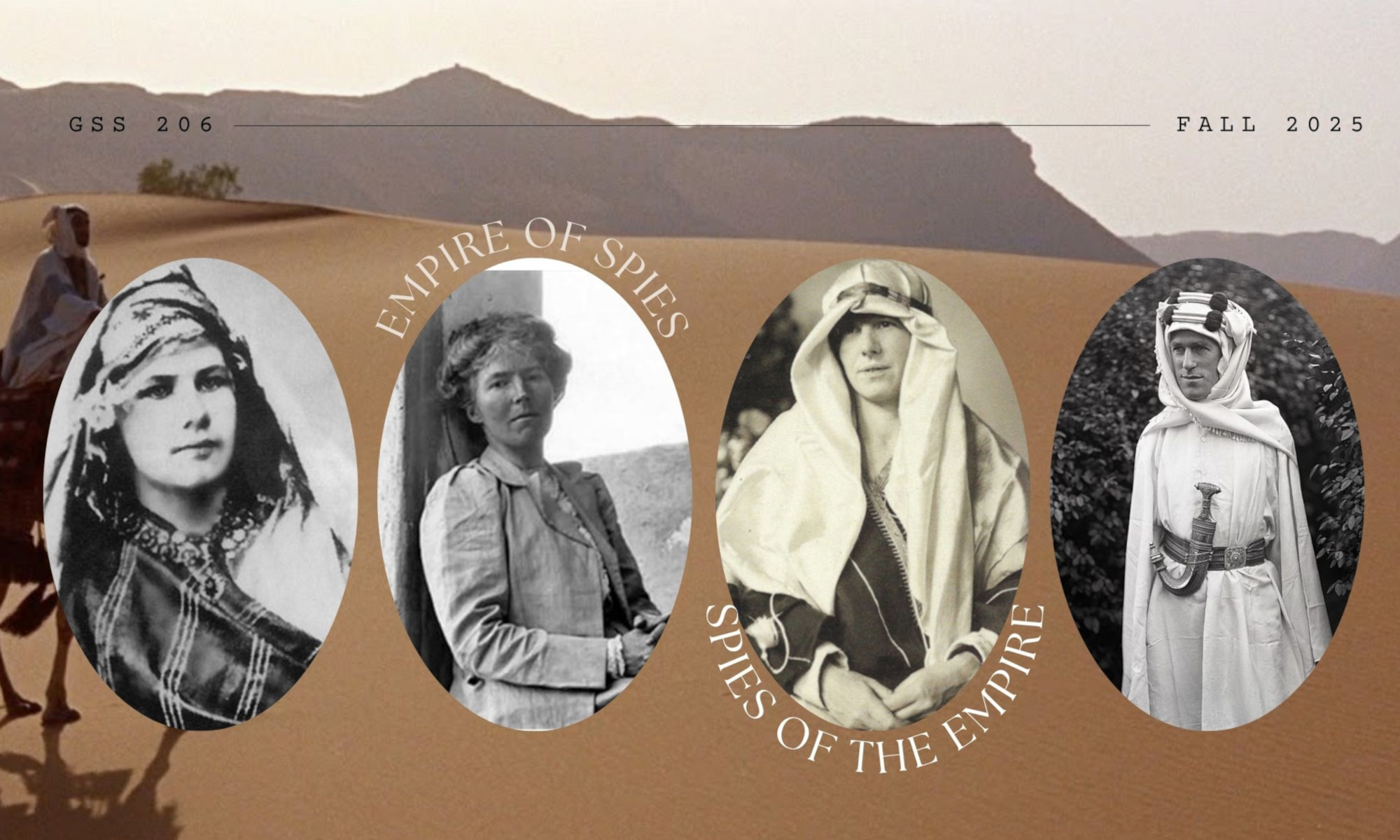
In class, I briefly made a point about the use of language in Queen of the Desert (in which most of the dialogue is in English, with only certain buzzwords, names, and greetings in Arabic or relevant Middle Eastern languages) and the use of Arabic in made-up languages in fantastical films based off the Middle East, such as Dune. Where does one draw the line between accessibility, exoticization, and authenticity? When Herzog’s Iran is as much a fantasy as Director Villeneuve’s Arrakis, what lends one white-made artistic vision credibility and the other condemnation?
After a bit of sleuthing, I found a New Yorker article, ‘“Dune” and the Delicate Art of Making Fictional Languages’ (https://www.newyorker.com/culture/cultural-comment/dune-and-the-delicate-art-of-making-fictional-languages?_sp=7e36c459-8134-41bc-9eee-8d6d99565401.1760207334616), which ruminates adjacently on this topic. In Dune, Arabic is the “language of greatest influence…[where the fantasy language] uses at least eighty terms with clear Arabic origins, many of them tied to Islam.” Amongst these words are, most notably, istislah (“natural law”), ijaz (“prophecy”), and names, such as shai-hulud (“thing of eternity”) and mu’addib (teacher). Strikingly, the word jihad, while present in the books, is excluded purposefully in the films, as not to perpetuate modern negative associations. The reasoning for these inclusions is unique; of course, the filmmakers thought it apt to pay tribute to the Middle East, but they also reason that Dune takes place so far in the future the language must have evolved beyond recognition, just as how English has evolved dramatically since Beowolf. There are some other stand-out lines from the article; particularly, when addressing the white-washing of certain characters, scholar Khaldoun Kheli states that “Arabs can’t be heroes…we must be erased.”
These two films hold an interesting dichotomy; Queen of the Desert is a fantasy of a Middle Eastern past, while Dune is essentially a fantasy of a Middle Eastern future. With a shared inspiration, the similarities and differences are fascinating. Both films deal with the colonization of the Middle East (perhaps subconsciously suggesting, though this may be a bit of a long shot, that a place only becomes accessible and relevant after a white man has stepped into it). Herzog’s film seems obviously fetishistic, while Villeneuve executes with more taste and tact. Both films suffer from White Hero Syndrome: Timothee Chalamet plays the world’s legendary prophet Lisan al-Gaib, and Gertrude Bell is bestowed the title of Umm al-Mu’minin (wife of the prophet) by King Faisal (how interesting that these are both Islamic epithets of the highest honor, which the narrative and history has bestowed upon white characters).
This projects onto a greater point of Orientalism, which characterizes the East as essentially a colonial fantasy. There is quite a depressing argument to be made here, which is that in the past, present, and future, the Middle East is imprisoned within the exaggerated imaginations of white creators. However, that may be too reductionist of a generalization to make in such short a post, as camel races did exist, Gertrude Bell was in fact named Umm al-Mu’minin, and the argument about Beowulf does make quite a lot of sense. Rather, the key definer seems to be about framing, rather than content. However, I am unfortunately running out of space — hopefully a commentator can take it from here.

I really like how you describe Queen of the Desert and Dune as two sides of the same fantasy, one reaching into the past, the other imagining the future. The part about framing instead of content really stayed with me. It’s not just about how “authentic” the Arabic sounds or how real the setting feels, but about who gets to imagine it and why.
Herzog’s choice to sprinkle in Arabic feels more like decoration than dialogue. It keeps the Western viewer comfortable while signaling “difference.” Villeneuve does the same thing, just with more polish. He borrows so much from Arabic and Islamic culture but removes the people behind it. Cutting out “jihad” says a lot (they want the aesthetic without the weight or politics that come with it).
Your last line about the Middle East being trapped in white imaginations really hit me. I think you’re right, the issue isn’t only how we’re represented, it’s who gets to tell the story in the first place, and who’s left out of that imagination.
I enjoyed your post, Catherine, and how it highlights the similarities between Queen of the Desert and Dune. I thought Dune was very much an Orientalist fantasy when I watched it, and it falls into the same “white hero” trap as other stories like Shogun and The Last Samurai. I think you were right in flagging the tension between a film’s accessibility versus exoticization. Dune is deliberate about this, seeking to have the feeling of an Arab world without the political, cultural, and historical implications of the real Arabic world. Comfort in using a fictionalized Arabic-esque language, without using real terms like “jihad”, is a very telling gesture. Dune stages a colonial fantasy where the protagonist masters the exotic world and is seen as a messiah figure, over any local people, a classic Orientalist trope. I like your point about the past versus the future – Queen of the Desert mythologizes the British Empire in the past, and Dune creates an imperial fantasy in an imagined future. In the Dune film as well, the imperialist Atreides family adopts the native dress of the exotic desert world Arrakis, just as T.E. Lawrence adopted Arab dress, which in class was criticized.
the politics of representation, and of circulation….really enjoyed the post and the comments it engendered from Sophie and Givarra. I wonder if you all are aware of the “Jihad Made in Germany” history during WW1? Since Germany was in alliance with the Ottomans at this time, it saw a strategic benefit to promoting the war agst the British and French in Islamic terms (jihad), so as to encourage a global Muslim uprising against the Allied powers it hoped to defeat (including amongst the Muslim troops)