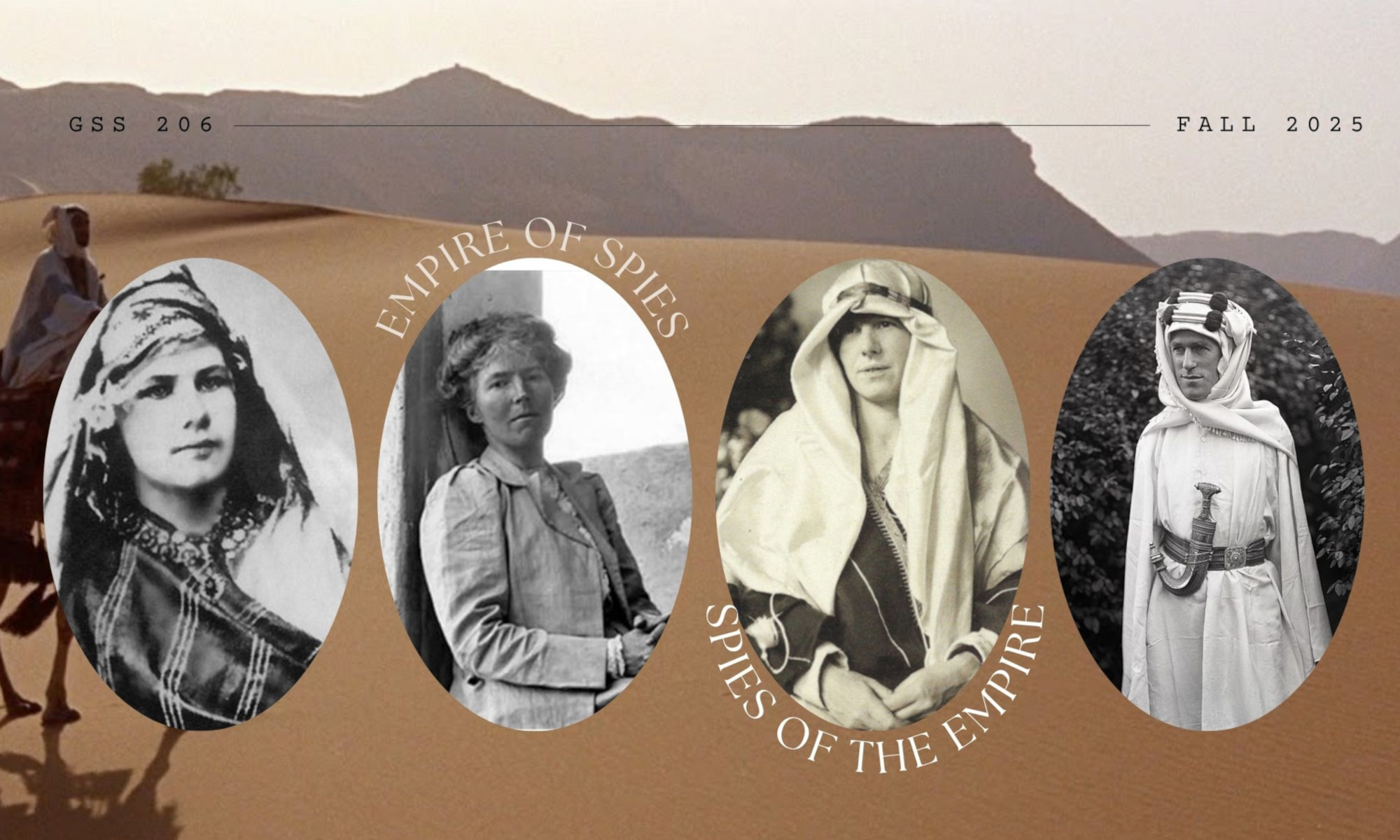
I must say, I love a good adventure, Isabella Eberhardt’s adventure however, while wild and exciting, left a confused and hyper romanticized legacy that left a bad taste in my mouth. In looking back at the readings and discussion notes for writing this post, I noticed two major themes along which our study of Isabella Eberhardt fell. The first theme was intentions and loyalties. Discussion of this theme revolved mostly around Eberhardt’s relationships with different people she came across, particularly, her relationship with the people of Algeria and her relationship with general Lyautey. While there is no definitive evidence which speaks to Eberhardt’s absolute allegiance to anyone but herself and the road, I believe that insight may be gained into her allegiances by analyzing two things. The first is Eberhardt’s own writings about topics surrounding the French and North African populations in both [INSERT TEXT} and [INSERT TEXT]. In [INSERT TEXT] she says “INSERT QUOTE”. Now, while this may have simply been an implication of Eberhardt’s personal admiration for Lyautey rather than her admiration for France’s colonial project, other evidence, such as her saying “INSERT QUOTE” on page [insert pg number] of [INSERT TEXT], suggests that she did, at least somewhat, buy into the French vision of North Africa, even if unintentionally.
The second thing that must be analyzed when attempting to decipher Eberhardt’s loyalties is her biographer’s outlooks on her journey. Now here, opinions do diverge, with some biographers, such as [THAT ONE COUPLE], who in my opinion were more so admirers than experts, claiming that Eberhardt’s allegiances were shifty, and that she was simply trying to survive wherever she went. [AUTHORS’ NAMES] appear to relay that Eberhardt was truly just a writer, a good one, and that if she was looped into French colonial projects, it was unintentional and cause by people taking advantage of her writings. For instance, on [insert pg] of their introduction, they say that Eberhardt “insert quote,” suggesting that Eberhardt was simply an innocent young adventurer trying to live out what she thought to be her purpose. These authors go on to build an what is, in my opinion, an overromanticized or maybe a glorified version of Isabella Eberhardt that focuses more on her allure as an adventurer than about the political motivations and implications of her adventure.
On the other end of the spectrum and just as essential to analyze when studying Eberhardt is [AUTHOR NAME]. [AUTHOR NAME] hints that Eberhardt was indeed mal-intentioned, saying things such as “quote” (cite) and “quote” (cite). These analyses, unlike those that came before, seem to build a more pragmatic version of Eberhardt that adopted the French cause intentionally, regardless of the reason. Since neither side presents definitive evidence, it is difficult to attach labels to Eberhardt, I find it difficult to believe however that someone with that many question marks around them and who has drawn so much attention across time is completely innocent of political involvement. Eberhardt was young, but she was mature and frankly, selfish, her decisions may not have been made in favor of any ideology, but in the pursuit of self-preservation, which for her may have meant walking on the edge between colonist and colonized.
The second, and in my opinion, equally important theme was Eberhardt’s nonconforming gender practices. Understanding how Eberhardt acted as a man and as a woman, what each gender meant to her and how and where each gender got her is crucial to understanding her person and positionality. One particularly odd thing that stands out about Eberhardt taking on a male persona in Algeria is that she is simply accepted! Even I did not expect that, I was pleasantly surprised but also wondered whether she was accepted because she was a traveller…would a local woman attempting to do the same thing be equally embraced? Both Eberhardt’s own texts and the films which we watched convey her complex understanding of herself as both man and woman. In many texts, including for instance [INSERT TEXT] she refers to herself using male pronouns. Additionally, not only is she addressed by others as Mahmoud, but she also has, as we discussed in class, a male gaze through which she looks upon other women! For example in [INSERT TEXT] she says “quote” (cite), indicating that she views Algerian women in what one might call a typical orientalist light (although to be fair it isn’t quite clear whether she feels this way about European women as well). The conception of herself as a male only in the public space and as female in private and sexual settings is fascinating and is actually a theme in feminist literature. By being male, she is able to access the inner circles of religious orders and society. She is able to freely engage in her hoodlum behaviour with little protest or outright shaming. I wonder however whether she loses a piece of herself in this way…
In the films, Eberhardt is also seen as both man and woman. In the documentary style reflection on her life, people, mostly men, reflect on her as a woman, but also seem to understand and respect the role she held as a man, reflecting the importance of both personas in her legacy. In the recreation of her adventures, she is seen as Mahmoud outside her home and Isabella inside (although the general still refers to her as Mahmoud). Her role as Mahmoud in the film reflects how she was able to form relationships her female existence would have otherwise prevented, specifically her odd relationship with general Lyautey and of course her relationship with many Sufi men.
Tying all of this together is Isabella’s existence as a writer. Through writing, or maybe for writing, she makes sense of herself and the world around her. Her relationships and her positionality, her goals and her past, and much more. We discussed the possibility of her writing being a production of information that categorizes her as a spy…I think that while this may be true, it was not her intention. I believe, because of the passion and colorful language with which she wrote about her travels, that Eberhardt genuinely had a love for the unknown. Whether she got taken advantage of or eventually served the French after losing purpose is a different story. Essentially, I don’t know whether she was a spy or not, and I don’t know that I particularly care…to me she was a woman who defied norms, which in some ways is “cool” but in other ways is genuinely stupid. She was the original Transcendentalist and I am not a huge fan of transcendentalism. She chose to live a difficult but eventful life, a selfish choice, but one that I suppose satisfied her craving for discovery.

Unfortunately, your selected quoted material did not transfer into this post—see above. Can you please add it in?
Nonetheless–a very enjoyable read, and as usual, you engage carefully with the readings and discussions, lighting your own path through the thicket! I appreciate your interest in her stories–id have liked to see some analysis of one or more of these that could have shed light on for eg, the theme of gender and/or sexuality—and i think your sense of fairness despite your dislike/disapproval of some of her life choices comes through. IE as a selfish traveler is an interesting take on her…though if she is also in pursuit of transcendance somewhat negates that, no? Also, what is the relationship of transcendentalism to Islam, particularly its Sufi variants?