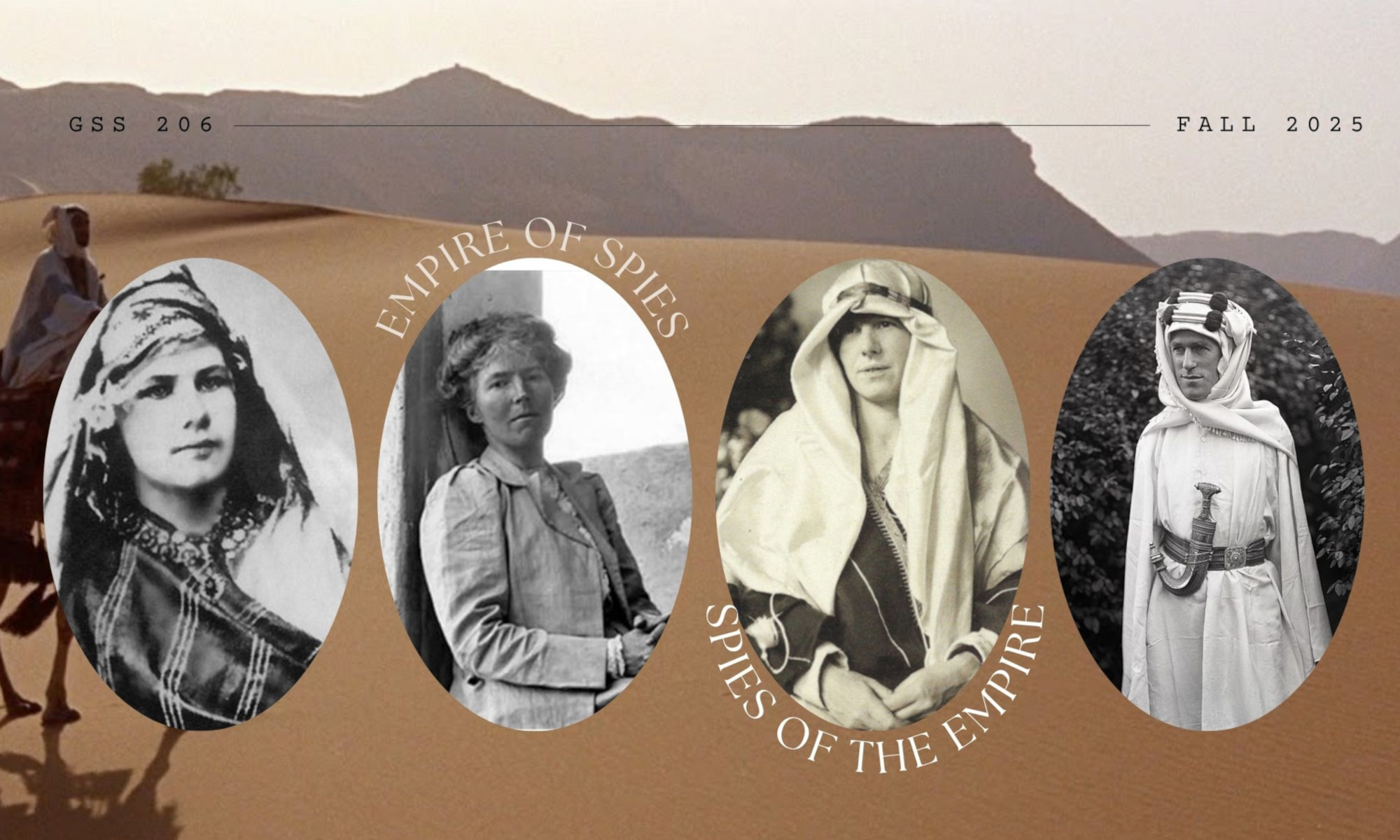
In the records of Isabelle Eberhardt’s life I find neither the vagabond nor the nomad she so fondly self-references. Instead, I find a woman at odds with her colonist’s background, yet who finds herself wedded to it again and again — no matter the landscape. This turn of events may have always caught Eberhardt by surprise, but its cause is really quite simple. A “nomad” must not only shed all attachment to the material forces around them (oppositional and otherwise), and, consequently, shed all loyalties. The spy, however, is a figure of multiple loyalties: their attachments not disavowed, but instead participated in with even more vigor than the common person. As such, a spy cannot be a vagabond, nor a vagabond a spy — no matter how much Ian Fleming’s romantic storytelling attempts to conflate the two.
Still, why does the role Isabelle occupies (spy) seem to correspond so frequently to the role she wishes to occupy (nomad)? The answer lies on page 213 of Julia Kristeva’s Powers of Horror.
“On close inspection, all literature is probably a version of the apoc-
alypse that seems to me rooted, no matter what its socio-historical
conditions might be, on the fragile border (borderline cases) where
identities (subject/object, etc.) do not exist or only barely so—
double, fuzzy, heterogeneous, animal, metamorphosed, altered, abject.”
It is important to understand that border enforcement, in the context of the nation-state, are largely a modern innovation. It draws on the colonial demand for dominion over the Earth, segmenting it into individual pieces that individuals or communities claim to “possess.” For many colonial subjects, the imposition of border regimes stoked more terror than direct violence from colonizers, as the false imposition of ill-defined borders led not only to violence from those meant to enforce them but also from the oft-disparate cultures and societies now forced to occupy the same “nation.” It is only in this world, where the horror of borders and their fragility is stark naked, that we can understand the blurring between Isabelle’s lived and desired roles.
Spies and nomads share one commonality: the ability to permeate borders. Nomads because they have unattached themselves from nation-states and all that they entail, and spies because they are attached to multiple of these colonial projects intending to redesign the world. Eberhardt, over and over again, confuses her ability to occupy the contradictory worlds of colonial Algeria as proof of her “nomadic” lack of attachment to the way of things. However, Isabelle’s ability and desire to occupy these worlds is a direct result of her many attachments — her eroticized fascination with Arab Islamic culture sublimated in her operative work for the French Empire. Unable to let go of either attachment, she finds a way to manipulate them in her favor: allowing her access to a “foreign frontier” all while refusing to renounce her colonial background.
The nomadic life she details living, then, is revealed to us: a tower of dust.

I really loved how you ended with “tower of dust” in regards to nomadic life because it really encapsulated how Isabelle Eberhardt argues about her own-self image of being a vagabond and nomad however neither being fully true. There is something so powerful and a bit sad about mentioning how Eberhardt longed to be a nomad was essentially incompatible with her being a spy entangled in power structures. Your use of Kristeva’s Power of Horror brought this into focus, the unsettling, fragile space of which identity begins to blurred like Eberhardt is exactly where Eberhardt was living in, her own shadow and fracturing mental and physical state. Her supposed freedom in Algeria and mixing with men was essentially an illusion, a “tower of dust” as you put it! I also was thinking about how this can be related to broader post-colonial condition, where traveling and transmovement can seem inspiring but underlying confinement and a lack of borders inclining to no roots. This made me question the narratives of freedom and self, what are the costs of crossing nation-states?
tough questions
A lot going on in your post Ayanna!
The fracturing of identities–personal and political–interests me a lot. I like that you underscore the paradoxical overlap of nomad/spy/man/woman/identity/abjection–as an allegory of borders. But Im not quite clear about how the apocalyptic nature of literature–as laid out by Kristeva–manifets in the written work of Eberhardt; would have been good to get some quoted details from one or more of her stories.