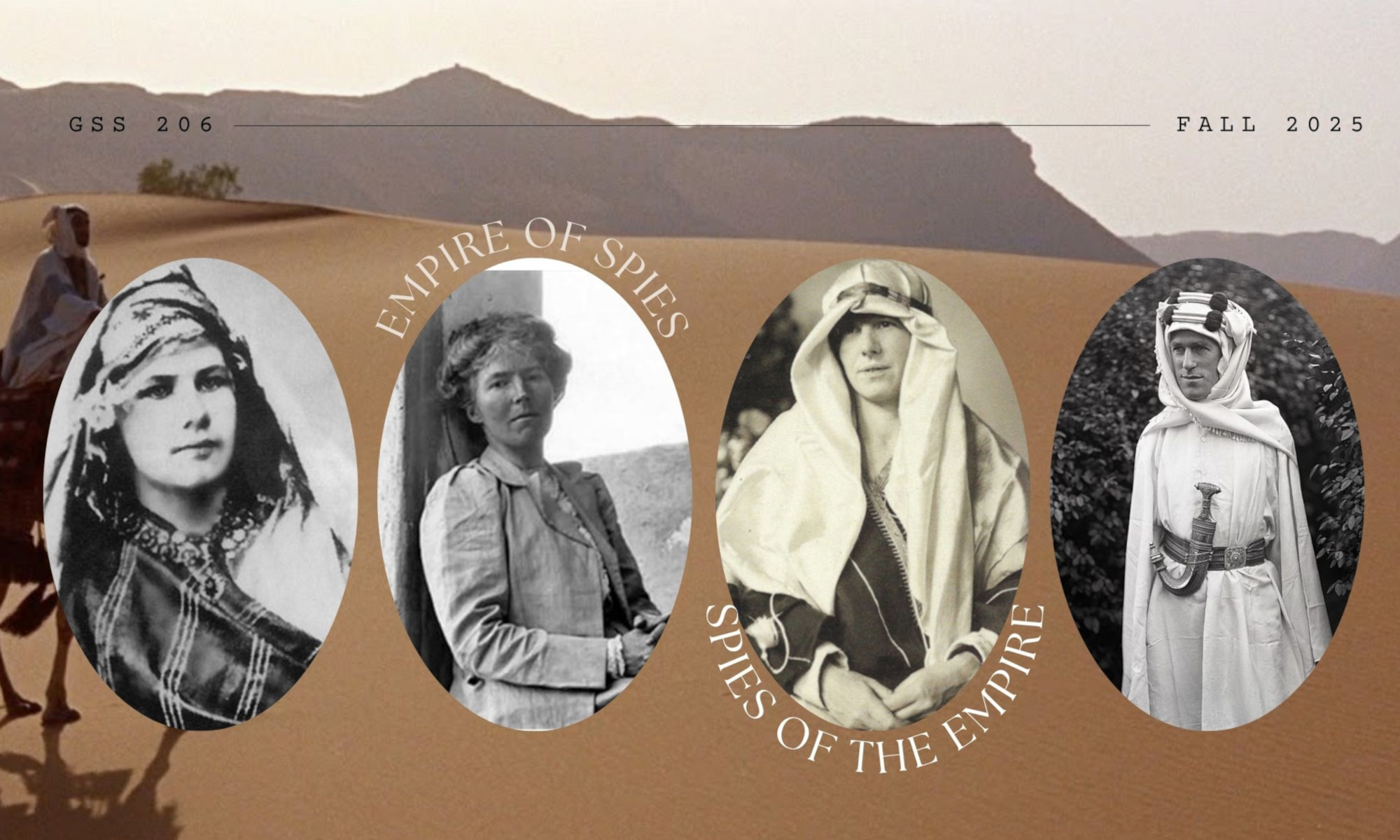
As a Kabyle-American, I found all of Eberhardt’s journeys quite fascinating. In a lot of the ways I’ve experienced and understood Algeria, she is transgressive if understood as a woman. While I use the pronouns “she” and “her” for Eberhardt, this is done only for linguistic clarity. I think her gender was far more complicated than just being a woman traveler in drag. Is it fair to even consider her a woman when her gender/religious/cultural expressions were entirely male? If Eberhardt is understood as a man, then really, all she did was not very transgressive. I think I’m inclined to read her this way because the very few times she refers to herself in her daily journals, masculine pronouns are used. So, she is then a masculine European figure, trying to (quasi-)disguise herself as an Arab. Once again, this is very surface level transgressive, and instead further reinforces what Mohamed Boudhan calls “France’s Arabizing function.”
Let me explain! “These Berber assemblies are tumultuous. Passions have free rein; violent, they often end in blood. However, the Berbers always remain protective of their collective rights. They defend themselves against autocracy by suppressing those who dare aspire to it. In Kenadsa the Arab theocratic spirit has triumphed over the republican confederative Berber spirit” (Eberhardt 307; Oranese South II). Essentially, Eberhardt establishes an ethnic hierarchy of her experiences in Algeria. The (often French-associated) Arabs act as enlightened Muslims, much better and more civilized than their primitive, Indigenous counterparts. While her fascination with Arab identity may be read as transgressive from a western lens, when Eberhardt is understood as someone in the lived reality of North Africa, she instead implicates herself with a fellow ruling, dominating class. She, as a native European, is understood as a qualified speaker on civilization, and she knows the Arabs have it where the Berbers don’t. It completely reinforces the French colonial tactic of dividing and conquering. Arabs and Berbers are SO different, and if you can’t be European, it’s much better to be a civilized Arab!
Despite the interesting and somewhat controversial history of Amazigh marabouts, Eberhardt associates this caste of people with Arabo-Islamic civilization. “The marabouts’ influence on Kenadsa has been so profound that Berbers and Kharantine have forgotten their languages, no longer using anything but Arabic. Their behavior has softened and become civilized” (Eberhardt 308; Oranese South II). Eberhardt then believes in a cultural/linguistic homogeneity, a precursor to the aftereffects of French colonialism on North Africa. While Eberhardt claims to be a neutral passerby on her journey to self-discovery in the exotic east, she claims to have “never played any kind of political role” (Bowles 87; Eberhardt’s letter to the editors of La petite Gironde). Yet, just a few sentences later, she admits, “whenever possible, I make a point of trying to explain to my native friends exact and reasonable ideas, explaining to them that French domination is far preferable to having the Turks here again, or for that matter, any other foreigners. It is completely unjust to accuse me of anti-French activities” (Bowles 87; Eberhardt’s letter to the editors of La petite Gironde).
Overall, Eberhardt is an incredibly interesting character, but perhaps for the exact opposite reasons western media lauds her as a transgressive, anti-racial, proto-feminist. To me, she is the perfect example of Europe’s ability to separate, class, and racialize their colonial subjects, as well as setting the stage for the postcolonial Arabization of North Africa. Eberhardt’s views were perhaps more progressive than the average European of the era, however, it wasn’t anything particularly revolutionary, despite how impressive her story was. Like Kabani says, “[Eberhardt] became a mouthpiece for patriarchy, voicing traditional male views on sex, culture, religion and politics” (Kabani ix). It’s like the kids say: fork was found in kitchen!

Fork was found in kitchen! Ha ha, just love that! This is a brilliant recap with careful engagement/attn to detail, and Im so happy to see you bring up the divide n rule aspect of what she sees as the (preferable) Arabic theocratic spirit vs the “confederate Berber spirit”–an early indication of how the elevation of theocracy itself–in different manifestations–was/is part of the colonial design in Muslim lands despite the West’s distaste and hostility to Islam.
Reading her as man–ie taking her identity games at face value–does reduce the allure or fascination of her drag persona—a quite interesting interpretation! But ofcourse, the ability to switch genders is a disguise mechanism, useful as a spy tool–even when everyone knows who s/he is. Curious whether you think her drag is a precursor to trans as a mechanism that allowed her to cross both (trans) gender and (trans) national borders.