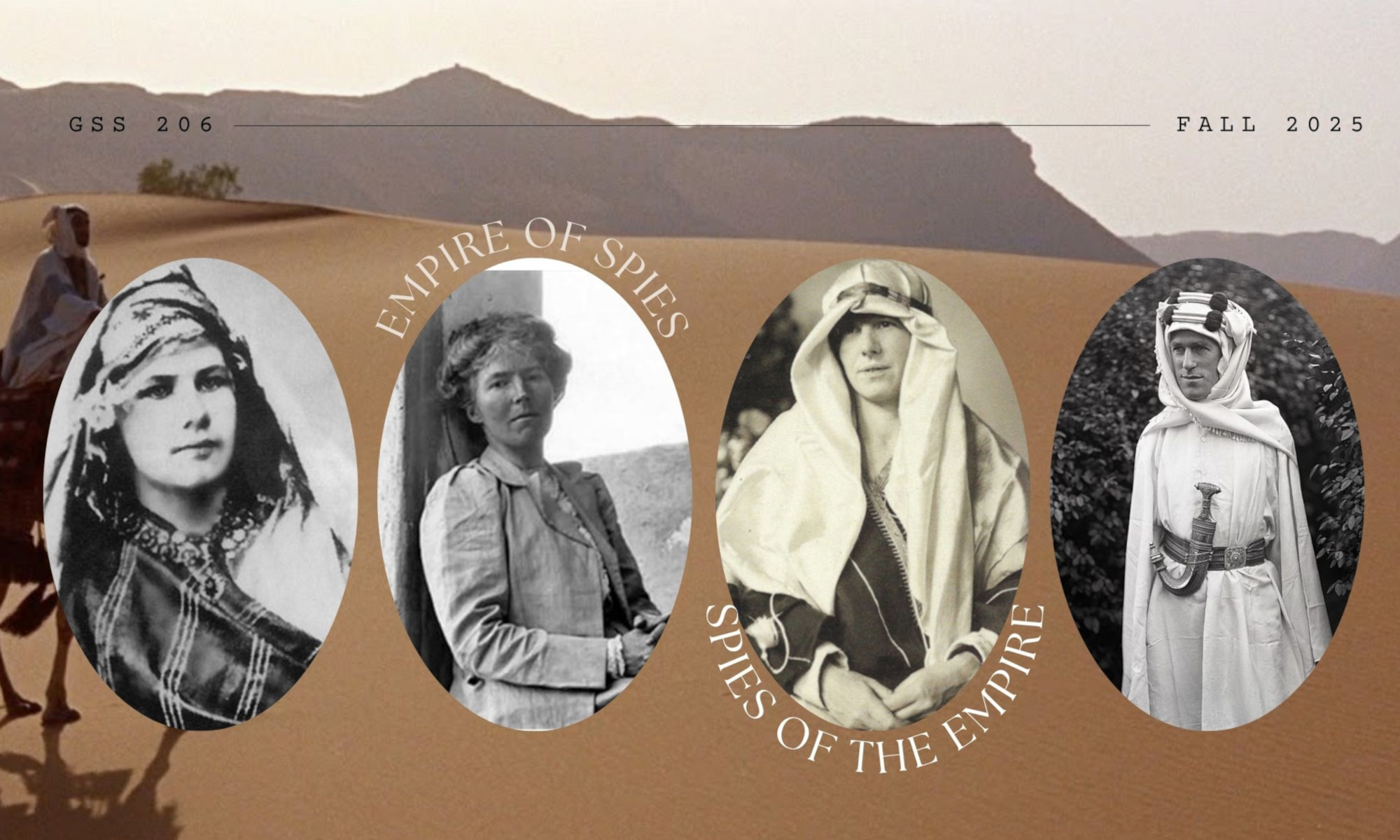
If I could assign this unit’s readings to anyone, I would assign them to my girlfriend Nikola. Her curiosity about Lawrence in Lahore sparked an interest in understanding the real T.E. Lawrence, but most portrayals present him as a mythologized hero of the British Empire. Our unit’s readings complicate that heroic image and provide a fuller sense of Lawrence as a complex, at times contradictory, figure.
A central text to begin with would be Seven Pillars of Wisdom, which reveals Lawrence’s contemplative voice and the internal contradictions he carefully constructs and performs. Pairing that with Raili Marling’s “Masculinity in the Margins” would show how Lawrence struggled to fully embody the masculine, heteronormative ideals of his era. Together, these readings would sharpen her understanding of the tension dramatized in Lawrence in Lahore, especially the gap between the public-facing, confident Lawrence and the private Lawrence, whose letters (including The Gay Love Letters of Lawrence of Arabia) describe shame, self-punishment, and discomfort with the heroic narrative imposed on him.
More broadly, reading about Lawrence, an accomplished figure, might make her feel empowered to leave her comfort zone and embark on “adventure”, as Lawrence himself did, and as a queer person, she would appreciate seeing how his time viewed homosexuality – a way of understanding the emotional cost of navigating queer identity within rigid imperial structures. Further, understanding empire from a different perspective (the British Empire, and its interactions with the Middle East), would provide insight on why this region remains unstable today, and a perspective outside of the typical Eurocentric narrative.
By studying Lawrence’s writings alongside biographies and media which re-interpret him, it becomes clear how imperial icons are constructed, edited, and continually developed for new audiences. Nikola often asks me how people “can be so stupid” as to fall for political cults of personality, and the Lawrence myth offers a concrete example of this process. His myth was manufactured and commodified during his lifetime by figures like Lowell Thomas, then posthumously spun by later biographers and filmmakers, who each built their own portrait of Lawrence to suit various political and cultural ends. Overall, I think that the Lawrence readings would be a compelling experience for her, and help her investigate questions about contemporary media and politicizing – and especially, how narratives are twisted and changed long after their creators are gone.

Fascinating perspective—and yes, I agree that we must share these myth-making processes with other readers and audiences as they help expose ideologies that underwrite our everyday belief systems which encourage us to look for and believe in “heroes” when in fact, we are all merely human. Which is not to say we should look to excuse the evil wrought in the name of Empire–but indeed, someone like Lawrence himself–perhaps due to his own complicated sexuality and positionality at the margins of his society–reveals through his self-fragmentation the possibilities of challenge to tradition.