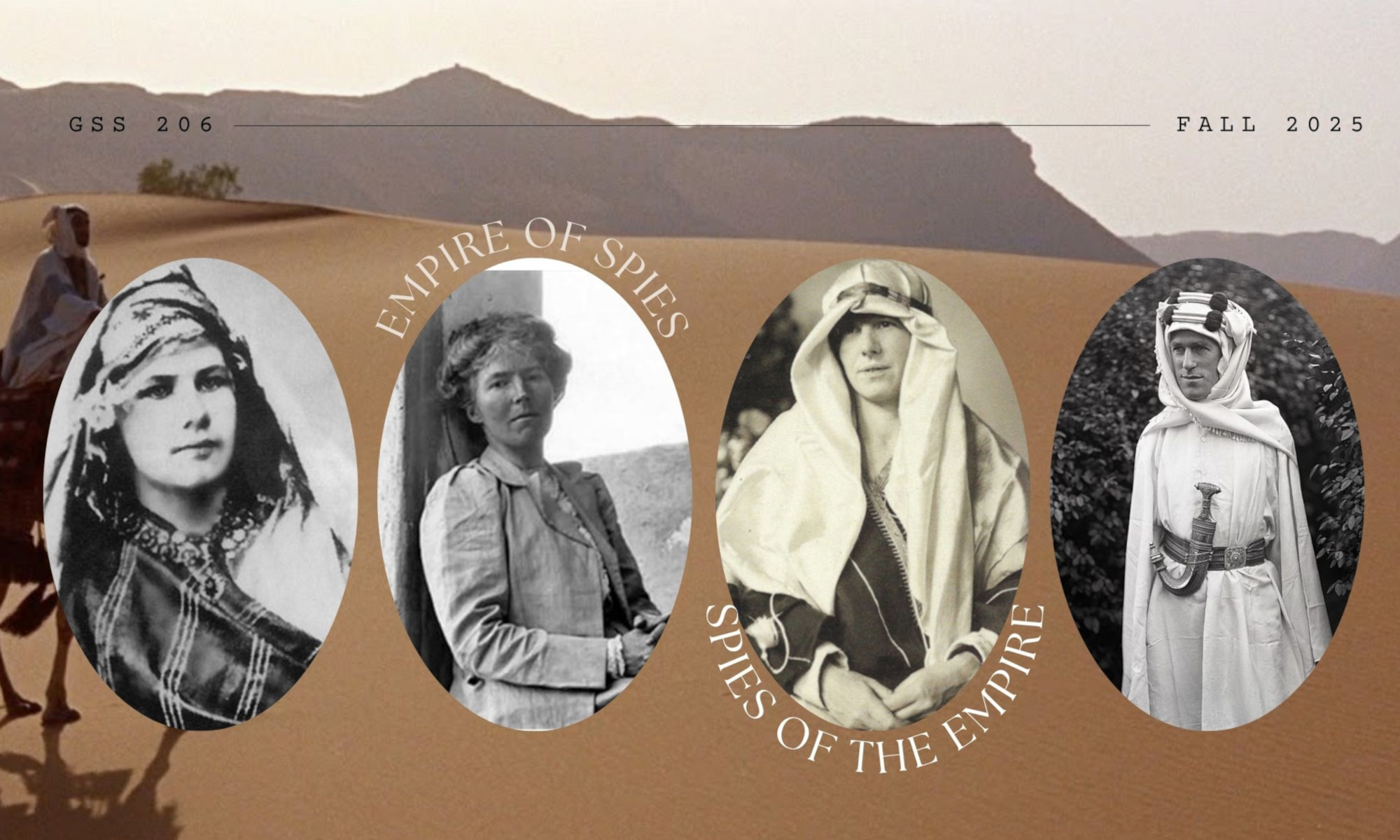
Over the semester, my blogposts evolved from a close reading to a gradual thematic overview of understanding espionage, identity, and travel writing and my own theological frameworks.
My writing overall became a culmination of the myths our historical figures have curated for themselves:
- In Bell: the myth of the courtier, the civilizing advisor, the indispensable “Major Miss Bell.”
- In Stark: the myth of the benign imperial wanderer, redeemed by feminine service.
- In Eberhardt: the myth of the vagabond outsider, a bird of perpetual flight
- In Lawrence: the myth of martyrdom and self-inflicted purification.
My earliest post on T. E. Lawrence centered on self-punishment and self-erasure. At first, I focused on Lawrence as a singular figure: a man fragmented by trauma, trying to remake himself through suffering. But even in that last piece, I began reaching beyond biography, linking his self-discipline to modern forms of identity pressure, even comparing it to the lives of university students. By the time I wrote about Stark and Bell, I was no longer treating personal contradictions as isolated oddities. As the course progressed, that reflex, to trace connections outward, became more intentional and structured. I learned to use individual cases to diagnose broader phenomena about empire, loyalty, narration, and gender. In the Stark playlist, I tried to think about the moral world Stark believed she was living in and what world she actually created. The musical curation forced me to think about tone, the environment, the emotional cadence and how these shape our perspectives in understanding a historical figure. In finding an image for Eberhardt, birds represented her well in her relentless freedom and seeing her as multiple pieces of a whole person brought internal reflection forward.
Some of my favorite ideas that have emerged have been feminine ethics of observation and the use of gender in diplomacy, birds as metaphors for fragmentation, spying as someone suspended between truth and myth, self-invention.
I would like to know more about the ethics of travel writing such as what responsibilities do figures have when representing cultures and when does it cross boundaries and what do those boundaries look like? What suffices? How would modern day spying shift conversations of gender, mobility, and sexuality working within political spheres?
Overall, this class made me go deep into the inner workings of state-building, helping recognize the ins and outs of political entities, but also letting me challege and questions the different stigmas, social work, and politics in play.

Not sure what you mean when you say that your “writing overall became a culmination of the myths our historical figures have curated for themselves”? Surely you mean to challenge these myths? Also am unclear what you are referring to when you mention your own “theological frameworks”?? id you mean “theoretical”? If so–what are these? Feminist? Psychoanalytic” Postcolonial?
I feel this was a rushed post–though i like that you are interested in exploring the ethics of travel writing moving forward.