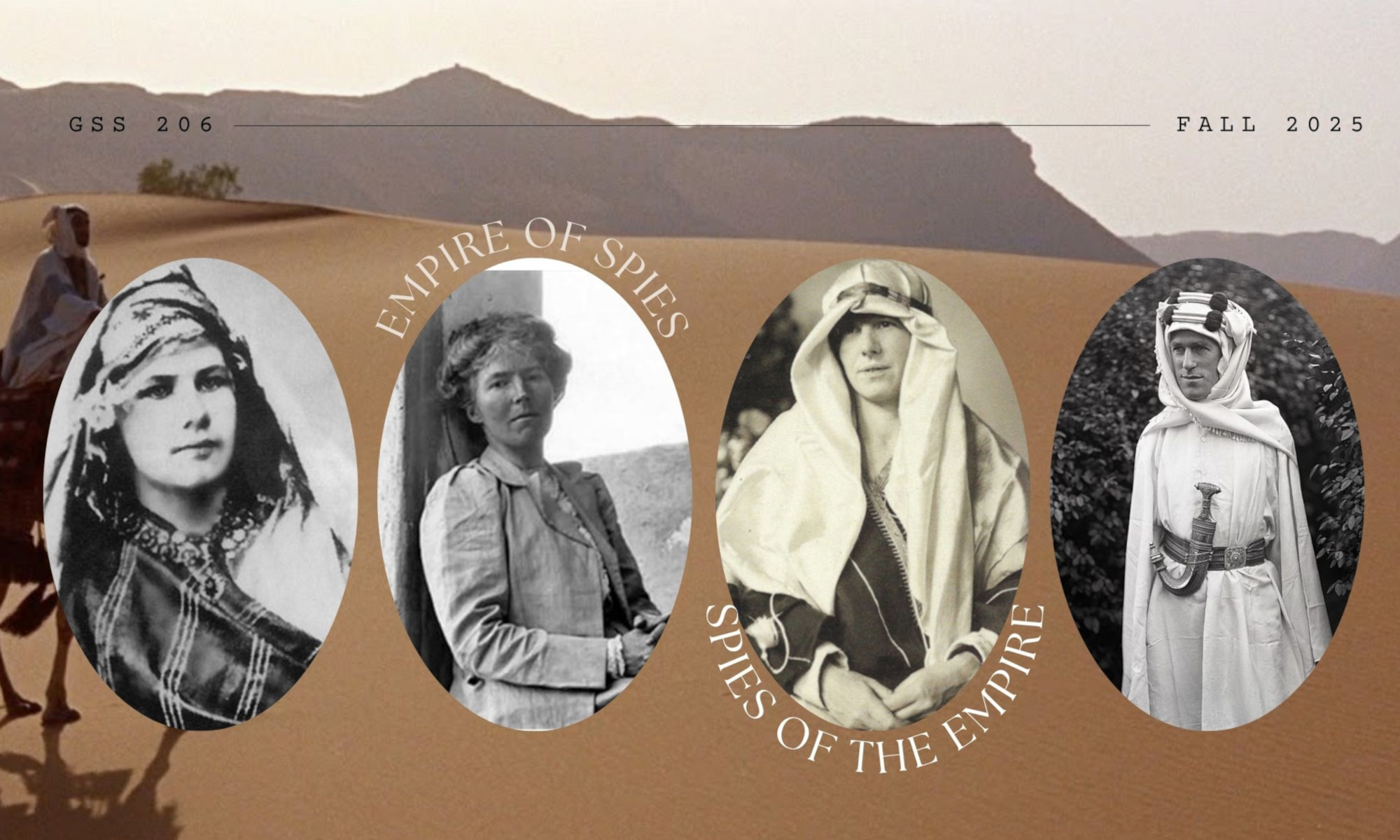
Freya Stark is the only one of the spies that we’ve studied that has had the ability to truly tell her own story. This is mainly because of the fact she didn’t die a tragic, untimely death like Bell, Eberhardt, and Lawrence. For both Eberhardt and Bell, their collections of letters were compiled by loved ones or family members (Florence Bell for Bell, and Victor Barrucand for Eberhardt). Since both of the women were dead, they did not have control over the choice or parts of letters that were selected for their books. Therefore, they were unable to control their own narratives. The same can not be said for Stark. In Beyond Euphrates, a story told through selected diary entries and letters, Stark picks and chooses what she wants to be read and seen by her audience. Furthermore, she comments on each of these excerpts, leading her audience towards a certain thought or belief. She is allowed to write her own story, to control her own narrative (though I’m sure others have many critiques of her (I know we have…)).
This follows the concept of “history is written by the victors”. While Stark is not necessarily a victor, she conquered not dying too young like her peers. It gave her the power to shape her public persona. Stark isn’t the only person or group of people to do it. After the Civil War, the Daughter of the Confederacy rewrote the textbooks to favor the Southern perspective (or rid them of any wrongdoing) that are still used today. Even though the women were unable to vote or had any “power”, they shaped the education systems in the south for hundreds of years. They changed the perception of the decisions made about slavery and other controversies during the Civil War by those in power in the South to be more favorable.
This power to shape your history or perception continues to influence the political scene today. As the government bans books, censors topics in higher ed, and defunds important research it is attempting to rewrite our history. We are allowing those in power to change our perception of reality and their view on history is becoming the accepted view. Trump forcing the Smithsonian to remove any exhibit or piece that would put the United States in a bad light is a prime example of reshaping the perception of the US. In allowing this, we are actively seeing our history be changed.
Freya Stark may have been one woman, but her continued legacy is a result of her ability to maintain control over how others perceive her. This idea is applicable to a wide range of situations, from the Civil War to current politics and we need to be aware of its power.

I really like how you linked Freya Stark’s ability to control her own narrative to modern day outcomes and thus controlling a broader historical narrative, it’s a great way to differentiate Bell and Eberhardt. I also think it’s interesting that her “victory” over not dying is still substantial, as she limits her own self through her own censorship, picking and choosing what to let the world know and feel. Her carefully constructed version is this humble servant of empire, and this pilgrim of faith. It fits within the postwar narrative of dignity and endurance from the British. I think Stark greatly reminds us of how narrative control can also be about selection, thus us selecting our own critiques of her.
I like how you connected Stark’s control over her own story to larger political tactics of shaping perception. Controlling the narrative has always been one of the most effective ways to control people. Whether it’s through censorship, selective storytelling, or rewriting history, those in power know that if you can shape what people believe about the past, you can influence how they act in the present. Stark might not have been a politician, but what she was able to do feels like a smaller version of that same tactic.
Excellent comments from Givarra and Nabiha; i dont have much more to add their responses–except to say that she was, ofcourse a victor in that she belonged to the side of the colonizing power, even as she critiqued it
I enjoyed how you brought in the example of shaping perceptions of U.S. Civil War history alongside Freya Stark’s extensive control over her own public narrative. Producing a high degree of content about oneself means you can fully shape your version of events. We must wonder about things Stark chose *not* to include. With museums, these are also important tools for shaping public perception of key events and figures, and many museums operate on institutional biases that favor certain cultures and “victors” in history. In that sense, Stark’s writings are her personal museum, and a bulk of analytical work on her draws from the museum she herself curated – if the curator is biased in favor of their own curation, what are the visitors to make of that?