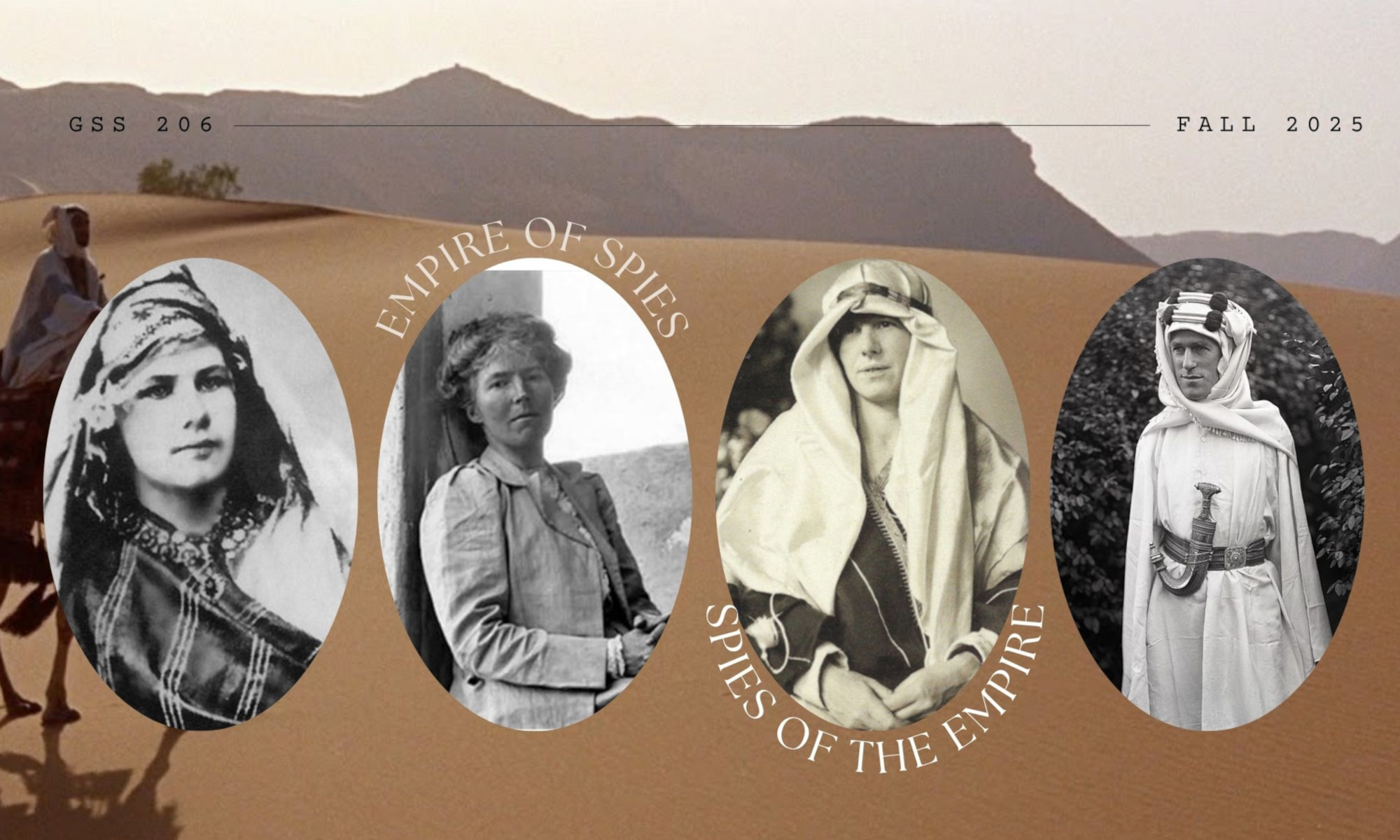
Intentions and motivations aside, the readings of the past three weeks have demonstrated that Gertrude Bell is nothing short of extraordinary. From the many occupations and areas of expertise she mastered to her role in shaping today’s Middle East and even her influence on TE Lawrence, Bell engraved her own name into history. Of course, we learn from Janet Wallach’s thorough account of her that Bell’s greatness was, to some extent, to be expected. After all, she was brought up in a generationally elite and educated family (Wallach 32) and was accustomed to the presence of the great socialites and academics she would later come to work with (Wallach 30, 39). From a young age, Bell was well versed in language learning, and soon, she became one of the first women to not only attend, but excel at Oxford (). However, what was not expected is her positionality as a woman posing so little hindrance to her climb up the British bureaucracy. While she did face some hurdles, from having to sit backwards in class (Wallach 48) to facing the demeaning comments and dismissals of Leachman and other colleagues on multiple occasions (Wallach 267) and even having to fight for an official position within the British intelligence order (Wallach Ch 17), Bell’s sheer expertise on the Middle East meant that once she broke these initial barriers, her climb to the top was smooth. So much so in fact, that Winston Churchill himself would come to rely on her knowledge ()!
And for good reason. Bell’s writings, from Persian Pictures to letters in which she extensively describes the peoples and geographies of Syria, Baghdad, and even areas of Europe, are clear evidence of her eye for detail and her unique aptitude for information gathering. In fact, Bell ends up producing detailed maps of what was Mesopotamia, maps which detailed tribal affiliations and public opinion of the British, that would become crucial in her later delineation of modern day Iraq ().
However, and this, I suppose, is what I have written my post to highlight, Bell’s consistent entitlement, whether earned like her positions and knowledge, or inherited like her wealth, meant that she had little sympathy for the struggle of other women, particularly when it came to political involvement. In other words, there is argument to be made that Bell’s scarcity of struggle in coming to power, and the amount of power she held, were the reason she said things like “”(), and was not a supporter of women’s suffrage or a respecter of more conservative women’s practices ()(). This is such an odd positionality. Unlike Eberheardt, Bell did not want to or pretend to be a man. In fact, she embraced her femininity, dressing in luxurious gowns and sophisticated hats (). Yet…Bell was not accepting of the beliefs and needs of other women, she was satisfied by simply being the woman who broke into a men’s world.
Despite this,we still see, like in the short videos and documentary clips we watched in class, many women praise Bell as a latent feminist, one who advanced the positionality of women through her actions and the achievements she showed were possible. Achievements which would earn her titles like Desert Queen and Maker of Kings…and, I suppose, that she was.

This take is so interesting. I think maybe part of what enables her dismissiveness toward other women is class—her massive familial wealth meant that she was afforded privileges other women would go all their lives without access to. I agree that the label of “latent feminist” is deserving of some dubiousness; she was actively anti-feminist during her lifetime, especially toward suffragists and Muslim women.
Yes, class is a important vector along which difference from other women gets enacted as a sense of superiority, of exceptionalism (I am different from other women, etc…)
The real question o ask those who see her as a latent feminist though–is what kind of feminism does Bell enable later? Id have to say that hers–whether she sees it or not–is a prototype for white liberal feminism that has served many atime as handmaiden to imperial missions (think, ore recently, Afghanistan)