Hello world!

Hello Students of Spies of Empire!

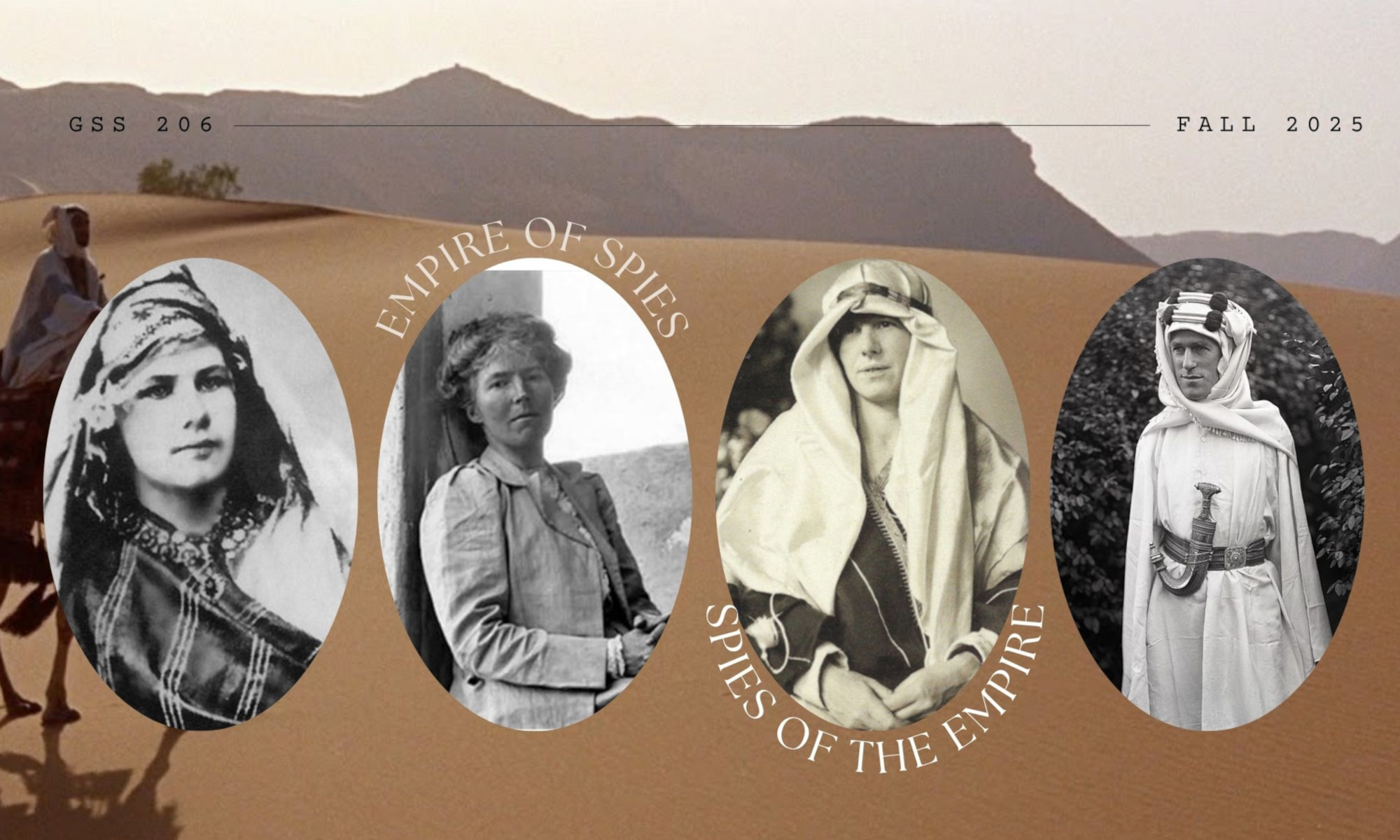
Lets have some fun interrogating the machinery of Empire as it reveals itself through the shenanigans of some of its more famous–or infamous!—writer-spies-archeologists-travelers: spies one and all!

We will think about what “spying” means” and whose interests it serves–and ask when it can be a force for good or evil, control or being controlled.

More to follow….for now, welcome to the course!

Am I a Spy? Is this an Empire? (Extra Credit Reflection)

On my first day of class, I remember reading the course code for the first time. My exact thought s were, “Huh, I wonder what GSS stands for?” As the room became full of woman, I quickly came to realize what it meant. I had never taken a gender studies class before. So, honestly, I was a little worried. However, after completing the class, I can confidently say it was a meaningful experience.

I want to start off with my biggest takeaway from the course. Due to this class, I will forever be more cognizant of how women feel in male dominated spaces. Perhaps unsurprisingly, I was the only man in our class. The class started off with three, but one guy couldn’t last ten minutes and the other was gone by week two. Then, we had Keletso, but we all know how that went. As the only guy, I often felt like my words and actions were under a microscope. There were multiple times where I refrained from speaking as I felt it wasn’t really my place. As a black man from Kentucky, I am used to being a minority in some capacity. Even still, this was a unique experience. While I know my experience doesn’t fully compare to what a lot of woman go through, it was close enough to make me more aware.

I also gained something from every spy we encountered. Eberhardt was such a free spirit. To some extent all of our spies were free, but let’s be honest, none of them were quite like Isabelle. When reading about her life, I felt called to adventure. It was so frustrating talking about her in class some times. I would think, “Why are we sitting here talking about this lady instead of going on a cool adventure? She would want us to go on an adventure.” As much as I adored her freedom, I never really envied her. She was clearly suffering from something. I wish I could have meet her. I think we would have been great friends, and I lowkey think I could have “fixed” her (This is 99% a joke, not sure it came across correctly over text). From Eberhardt, I learned to never let your circumstances stop you from making life an adventure. I also learned that I should definitely not get into smoking. Gertrude Bell taught me a very important lesson about religion. She made me realize that, more matter what they claim, everyone has a “god.” For Gertrude Bell it was her family and her country. Above everything else she worshipped those two things. This is a similar sentiment to everyone being a slave to something. The difference being that we willing and happily serve these vices. This lesson gave me a deeper understanding of how people’s actions. No matter how much someone says they love or will prioritize you, there is likely something most people will put ahead of you (just as Bell always placed Empire first). With Freya Stark, I learning about desire. I related to Stark’s pursuit of love heavily. While I am not personally chasing a relationship, I understand pursuing an objective only to fail countlessly. Experiencing Freya’s struggle brought me a weird sense of comfort. Finally, through T.E. Lawrence, I was taught lessons about fame. As someone who would love to be famous, I found Lawrence’s distain for fame peculiar. However, it made me think about the amount of responsibility people will place on you due to your notoriety. Suddenly, your words are no longer just good intentions and niceties, they are promises you must make good on. While I still want to be famous, Lawrence recontextualize the weight of the crown.

As for assignments, two stuck out the most: the play and the final. I won’t lie, I was not the biggest fan of our production. I felt awkward preforming and it was a stressful process. That does not mean it was a meaningless experience. Through the performance, I was able to engage with the material from class in a unique way. The script along with the actors’ mannerisms and delivery presented Lawrence and others in a particular way which informed my preconceived notions on these individuals. It was interesting to see how these notions were either reinforced or dismantled as I later engaged with the readings. On the other hand, I loved making my final video. Outside of just enjoying making videos, I really liked learning about Josephine Baker. In my opinion, she was more interesting than any of our other spies. Putting her and Lawrence in conversation with each other through the lens of their fame was a particular memorable exercise. My final video was the first time I felt as though I was able to fully buy in to all the aspects of the class.

Now, there are some overarching themes I want to touch on. Are we all spires? This question was brought up multiple times throughout the semester. While I now see it as a more respectable question, my answer is still no. I do not think “creating” knowledge is inherently espionage. Additionally, I think equating the type of knowledge I gather to say that of a journalist is reductive (to the journalist). While astrophysics is super interesting and actually very useful, it does not challenge systems in the same as journalism, film, politics, etc. Additionally, I want to briefly touch on the topic of Empire. While I do not think any of us really thought empire had fully come to an end, this class brought me to the realization that systems that essentially operate as empire are even more present than I initially thought. It also put into perspective just how close in history we still are to traditional empire. I urge you to remember, Freya Stark died one year before Toy Story.

One thing I wish we got to discuss in class is how modern “history” will be preserved. Whether it was autobiographies or letters, for all of our spies, there was a plethora of their own writing historians, biographers, and students can go through. After decades, these writings are essentially who Eberhardt, Bell, Stark, and Lawrence are in the modern day. I think about my generation and wonder how will we leave a presence for the future. While we don’t write letters there is obviously still social media, emails, text etc. But, are these really as representative as a collection of letters. Since the first day of my junior year of high school, I have recorded a one second video every single day. I have no intention of stopping. Even I still wonder, though, if someone could truly get a deep look at me as a person from these videos. Just something to think about.

Overall, I had fun.

Final Post: A Reflection

I’m very glad I enrolled in this course. The description stood out as unique, in that it wasn’t a conventional history class, and that it focused on four individuals. I think this was the most entertaining and fun course I’ve had so far because of the exciting topics we covered each week and the spirited discussions we developed together. Initially, my understanding of the course was that we would learn about each spy’s life and activities, and very quickly this deepened into an awareness that the course would address lots of interconnecting, layered aspects that are often not conventionally addressed when looking at historic figures and events – questions of internal motivation, struggle, psychoanalysis, tensions in the spies home environments that pushed them abroad, overarching imperialism that existed before and after their lifespans, and developed their worldviews, and the chief question of morality in espionage: can a spy ever be moral, or morally self-aware?

Why did Eberhardt, Bell, Stark, and Lawrence all deeply love the people they met and lived alongside, while also actively working against their best interests? I question too, how difficult it is to extricate oneself from a dominant empire that one is raised in, and how deep the dedication goes to convincing oneself (and others, and perhaps too in perpetuity through one’s writing) that you are on the right side of history, and that all of your surveillance, information brokering, and political intrigue has been really to help the empire help the local people – to bring some dream of stability and order and “civilization” to a perceived uncivilized place. Operating in this mental frame, which all four of them certainly grew up in, and the tension against their personal difficulties fitting into conventional society (three being confident, independent women in a man’s world, and one being a homosexual man in a heteronormative world), deepened the axes of conflict between individual and empire – they had to serve societies that oppressed them too, and they reclaimed some sense of power by participating in a grand machine (empire) that oppressed foreign peoples, because it validated their need to fit in, to contribute, to go on an ā€œadventureā€, to really write their names in the history books and be praised and remembered by their home society which very well might have otherwise discarded them and labelled them as outcasts, had they not turned their passions and obsessions with languages, cultures, writing, and travel to the art of espionage.

Before taking this course, I didn’t really understand what Postcolonial Studies were, or why it was a relevant academic shift to turn to postcolonial analysis. I feel that I’ve gained a significant understanding of what it is and the many ways it is highly useful and important to integrate into how we understand history, politics, culture, and other fields, both in the past and in the present. As we moved through the semester, I began to consider strongly the perspectives and voices (though suppressed in the Western corpus) of the ā€œother sideā€, that is, the people facing imperialism, and how it changes our interpretation of history when we seek to understand their history and context, rather than only the angle dominated by the colonizing force. I enjoyed how as a class we began linking the figures together, and thinking about similar motives and patterns that connected them, as well as critiquing them and the (often detrimental) long-lasting effects they had upon foreign peoples. I thought as well about contemporary imperialism and overreach, and how while imperialism today is not identical to the imperialism of the late 19th and early 20th centuries, it is very much still present, as is Orientalism (the fantasy of exoticising the foreign, and commodifying it). A lot of our topics intersected with film and TV tropes I had seen, with these fantasies of an imagined Arabia, Persia, Mesopotamia, which all collapse the moment you examine any real history.

Something too that stuck out to me was the concept that empire survives only when an ā€œotherā€ is invented from a real group of people, an ā€œotherā€ which must be civilized and converted, educated, changed, in order to fix them, and to perpetuate the economy, military, and cultural engines of the colonizing imperial state. The empire feels superior when it makes the ā€œotherā€ exist, and the empire remains superior when the ā€œotherā€ is forced to serve its ends. But our four spies interacted so heavily with the ā€œotherā€ that their empires named, and they seemed genuinely to be fascinated and drawn to them, learning their languages, reading their histories and classical literature, traveling everywhere, observing and partaking in traditions, trying to preserve artefacts, making maps, and documenting and photographing places no other Westerners bothered spending time with.

So then, I’m left with this… A whirlwind of a semester, and a lot of unanswered questions – but to me, this doesn’t feel like a conclusion. It feels like I’ve been equipped with a lot of frameworks, tools, and ideas with which to approach everything else. And for that I’m very, very grateful.

Beyond the Lawrence Myth: Gaining Insight into the Distortion of Narrative

If I could assign this unit’s readings to anyone, I would assign them to my girlfriend Nikola. Her curiosity about Lawrence in Lahore sparked an interest in understanding the real T.E. Lawrence, but most portrayals present him as a mythologized hero of the British Empire. Our unit’s readings complicate that heroic image and provide a fuller sense of Lawrence as a complex, at times contradictory, figure.

A central text to begin with would be Seven Pillars of Wisdom, which reveals Lawrence’s contemplative voice and the internal contradictions he carefully constructs and performs. Pairing that with Raili Marling’s ā€œMasculinity in the Marginsā€ would show how Lawrence struggled to fully embody the masculine, heteronormative ideals of his era. Together, these readings would sharpen her understanding of the tension dramatized in Lawrence in Lahore, especially the gap between the public-facing, confident Lawrence and the private Lawrence, whose letters (including The Gay Love Letters of Lawrence of Arabia) describe shame, self-punishment, and discomfort with the heroic narrative imposed on him.

More broadly, reading about Lawrence, an accomplished figure, might make her feel empowered to leave her comfort zone and embark on ā€œadventureā€, as Lawrence himself did, and as a queer person, she would appreciate seeing how his time viewed homosexuality – a way of understanding the emotional cost of navigating queer identity within rigid imperial structures. Further, understanding empire from a different perspective (the British Empire, and its interactions with the Middle East), would provide insight on why this region remains unstable today, and a perspective outside of the typical Eurocentric narrative.

By studying Lawrence’s writings alongside biographies and media which re-interpret him, it becomes clear how imperial icons are constructed, edited, and continually developed for new audiences. Nikola often asks me how people ā€œcan be so stupidā€ as to fall for political cults of personality, and the Lawrence myth offers a concrete example of this process. His myth was manufactured and commodified during his lifetime by figures like Lowell Thomas, then posthumously spun by later biographers and filmmakers, who each built their own portrait of Lawrence to suit various political and cultural ends. Overall, I think that the Lawrence readings would be a compelling experience for her, and help her investigate questions about contemporary media and politicizing – and especially, how narratives are twisted and changed long after their creators are gone.

Examining an Archaeologist – Freya Stark’s Actions in Luristan

Excerpt from The Valleys of the Assassins by Freya Stark, p. 47:

I bought the jar, collected the skull — which broke into pieces in my hand and required careful packing — and came away none too pleased with the morning’s result, for I had hoped for a grave of the Bronze Age, and it was now quite useless to expect the tribe to dig again. Their misgivings as to the permissibility of carrying away people’s bones had been allayed by the fact that the skeleton had obviously not been laid in the direction of Mecca; but they were still nervous about the Persian law of antiquities, which has brought punishment for illicit dealing in bronzes on to several of the tribes. The government occasionally send spies and then get the chiefs to pay fines, and are really making praiseworthy efforts to save what is left of the graves in Luristan. I knew that what I was doing went directly against this law: but there were some extenuating circumstances.

My rewrite, changing from first to third-person:

Stark purchased the jar and collected the ancient skull, which came to pieces in her hands. She packed the fragments carefully away and regarded the morning with an air of disappointment. She had hoped to find a proper Bronze Age grave. Furthermore, she was fully in the belief that the tribe would not excavate again, despite the richness of archaeological potential here. They were displeased with the idea of walking off with human remains, though they were placated somewhat with the finding that the ancient skeleton had not been faced towards Mecca. Yet the tribesmen remained nervous about the Persian antiquities law, which had already punished several tribes for the blackmarket trading of bronzes. Now, the government did, on occasion, dispatch spies and force the tribal chiefs to pay fines – a noble effort to save the remnants of the Luristan graves. Stark was rather aware that her own actions were in violation of the antiquities law, but she had her reasons. The circumstances justified it.

The effect of the changes:

By removing the passage from Stark’s own POV and voice and shifting it into novel-style third-person narration, the rewrite distances the reader from Stark’s personally-motivated justifications and broadens the scope of issues addressed: placing more weight on the antiquities law, local tribes, and the ethics of archaeology, rather than on Stark’s desire to make archaeological discoveries from the perspective of an outsider. The narration preserves Stark’s private thoughts and attitude towards the activities and the tribes, but leaves to the reader to judge whether she is correct. The final line, ā€œThe circumstances justified it.ā€, is a more terse rewrite of ā€œbut there were some extenuating circumstancesā€ (and from later in the paragraph, ā€œI felt that one was justified in trying to discover as much as possible while one was on the spot.ā€). By stating this in a factual tone, the narration appears to agree with Stark, but the overall tone is critical.

When reading texts in the first-person, it is hard to divest oneself from the internal narrative of the author. Inherently, such texts are more personal, more emotional, and we identify with the human fears and desires of the writer. By removing a text from the first-person, the same emotions and internal dialogue can be captured, but the reader is empowered in a heightened sense to question each character encountered. While Stark remains the main character of the passage, the reader wonders about her affect on the others present, and if this rewrite had a broader scope, the reader would also be able to criticize or root for other characters beyond Stark, and gain perspective into their motivations and feelings about situations Stark engages with.

Final Blog Post

My biggest takeaway from this class, I believe, is a more nuanced and comprehensive understanding of historical figures and historiography, particularly in the imperial/colonial context. I can’t say I’ve ever before spent so much time deconstructing the kinds of narratives I’ve taken for granted since childhood—the intrepid, mystical traveler, like Eberhardt, or the fierce woman kingmaker, like Bell, or the prodigal soldier in a strange land, like Lawrence. When we began, with Eberhardt, I was ready to dig in and take apart her approach to Algeria—and while I did find some elements of her behavior and worldview to criticize, I also realized that I needed to be more generous with her, since her story, especially in its transgressions of class, race, sexuality, and gender, also carries terrific revolutionary potential. I was stunned, too, by how beautiful I found her writing, even when it glossed over the Northern African political climate of her time or hid her sometimes-condescending view of Arabs.

In some ways, I was more inclined to appreciate Bell, since she at least was a straightforward imperialist. In the same way I was surprised by how much I appreciated Eberhardt, however, I was surprised by how little I appreciated Bell. Her accomplishments, impressive as they were, meant little to me, and I found her personality and writing uncompelling. Still, it was enlightening to learn just how much of the historical processes I tend to assume just happen, like the ascensions and descents of certain figures, or the emergence of certain groups, could actually be engineered by someone like Bell. It’s put me on the lookout for manufactured events now and in my studies of history, and it’s made me more careful in how I talk about how past events came to be.

While I admired Stark’s writing style more than Bell’s, I found her, in a lot of ways, a weaker version of her. Especially in her case, I was struck by how nonlinear political/historical trends can be; her logic of anti-Zionism in her letters and US tour was not unlike current arguments against Zionism in lots of ways, even though Zionism persists today. I appreciated that Stark wasn’t aristocratic or classed in the same way Bell and even to some extent Lawrence and Eberhardt were; it made her feel more real, and in a way more approachable. She was also the only spy who wrote about the other spies (Lawrence and Bell), which I found fascinating—I liked seeing what she thought of their history, since she was so much closer to it in time than I could be.Ā 

As for Lawrence, he really made me think critically about how historical narratives are formed, and how historical characters are just that—characters, and not necessarily accurate reflections of real people. Mousa’s work was especially interesting in this regard. I knew that history as I knew it could be inaccurate, but somehow, I saw the historiographical process as something that just happened, not as something influenced by the character of the very historical figures it follows, as with Lawrence’s work in forming his history to his desires. Prof. AK’s interventions, too—allowing us to remember why we can be so attracted to the myth/story of Lawrence, and making sure we understand why/why that is fine but also worthy of investigation—helped me form a skeptical view of history that didn’t totally disregard the attractions of conventional historical narratives.

Final Blog Post :)

If I’m going to be completely honest, I was completely terrified coming into this semester. The topic was very intriguing (it’s spies who wouldn’t be intrigued) when I was looking at it on the course registrar but the whole small class, totally new topic was very intimidating. I also didn’t originally get it on my schedule, which means I didn’t come to the first class (I was extremely confused during second class to be honest). I also didn’t read the ā€œTHRā€ so I was shocked when I learned that there was an acting element.Ā 


However, everything turned out to be okay, actually quite eye opening and perspective changing. Even though I lived in the Middle East for a majority of my childhood, I did not learn anything about the history of the Middle East. I really enjoyed being able to do this in the class. I also really like the set up of the class and how our discussions would go down rabbit holes on occasion. Not only were they interesting but also very funny (e.g. hating on the various spies). I loved our class blog. It was a really nice way to wrap up each spy. It allowed me to really sit down and think about all the stuff we discussed in class and finalize my thoughts. I often chose creative prompts like imagining a day with Gertrude Bell and doing a yelp review of Theeb because they are such an interesting way to think about the people we studied. I also think that the class and the creative assignments are a break from a lot of Princeton assignments. Labs and papers can be very serious and so being able to have these blog posts are very refreshing. I also enjoyed reading everyone else’s blog posts and seeing their creativity and opinions. Sometimes it’s hard to see what everyone else thinks in class (there’s only so much time) so being able to read it is very nice!Ā 


I would say that my favorite part of the class was the play. The rehearsals were hilariously chaotic and unorganized and I enjoyed all of it. I loved being an Arab brother with Salma and jumping out of the ā€œwindowā€ more and more aggressively every time. It also helped me connect to the material in a different way and connect to the class better. I think our in class conversations got better after the play. We were more comfortable with each other and I felt more comfortable speaking! I am so glad I took the leap and took the class because I’ve learned so much and met so many truly amazing people.

Final Reflection? Final Blog Post?

When I decided to write about Isabelle Eberhardt as a “nomad” at the beginning of the semester, I was still preoccupied by questions about goodness (and maybe colonial self-definition). What I wondered was along the lines of: how can Eberhardt escape her colonial positionality through desire? Is her identification with Arab Islamic culture genuine or just another form of appropriation? I spent the entire post wrestling with whether the nomad and the spy could coexist, and genuinely puzzling over whether her attachments were proof of complicity or evidence of something more complex at work underneath the waves. Looking back now, I realize I was trapped in the same framework as Eberhardt herself when she wrestled over her identity in Algeria: implicitly positing via my argumentation that individual intention could transcend the material reality of empire.Ā 

Yet, a shift happened somewhere between Bell and Stark specifically, I believe, with our discussion of Herzog. Discussing a figure who fell so firmly into an imperial stereotype yet also commanded the respect of those around her, Arab and non-Arab alike, I think I started realizing that ā€œgoodnessā€ or intentionality couldn’t truly capture what was at play in her imperial exploits. With Bell, I began not just to see how narrative forms operate as colonial technologies, but to also treat them with the urgency required in a world order saturated with them. For example, I realized Herzog’s Queen of the Desert succeeded at what colonial craft is designed to do: orient the viewer, create messianic figures, and turn the traditions of colonized peoples into narrative fodder. In such an analysis, drawn from FNT’s criticisms of “craft,” I was not inquiring as to whether individual colonizers were good or bad. Instead, I was asking how the structures they belonged within function: how they produce certain subjects, certain narratives, and certain ways of seeing that make empire inevitable.

By the time I wrote about Stark and Lawrence, I think I’d fully moved into analyzing the material mechanisms of colonial narrative production. With Stark, I experimented with a counter-perspective not to redeem her but to expose what her original narrative structurally excludes such as reciprocity, the possibility of being equally known by colonial subjects, and the colonial asymmetry of travel writing. With Lawrence, I traced how imperial narrativization operates as an obliterative force, the flattening of his fragmentation all served the empire’s material needs. The question I asked this time around wasn’t whether Lawrence was complicit (yes, duh) or whether he felt bad about it (probably) because ultimately, those questions are not helpful in understanding what Lawrence did to Arabia. The question I asked this time around was about how the empire required him to be mythologized differently than Bell, Stark, or Eberhardt because he carried different symbolic weight. This had nothing to do with anyone’s individual goodness and everything to do with how imperial narrative machines function.

What I understand now, looking across these four posts, is that my initial focus upon individual morality was a distraction from actually understanding Empire. The spy figures we studied this semester were all caught in structures that exceeded them, formal mechanisms that shaped what they could write and how they would be remembered. My thinking moved from asking “were they good people?” to asking “how do these structures work, and what would it take to actually betray them?” That shift from individual judgment to structural analysis feels most pertinent in tracing not only my intellectual development this semester, but also in doing the sort of analysis that is useful to the decolonial project as a whole.

P.S. I’m sorry but I hope this can apply for extra credit too…sorry…thank you for the lovely classes!!!!!Ā 

Lawrence, Empire, and the Violence of Mythmaking

There’s a peculiar paradox that stood out to me in our discussion of T.E. Lawrence compared to his female contemporaries in colonial exploration such as Gertrude Bell, Freya Stark, Isabelle Eberhardt. Lawrence seemed most opportunistically positioned, the spy in the right place at the right time, and yet our discussions of him always required going back to the myth of Lawrence. While the women in our texts are frequently discussed not as cultural figures but personal ones (i.e. the forewords to their letters), Lawrence has been calcified into a central figure of the long-lost “Orient,” and as such cannot be discussed outside of this myth. More accurately, if one seeks to discuss the “real” Lawrence, you must first navigate the myth of Lawrence—which is likely to leave you with more questions than answers, after all. It is important to understand that this is a buy-in Lawrence makes to some extent in his lifetime. This narrativization was not a choice made posthumously by stuffy Oxfordites, but rather one he consciously played into on some levels, and was haunted by on others. The result? Lawrence of Arabia: the unified hero, the sovereign self, and ultimately the kind of man who traded in certainties of the imperial hours. The imperial narrative required him to be more than human, and in doing so, made him less.

This is where the critical work on masculine autobiography becomes urgent, particularly Leigh Gilmore’s observation about how men are framed as “autonomous individuals with inflexible ego boundaries who write autobiographies that place the self at the center of the drama.” This framework isn’t just embedded throughout our depictions of male self-reflexivity. It’s also essential to colonial narratives that desperately need for self-maintenance. In essence, empires require their male heroes to be monuments, not men (especially if in the vein of Greco-Roman tradition). It required them to embody unified selfhood because fragmentation, doubt, and relationality would undermine the justification for colonial authority.

But as Marling notes, this “inflexibility of male ego boundaries” is a cultural ideal, not a cultural reality. The obliterative force of imperial narrativization reduces Lawrence to this ideal rather than allowing him to exist as he actually wrote himself: fragmented, anxious, and ambivalent about his role in the Arab Revolt. The Seven Pillars of Wisdom is not the confident autobiography of a unified colonial subject, regardless of its publisher’s intent; it’s far more nuanced. While Lawrence (or maybe even his publishers) attempt to dress the book in the garb of imperial wisdom, the images of violence he can’t help but return to (such as the torture of a prisoner) haunt him. Like all our other spies, Lawrence is implicitly responsible for furthering the European colonial project. But he, perhaps, is something even more tortured: an imperial figurehead. Thus, the imperial project couldn’t afford readings of The Seven Pillars that account for the nuances in Lawrence’s thought. In 1922, exhausted and disappointed by the outcome of the Arab revolt, his friends encouraged him to write an abridged version of The Seven Pillars to secure income. What was left out of this subscriber’s edition was a foreword in which Lawrence discussed his heartfelt shame in the Arab Revolt’s betrayal by colonial powers and his own contentions with his complicity. The fact that so few copies of this chapter remain in existence that the last one was auctioned for Ā£65,000, exactly a 100 years after its publication says much about the crafting of Lawrence’s literary persona. Namely, that (in the West, at least) it needed Lawrence the myth more than it needed Lawrence the person.

Women in colonial spaces are implicitly condemned to subversion: they can be eccentric, complex, even contradictory, because they aren’t carrying the symbolic weight of the empire itself, unless representing its virtue or fragility. They are exceptions to the rule, which expects female subordination to the maintenance of the colonial empire at home or on the settlement via childcare, housekeeping, etc. but never intellectual and physical participation. No easy mythological narrative can be bound together from these contradictory shards of their lives. But Lawrence was not subject to these stereotypes to such a degree, and thus his identity had an ability to be rendered “coherent” even if through false pretenses. He had to be the hero. His narrative had to be one of mastery and certainty because the alternative—a British officer colonized by doubt, unable to maintain the boundaries of his own selfhood, victimized by sexual violence yet reenacting it in order to somehow shed himself of guilt as the assaulted and as the colonizer—would have been a dangerous admission that the men running the empire were as fragmented and uncertain as everyone else.

To read Lawrence with attention to fragmentation and ambivalence is to resist that obliteration. It’s to recognize that the myth of unified masculine selfhood was always a lie that served the empire’s purposes, not a truth about how men actually experienced their lives or wrote their stories. If one seeks to discuss the “real” Lawrence, you must first navigate the myth of Lawrence. But is it a greater boon or tragedy that Bell, Stark, and Eberhardt were never afforded myths in the first place? They were allowed complexity by default because they were never expected to be heroes. Lawrence’s fate, and the fate of masculine figures within the project of imperial mythmaking more broadly, is simple: to be chosen as a hero means losing the right to be understood on human terms. It’s a trade-off, as unsettling as it is to make.

Okay, now that that’s done: mandatory viewing material…Lawrence/Ali edit to Olivia Rodrigo…do you guys feel the love!!!!!!