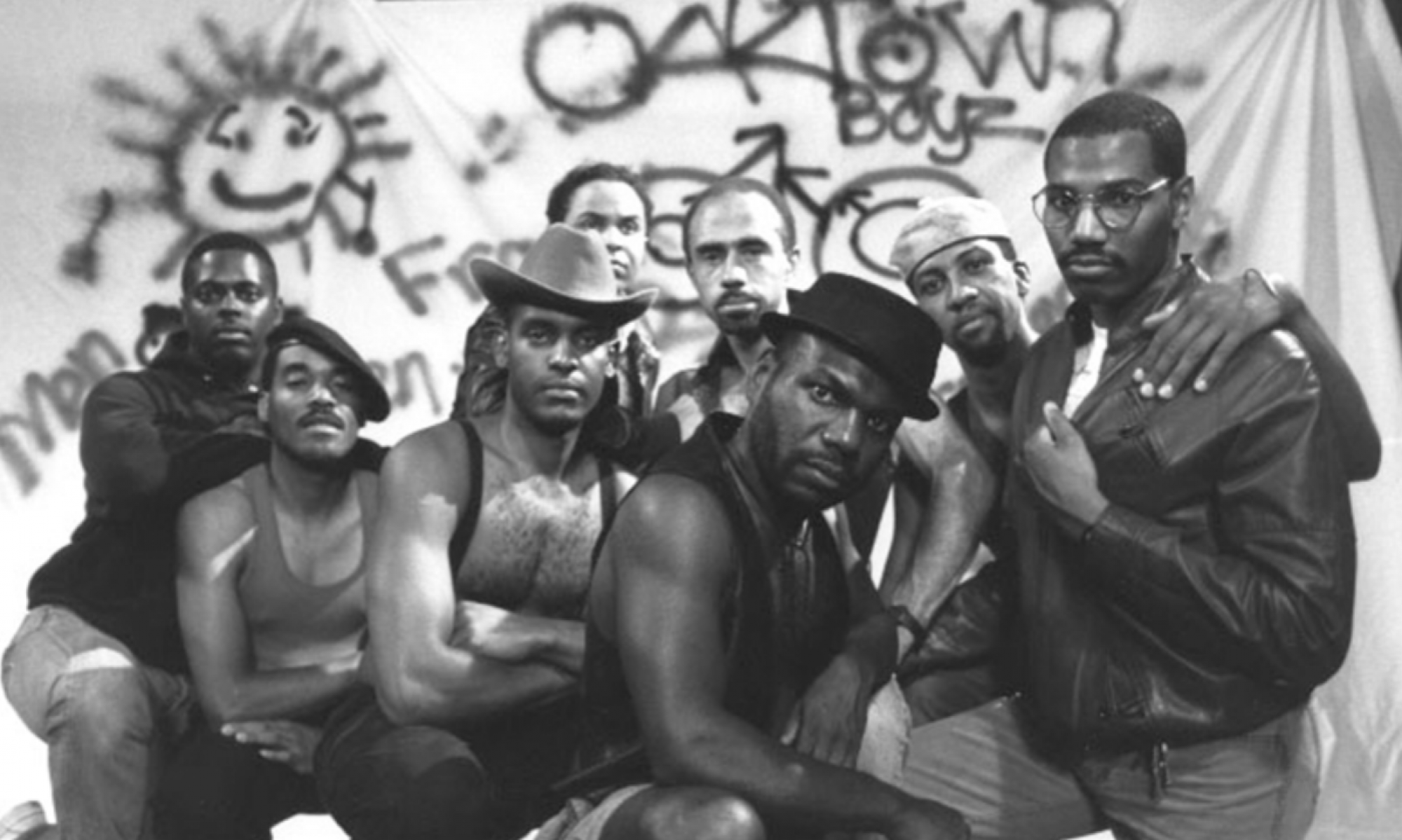
Following this week’s screening, I left feeling rather perplexed as to how the readings and the films pieced together. After rereading Audre Lorde’s Sister Outsider and re-watching the selected films, however, I found some clarity, which was centered almost entirely around Lorde’s margarine metaphor. Lorde’s metaphor, which describes the way in which “a tiny, intense pellet of yellow coloring” is mixed with “uncolored margarine” to create the classic butter-like spread that many of us have used at one point or another, captures both the essence of eroticism that she is writing about in her short essay as well as the essence and character of the experimental films that we viewed in our screening this past Monday. Lorde’s metaphor, in this manner, provided a critical intellectual framework that ultimately allowed me to transpose my understanding of power, the erotic, and its effects on women to the films that we screened. In all five films, the women appear to have harnessed Lorde’s erotic, which ultimately gave each woman a new found inspiration and empowerment in their respective lives or endeavors. Additionally, these women were able to use this newfound sense of eroticism to surpass what Lorde describes as “the false notion that there is only a limited and particular amount of freedom that must be divided up between us.” In this manner they used their empowered outlook as a catalyst for life improvement, which involved the conscious decision not to “settle for the convenient, the shoddy, the conventionally expected, nor the merely safe.” The connection that I perceived between power, the erotic, and the empowerment that these two phenomenon create is especially evident in the film Janie’s Janie.
In the 25-minute documentary style film Janie’s Janie, audiences are subjected to an unedited and raw depiction of the realities of single motherhood and the welfare state. Janie, a single mother of five who recently separated from her husband, Charlie, allows filmmakers to follow her trials and tribulations as she attempts to provide for both her children and herself. While the film is shot in a way that emphasizes the struggles of single motherhood, it also goes to great lengths to depict the inspiring effects that an empowered single mother had on a poor community in Newark, New Jersey. With the film’s up-close shots of Janie sitting exhausted and coughing at the kitchen table after a long day of cooking, cleaning, and taking care of the children, audiences are able to see the physical toll that single motherhood takes on this woman’s health and vitality. This presentation of Janie combined with the way in which the camera follows her around and interviews her as she goes about her daily duties as a single mother allows audiences a glimpse into the endless chaos that comes with this type of lifestyle. The seemingly endless struggle is complicated, however, by the one-on-one interviews that the film crew conducts with Janie. In these interviews, the struggling single mother demonstrates an empowered and inspired view on her new life. In one particularly poignant interview Janie claims “’Before I was my father’s Janie, and then I was Charlie’s Janie, and now I am Janie’s Janie. I have to be my own person’” thus demonstrating to viewers a drive and determination that she has created for herself, which I have come to realize perfectly coincides with Lorde’s essay on the Uses of the Erotic.
In Janie’s Janie, both the one-on-one interviews as well as the progression that the film depicts of Janie’s character demonstrate a seamless embodiment of Lorde’s theory on the connection between the erotic and power. In her essay, Lorde claims that “the fear that we cannot grow beyond whatever distortions we may find within ourselves keeps us docile and loyal and obedient, externally defined, and leads us to accept many facets of our oppression as women,” which is sentiment that Janie reiterates especially at the beginning of the film. For Lorde it seems that erotic revolves around an acceptance and understanding of your inner desires. In this manner, Lorde appears to be arguing that once a woman accepts and acknowledges her inner desires, whether they be sexual, emotional, or intellectual, she can begin to throw off the shackles of societal oppression, which was a sentiment that was clearly demonstrated in Janie’s Janie. Viewers hear the physical, mental, and emotional abuse that Janie suffered at the hands of her father, and they also hear the ways in which Janie had come to accept them as true. She accepted the fact that she needed to get married and get pregnant in order to escape her father’s abuse, and she accepted the fact that she would be confined to a loveless marriage and a solitary and isolated existence as a stay at home mother. She accepted, in essence, the “externally defined” gender norms that left her without a voice, without opinions, and without companionship. Upon separation from her husband, however, something inside Janie changed that allowed her to think, act, and demand what she desired for herself and her children. The film underscores this internal transformation by transforming the manner in which Janie is presented to the audience. In the second half of the film, Janie is no longer confined to the isolated existence of single motherhood. She is filmed outside of the house with other women doing things other than cooking and cleaning her house. She is organizing groups of single women, she is fixing major appliances, and she is smiling and enjoying her life. She is no longer the exhausted and sick housewife who is confined to her house. She is free and liberated both spatially as well as intellectually and emotionally. In essence, she has found her purpose by unlocking the erotic power within.

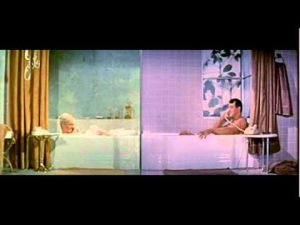
 The one-way gaze signifies desire, which, according to Mulvey, “allows the possibility of transcending the instinctual and the imagined” (1975).2 While desire may transcend the imagined through its capacity to bring us actual pleasure (at least temporarily), such transcendence does not make the desired situation any less of an egotistic projection nor figment of the imagination. Notwithstanding a loaded performance by Doris Day, casting Rock Hudson as a bifurcated character (Wojcik 2010)3 makes any potential female desire for male attention conflated with desire for attention from someone like Rock, neither fully Brad nor fully Rex. When (fragile) masculine identifications with Rock’s performance—a performance that encodes facility in wooing the object and in manipulating himselves to do so—compounds with female desire for like-Rock male attention, male confidence is built higher on contradictory assumptions that she is both passive and secretly ‘wants it.’
 After having verbally denied Tony repeatedly, he says: “it’s your word against mine.”4 While such an utterance elicits observable cringes from audience members steeped in today’s political climate, this scene and this phrase indicate that the film was conscious of consent to sexual advances in a way that Wojcik (2015) claimed it could not possibly have been.5
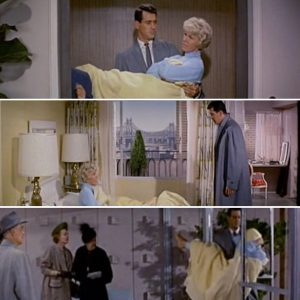 Brad literally setting his sights on Jan is pleasurable because of the sexual fantasy that him gazing can produce, but additionally so because he subconsciously exaggerates his own agency in transferring this situation from imagination to reality.