Students:
Henry Dubiel ’24
- Handled the majority of carving and cutting responsibilities. Specialized in programming and running the carvey as well as the more hands-on parts of the project such as cutting the wood and drilling holes/installing metal handles.
Carson Levit ‘
- The mastermind behind the design as well as bringing it to life in digital renderings on the carvey, graphic design of the model, as well as refining the product with sandpaper, glaze, and finishing touches on the project.
While this was an extremely collaborative process and only a team of 2, most of the work was done together. However, each of us took the lead on a different aspect of the project.
Description of the project & intent
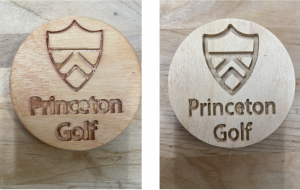
- During this process, we wanted to focus on making something sentimental to remember our time on the golf team here at Princeton. We wanted this project to be both commemorative and functional. We created a set of unique coasters, as well as a tray for glasses, all imprinted with the Princeton crest and Princeton golf. Our final project yielded 4 coasters and a glass tray that will both be extremely useful but also a really nice decorative piece for any occasion. The intent was to use a variety of different machines in the process to create something unique and original. We learned how to use the drill press, the carvey, the different DeWalt machinery to cut wood, Fusion 360, along with Adobe Illustrator, and many other digital design tools. We also used adhesives, wood stain, as well as sandpaper to complement the technical side of the process and refine the final product. Taka, Jasen, and John were monumental in shaping our process as they gave us extremely valuable feedback along the way. Their experience in the field enabled them to give very constructive feedback. We used this feedback in the way that an artist utilizes a critique session where fellow artists give suggestions for improvement. This is a great way to improve a product as the producer of art is often unable to see things that an outside observer would see.
Description of the tools used
- For our design, we used a variety of different tools. First, we used fusion 360 to produce a design that could be sent to a computer to carve. We encountered some troubles in this process and eventually had to recreate the design in other programs more compatible with the carvey. Then, we ordered quality pieces of Walnut wood in which to carve our designs. Once these arrived, we used the Dewalt machine to shave down the wood to our desired thickness. After this, we used the carvey machine to imprint our designs, using a combination of a ⅛ inch drill bit and a 1/32 inch drill bit to carve different parts of the wood to ensure the best quality of cut. After using these two machines, we then moved on to refining our design, as seeing the actual design made us rethink what would look best on a small coaster. Hence, we took out some of the text, and resolved to only keep the simple “Princeton Golf”. After much trial and error, and many failures, we made the coaster that we had envisioned. To polish up the look, we glazed the wood. Then we moved on to the tray, as we thought a tray would be a great complement to the coasters. We used the same type of wood for the tray as it looked great and performed well in the carvey for the coasters. The tray was easier to carve now that we had become more skilled in the process. Our next task was to attach the handles to the tray. To do this, we used a drill press to cut holes for the handles. The metal handles were the only part of the project that we did not fashion ourselves, but we were able to find handles that we could incorporate in a unique way that also maintained the more homemade feel of our project. After this, we used a strong adhesive to fasten the handles to the wood. Upon completion, we used a fine-grade sandpaper to get rid of any imperfections in the wood.
Photos: