Kawada Kikuji 川田喜久治 ––Resonant Pages and Unstable Narratives
This section presents three works from Kawada Kikuji’s 川田喜久治 (b. 1933) The Map (Chizu 地図) series that he worked on from 1959 through 1965.[1] The series The Map addresses the aftermath of World War II and was published as a photobook titled The Map (Chizu 地図) in 1965. The three photographs on display represent three major themes of Kawada’s photobook The Map: architectural ruins including the A-Bomb Dome in Hiroshima and desolate war fortifications, discarded objects including personal effects as wartime relics, and signs of postwar economic development and social conditions. This section focuses on the ways that the format of photobook facilitates the construction of multiple narratives and complicates the meaning of Kawada’s photographs.
A self-taught photographer, Kawada began his career as a staff photographer at the Shinchōsha publishing house since 1955.[2] Shortly after joining VIVO in 1959, Kawada quit the job to become a free-lance photographer. Kawada started photographing the series The Map in 1959 and exhibited some of the works in journals and small exhibitions during the course of his development of the project.[3] He continued to work on this project after VIVO disbanded in 1961 and eventually published the works in the format of a photobook on August 6, 1965––the twentieth anniversary of the atomic bombing of Hiroshima.
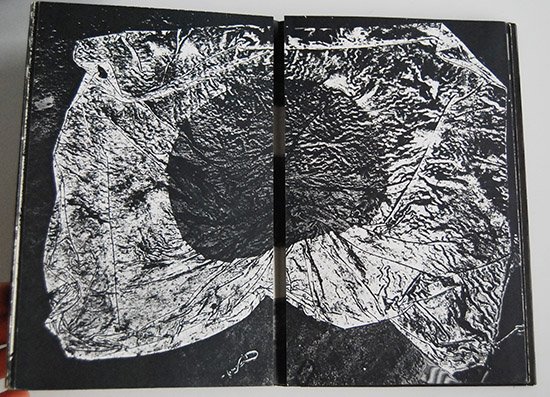
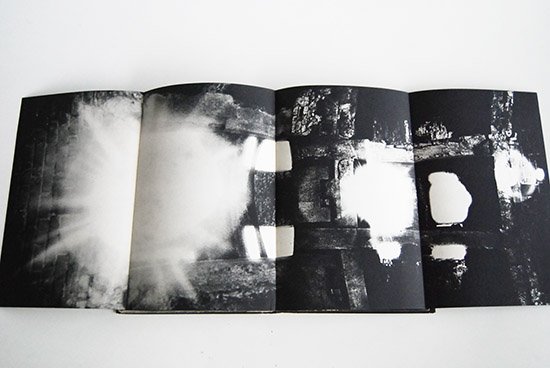
Fig. 3. The kannon-biraki gatefold design of The Map (Chizu 地図), 2005 reprint.
Designed collaboratively by Kawada and the designer Sugiura Kōhei 杉浦康平 (b. 1932), the photobook The Map adopts a four-panel gatefold design, or a kannon-biraki 観音開き design as called by Kawada, which curates a special viewing experience for the viewer (Fig. 3). Like the double-door kannon-biraki chest, every page in the photobook can be unfolded from the center to extend into a large four-leaf image on the reverse side of the pages. Though this design was first proposed as a financial compromise to substitute an initial two-volume design in order to include more photographs within a photobook of a manageable size, the design eventually evolved into an integral part of the project.[4] When reading this photobook, one has to constantly unfolds and folds the pages in order to see all photographs and get a complete experience of this book. In this manner, Kawada creates a convoluted narrative that adds another layer of meaning to the photographs. The social and historical reality already mediated by the medium of photography is now further mediated by the format of photobook. Through the reorganization of the photographs in the kannon-biraki gatefold design, Kawada reinterprets the reality that he has captured in the resonance of the photobook’s turning pages.
EXPLORE THIS SECTION
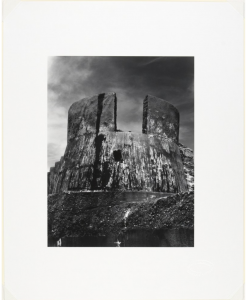 The Ruin of a Stronghold, Atomic Bomb Memorial Dome, 1960-65, printed 1973
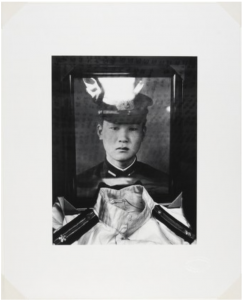 Photograph and Personal Effects of a Kamikaze Commando, 1960–65, printed 1973
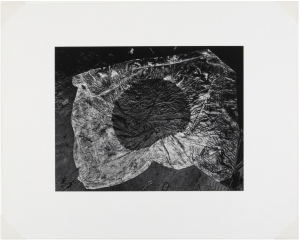 The Japanese National Flag, 1960, printed 1973
[1] Kawada Kikuji, Interview, San Francisco Museum of Fine Arts, March 2016. https://www.sfmoma.org/artist/Kikuji_Kawada/.
[2] “Artist Profiles,” in Anne Wilkes Tucker, et al, eds. The History of Japanese Photography (New Haven: Yale University Press, 2003), 347.
[3] Kawada Kikuji and Lena Fritsch, “In Conversation with Kawada Kikuji,” in Ravens & Red Lipstick: Japanese Photography Since 1945 (London: Thames & Hudson, 2018), 50. Kawada Kikuji, Interview, San Francisco Museum of Fine Arts, March 2016. https://www.sfmoma.org/artist/Kikuji_Kawada/.
[4] Maggie Mustard, “Atlas Novus: Kawada Kikuji’s Chizu (The Map) and Postwar Japanese Photography,” PhD dissertation (Columbia University, 2018), 75.