Introduction: VIVO and Subjective Documentary
Photography has often been treated as the modern medium of factuality. Because the photographic image forms through the action of light on a photosensitive surface, it has been understood as indexical rather than mimetic: not simply an imitation of the world, but a physical registration of it. This association with photomechanical fidelity has given photography a privileged place in documentary culture, where the camera is expected to deliver a neutral and comprehensive account of social reality.
This exhibition explores a moment when Japanese photographers took that assumption as both a resource and a problem. In the late 1950s and early 1960s, documentary and photojournalistic expectations exerted strong pressure on photographic practice, encouraging legible narratives and an ethic of visual clarity. Yet for a younger generation coming of age amid war memory, the afterlives of occupation, rapid economic and urban transformation, and the visual saturation of mass culture, “reality” felt neither stable nor singular.[1] If the postwar world was fractured, volatile, and unevenly experienced, then photography’s claim to transparent objectivity could seem less like a guarantee than a constraint.
It was in this context that VIVO emerged as one of the most influential experiments in postwar Japanese photography. Formed in 1959 by six photographers—Tōmatsu Shōmei 東松照明 (1930–2012), Hosoe Eikoh 細江英公 (b. 1933), Kawada Kikuji 川田喜久治 (b. 1933), Narahara Ikkō 奈良原一高 (1931–2020), Satō Akira 佐藤明 (1930–2002), and Tanno Akira 丹野章 (1925–2015)—VIVO operated as a short lived cooperative that supported its members’ independent work while providing shared infrastructure and a collective identity (Fig. 1). The group’s name came from the Esperanto word for “life” and also alluded to LIFE magazine, signaling a desire to keep photography close to lived experience even as its practitioners rejected the idea that experience could be delivered to viewers in a purely unfiltered form.[2] VIVO’s members shared an office and darkroom in East Ginza, Tokyo, and the cooperative functioned in part as a practical self-agency model that helped photographers promote and circulate their work outside the constraints of conventional editorial assignments.[3]
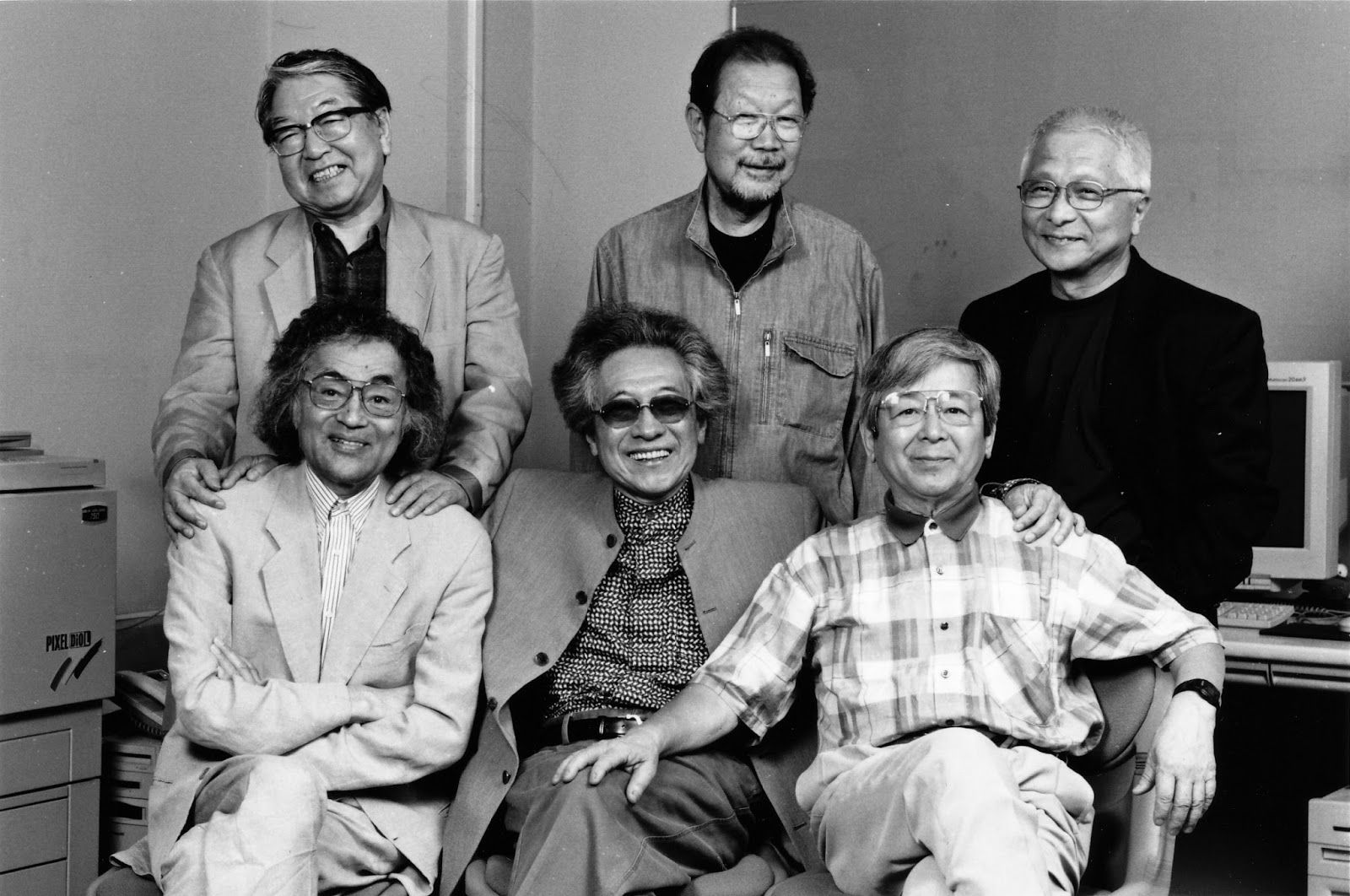
Fig. 1. Members of VIVO, in 2001. Photo by Shu Sakurai. Back row, left to right: Hosoe Eikoh, Tōmatsu Shōmei, Kawada Kikuji; front row, left to right: Tanno Akira, Narahara Ikkō, Satō Akira.
VIVO grew out of The Eyes of Ten, a series of exhibitions held in Tokyo between 1957 and 1959, which showcased ten emerging photographers and signaled a turning point in the field. In the wake of these exhibitions, six of the ten photographers formed the group VIVO with the shared ambition of creating “a new form of photography”—one that insisted on the medium’s expressive and structural possibilities without retreating into prewar pictorialism.[4] Although the cooperative lasted only about two years, disbanding in 1961, its impact as both an idea and a photographic movement endured. In later accounts of Japanese photography’s postwar trajectory, VIVO is often treated as a crucial hinge between earlier documentary paradigms and the more overtly experimental, media-critical practices that would emerge later in the 1960s and beyond, including Provoke.
What, then, did it mean to “reframe” the real? For VIVO photographers, the answer was not to abandon social engagement, but to rethink how documentary could operate. Their work remained insistently attuned to contemporary conditions—war trauma and its material residues, the political pressures of the US-Japan alliance, urban change, and consumer spectacle—yet it refused the obligation to translate these conditions into a single authoritative narrative. In VIVO practices, documentary becomes intimate, performative, and sometimes deliberately unstable. The photograph still indexes, but it also interprets; it still records, but it also reconstructs. The “real” appears less as a self-evident scene than as something that comes into view through framing, layering, sequencing, and the photographer’s situated presence.
This exhibition focuses on three VIVO photographers—Tōmatsu Shōmei, Hosoe Eikoh, and Kawada Kikuji—whose works from the late 1950s through the early 1960s exemplify distinct strategies for reframing reality. Tōmatsu turns fragments of everyday life into emblematic encounters, using close framing, tonal contrast, and a logic of the partial to bind private vulnerability to public history. Hosoe treats photography as a collaborative performance, constructing charged tableaux in which bodies and cultural references collide, and in which identity is staged rather than simply revealed. Kawada extends reframing into the increasingly prominent format of the photobook: through sequencing, juxtaposition, and page structures such as gatefolds, he shows how documentary meaning is produced across images and across time, rather than contained within a single frame.
Taken together, these works invite viewers to ask: when the photograph “records,” what kinds of realities does it also invent? The Real, Reframed suggests that VIVO’s achievement was not to negate photography’s documentary force, but to show that the documentary is always already mediated—by form, by context, and by the acts of looking through which “reality” becomes thinkable as such.
Explore the Works by Tōmatsu Shōmei 東松照明
Explore the Works by Hosoe Eikoh 細江英公
Explore the Works by Kawada Kikuji 川田喜久治
[1] For accounts of the development of postwar Japanese photography from trends of Photo-Realism to more subjective expressions of the VIVO collective, see: Ilzawa Kōtarō, “The Revolution of Postwar Photography,” in Anne Wilkes Tucker, et al, eds. The History of Japanese Photography (New Haven: Yale University Press, 2003), 208–225. Lena Fritsch, “Post-war Trauma,” in Ravens & Red Lipstick: Japanese Photography Since 1945 (London: Thames & Hudson, 2018), 19–40. Lena Fritsch, “The Image Generation,” in Ravens & Red Lipstick: Japanese Photography Since 1945, 41–72.
[2] The group chose the word VIVO collectively from an Esperanto dictionary. Hosoe Eikoh explained their choice of the word in an interview: “LIFE was the most important journal in the field of photojournalism––‘vivo’ is another word for ‘life’. But it is also a term that combines the essential with everyday reality: ‘life’ stands for a person’s life as well as daily life. Vivo is a good word.” Hosoe Eikoh and Lena Fritsch, “In Conversation with Hosoe Eikoh,” in Ravens & Red Lipstick: Japanese Photography Since 1945 (London: Thames & Hudson, 2018), 51.
[3] Ilzawa Kōtarō, “The Revolution of Postwar Photography,” 217.
[4] Kawada Kikuji and Lena Fritsch, “In Conversation with Kawada Kikuji,” in Ravens & Red Lipstick: Japanese Photography Since 1945 (London: Thames & Hudson, 2018), 49.