Beatriz Cortez: Deconstructing Chronologies
“Memory is an ideal time machine because it allows us to not only travel to a past moment but to reimagine it.” — Beatriz Cortez
Born in El Salvador and working in Los Angeles, artist and scholar Beatriz Cortez (1970-) challenges mainstream chronologies of time and knowledge in an age of rapid environmental degradation. In contrast to “ticking clock,” disaster-based narratives of climate change, Cortez’s emphasis on vast geologic and celestial time, ancient knowledge, and continual movement of land forms, animals, and people is a meaningful framework for considering environmental change from a holistic perspective. Working mainly in monumental steel sculpture, Cortez visualizes the natural geologic change of centuries past–from exploding volcanoes to rocks from melting glaciers–far away from their locales of origin, connecting the inhabitants of current-day cities to the ancient practices and myths of the past. In future-oriented works, Cortez expresses the importance of Indigenous knowledge and community-minded action for the survival of life forms on Earth, and indeed, Earth itself. By engaging in a cross-temporal and cross-geographic discourse, Cortez helps recast human-environment relationships as ones of kinship, knowledge, and tangled mutual influence, both positive and negative, rather than one sole narrative of recent human destruction.
The first section of the gallery, “Visualizing the Anthropocene” examines Cortez’s perspectives on the Anthropocene, the current environmental epoch characterized by human influence on the natural environment. By highlighting geologic formations formed long before our current age, Cortez brings the deep past into contact with environmental conditions of the present, where the environment influences us as we influence the environment. Ultimately, this de-centers humans in climate solutions in favor of a more interconnected framework of time, land, space, and living beings on Earth.
The next section focuses on one of Cortez’s most well-known projects, titled “Ilopango, The Volcano That Left,” originally shown at the Storm King Art Center. In this project, three works and a performance express the central theme of human-environment interaction understood through invoking the simultaneity of temporalities past, present, and future. Reimagining the Ilopango volcano, which erupted in the sixth century in current-day El Salvador and scattered ash around the world, a welded-steel sculpture imagines the consequence of geologic change on the movement of the ancient Mayan people and of people living today.
The final section, “Speculative Futures,” examines the future-oriented work in Cortez’s oeuvre, which likewise calls to Indigenous practice and ways of knowing. Combining discourses of speculative fiction, space travel, and traditional knowledge, Cortez frames the future of people and the planet as one grounded in ancient wisdom, multiple temporalities, and imagination. She pays particular attention to Indigenous seeds as a solution to nurturing human survival in a time of decreasing resources to humanity.
Can we imagine climate change solutions with the vocabulary of vast time, ancient knowledge, and collaborative desire for the future? This collection of Cortez’s work pushes viewers to ask how alternative modes of thinking inspire hope for equitable solutions. Challenging viewers with the assertion of movement and change–environmental, social, political–as a constant, Cortez inspires reflection on how humanity may approach repairing the world through a balance of action and connection to the larger ecosystems and temporalities that bind us together.
All works are by Beatriz Cortez unless otherwise stated.
Visualizing the Anthropocene
How can we understand the Anthropocene, the era of human-driven environmental change? Cortez combines ancient Indigenous knowledge with contemporary localities and materials to challenge narrative of environmental change as purely linear, helping viewers consider the future in cross-temporal and cross-geological ways. In this section, three works, Glacial Erratic, Aqui Estamos, and Migrate, complicate ideas of the Anthropocene by merging what is typically thought of as past, present, and future.
Glacial Erratic, 2021
Steel and sheet metal
Rockefeller Center, New York, New York
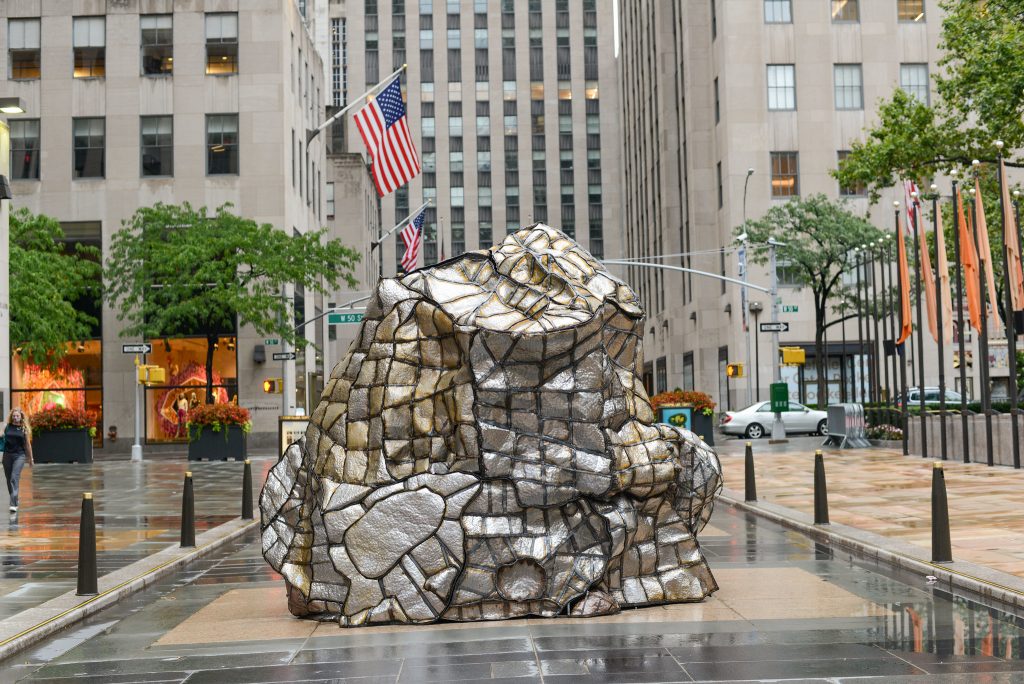
In Glacial Erratic, Cortez juxtaposes long, millennia-old processes of geologic change with the busy foot traffic of Rockefeller Center. Glacial erratics, rocks transported to their location by past moving and melting glaciers, are found all over Manhattan. Made of a steel frame and walls of sheet metal, this glacial erratic references natural forms created before the human era in contemporary materials and is subject to the elements and human interaction of the present moment. Calling to mind the human-influenced glacial melting of the current era, Glacial Erratic connects large-scale environmental processes began long ago and those accelerated by human involvement.
Aquí Estamos (Here We Are), 2019
Rocks
John Michael Kohler Arts Center
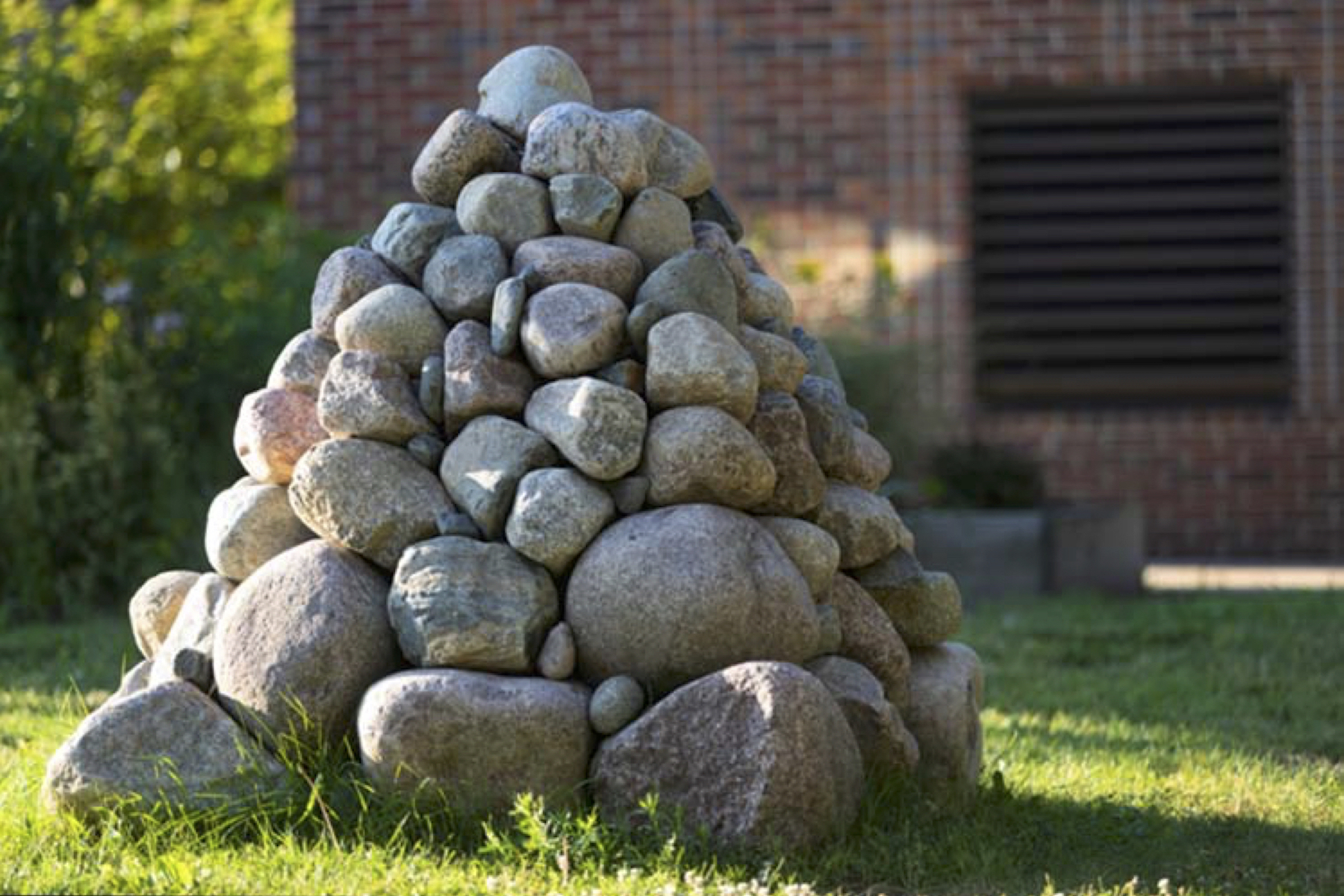
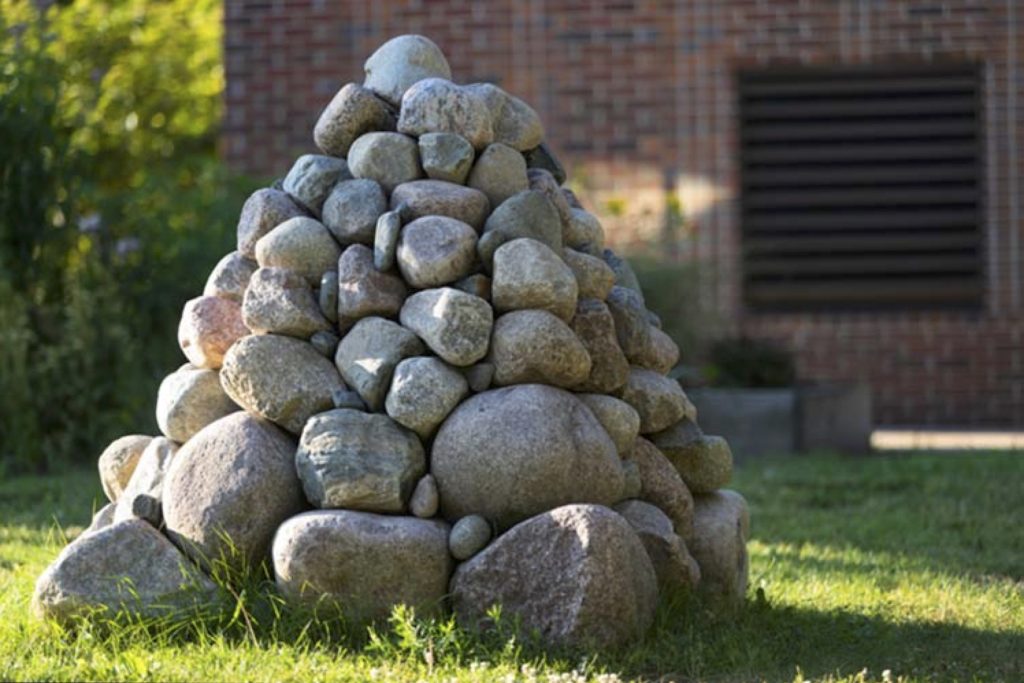
The pyramid-like marker of Aquí Estamos (We Are Here) is made of rocks once hidden beneath ice, gradually pulled to what is now the state of Wisconsin as ice melted in the region. Cortez surrounded the sculpture with corn, bean, and potato crops core to civilizations of the Ancient Americas, reminding viewers that as the rocks recall the impact of global warming, humans also adapt in the Anthropocene through ancient knowledge and care for cultivating land. Balancing natural forms, such as rocks and plants, with the geometric shape of the marker calls to mind the possibility of maintaining hope by documenting both the resilience of humans and the plants that sustain us. In this view of the Anthropocene, hope and pessimism coexist and are grounded in processes larger than each individual.
Migrante, 2024
Steel and metal
San José del Cabo, Baja California Sur
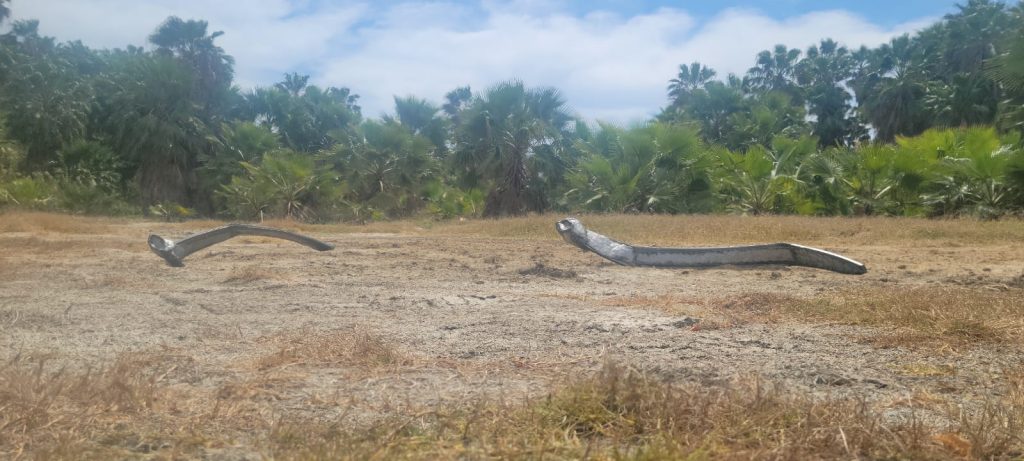
In this site-specific sculpture, two steel whale bones lay on the earth of the Peninsula of Baja California, where an ocean once existed before global warming changed the landscape. By placing the bones at this site, Cortez suggests the coexisting impact of global warming and past colonial endeavors on whale populations in the wider region. The distance between the two bones highlight the different temporalities of climate change and of nineteenth-century colonial efforts that killed many of the region’s whales along the U.S.-Mexico border. Migrante relates the migration of the diminished whale population in California to the movement of humans, suggesting complicated relationships between global warming, species protection, migration, and humans in the Anthropocene.
Ilopango, the Volcano That Left
Cortez threads a subtle but powerful connection between environmental change and migration, revealing how geologic movement impacts human migration, connecting people across time and space. From a climate change perspective, Cortez’s examination of time, change, and movement emphasizes intersectional angles on environmental justice. Narrowing in on her experience migrating from El Salvador to Los Angeles, these works from her 2023 exhibition “Ilopango, The Volcano That Left” at the Storm King Art Center complicate narratives about human-environment relationships by centering movement as a geologic and human constant.
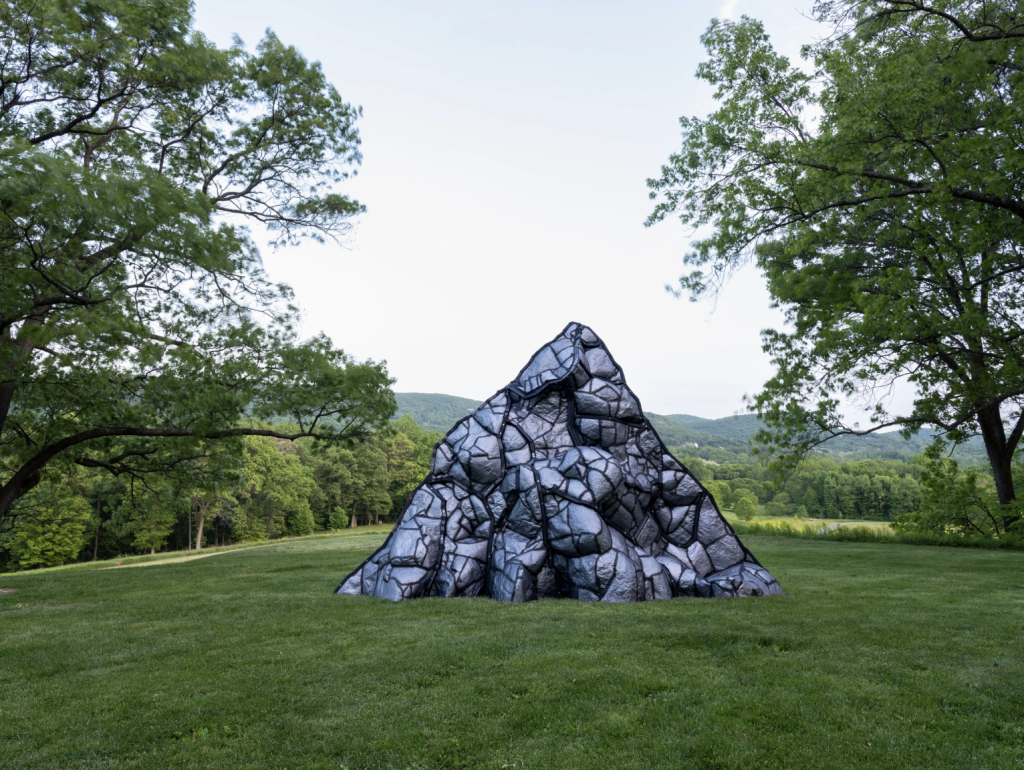
Ilopango, The Volcano That Left, 2023
Steel
Ilopango, the volcano represented by this 12-foot steel sculpture, exploded in the sixth century in current-day El Salvador. Now considered one of the largest volcanic eruptions in history, Ilopango scattered ash as far as Greenland, causing environmental and societal change as Mayans–for whom Ilopango was a spiritual deity–migrated from their destroyed land. Ilopango, The Volcano That Left, originally shown along the Hudson River, reimagines this geological event in a new temporal and geographic context, depicting an imminent explosion of the steel Ilopango through the crack-like lines of the dark steel frame. Connecting to her migration from El Salvador to Los Angeles, Cortez reveals how people worldwide remain tied to Ilopango through its scattered ashes. Presenting the simultaneity of past temporalities and the present, Cortez emphasizes the impact of long-ago geologic change on human movement, an astute perspective as climate change forces communities to leave the places they once called home.
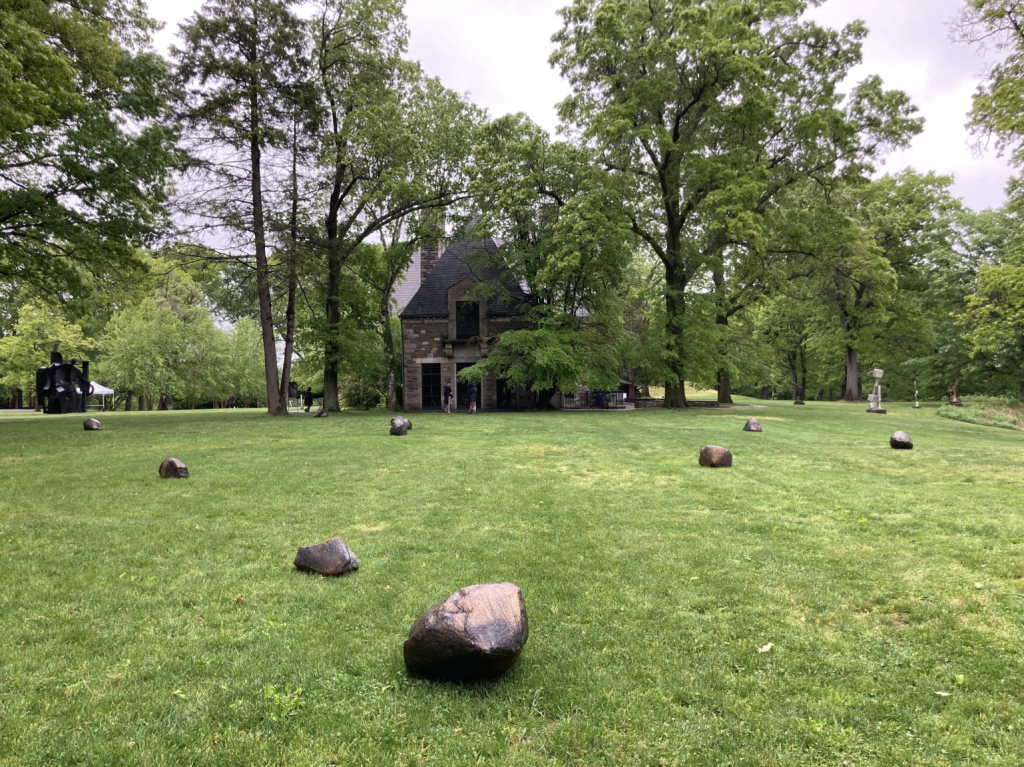
Cosmic Mirror (The Sky Over New York), 2023
Steel with patina
The eleven steel boulders of Cosmic Mirror (The Sky Over New York) accompanied Ilopango, The Volcano That Left at the exhibition at Storm King Art Center in upstate New York, engaging celestial time alongside the geologic time centered in the Ilopango work. Celestial or cosmic time was core to the belief systems of the Olmec people, indigenous to modern-day Central America, revealing yet another mode of conceptualizing time as it relates to gradual environmental change and spirituality. Cortez imagines each boulder as an asteroid fallen from the sky and creates a land-based constellation impossible to see without a bird’s-eye view, centering the celestial over human perspectives and opening a dialogue about humanity’s elusive relationship with the Earth beyond an often human-centered “ticking clock” narrative.
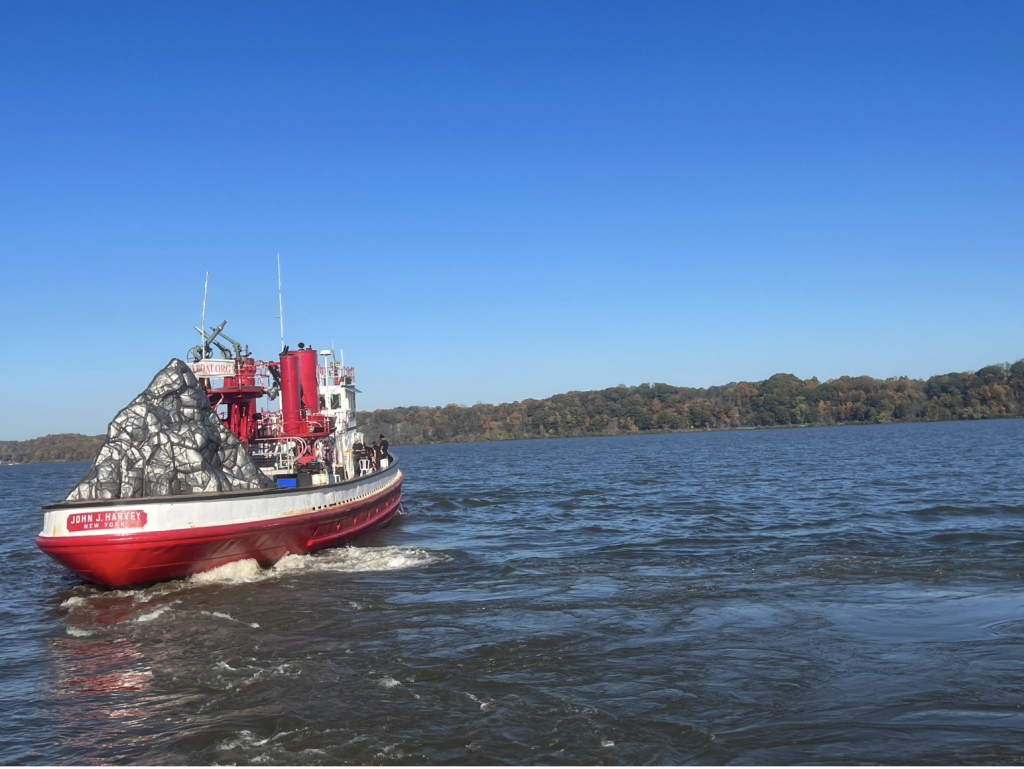
Ilopango, October 27-29, 2023
Performance
Hudson River
From October 27-29, 2023, Cortez’s Ilopango, The Volcano That Left sculpture turned into a work of performance and social action art. Over time, the original Ilopango volcano left a crater where it originally stood in El Salvador, creating a lake in its place. Cortez’s steel Ilopango reenacted this movement with a journey up the Hudson River to Troy, New York, leaving a volcano-shaped mark on its original location at Storm King. Traveling on a path known to be a hot zone greatly impacted by global warming, the sculpture’s journey connects the geologic time of exploding volcanoes to the acceleration of geologic movement in the Anthropocene, allowing Ilopango to reflect new meanings throughout its migration. Today, as glaciers, lakes, and tides continue to migrate, Cortez poses environmental transformation as inherently related to larger notions of multiple temporalities, ancient and Indigenous knowledge, and change as one of Earth’s constants.
Speculative Futures
Just as Cortez deconstructs traditional chronologies in her works about geologic change, she focuses on Indigenous knowledge and generosity in her works speculating about future solutions to climate and resource destruction. Following threads of community, seeds, and connecting to future beings in Cortez’s work, this final section underscores how multiple temporalities, relationships, and spiritualities contribute to equitable approaches to sustaining life on Earth.
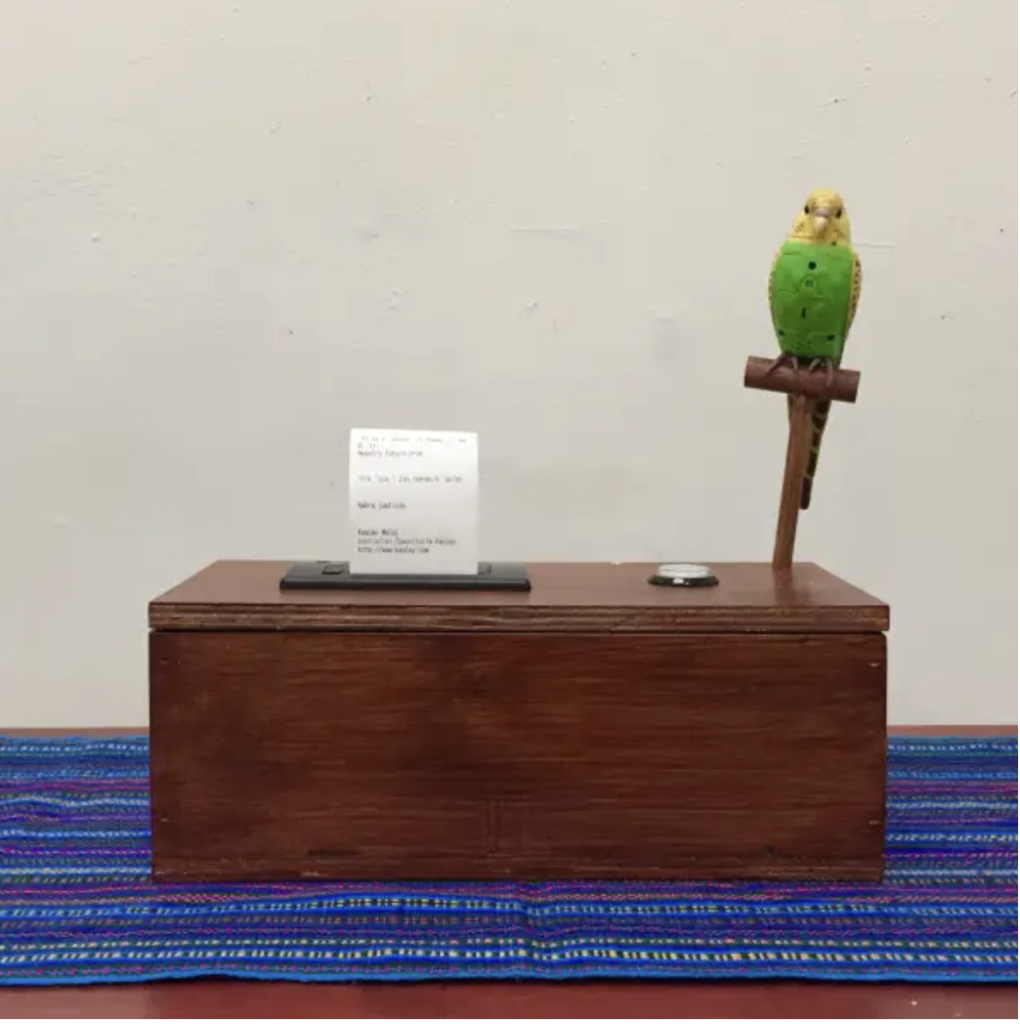
The Fortune Teller Machine, undated
Beatriz Cortez and Kaqjay Moloj
Mechanical Australian parakeet, button switch, a thermal printer, a wooden box, arduino technology
Cortez’s The Fortune Teller Machine, created in collaboration with the Mayan collective Kaqjay Moloj, prints out desires for the future at the push of a button. Containing message in the Indigenous language Kaqchikel and in Spanish, one such fortune reads:
Xtik’oje qulew richi’ qatikon
Tendremos tierra para cultivar
We will have land to cultivate
Hoping for and manifesting land to till, this desire reveals the interconnectedness of environmental change and lasting impacts of colonial efforts. Emphasizing Indigenous connection to land, Cortez and Kaqjay Moloj center traditional agriculture as core to cultural preservation, raising the stakes on both climate change impactful lands and on how powerful companies and governmental entities treat the land of Indigenous people. In her work focusing on futurities and imagining human survival, the machine highlights the power of words for instilling hope in times of environmental danger and threats to Indigenous rights and identity.
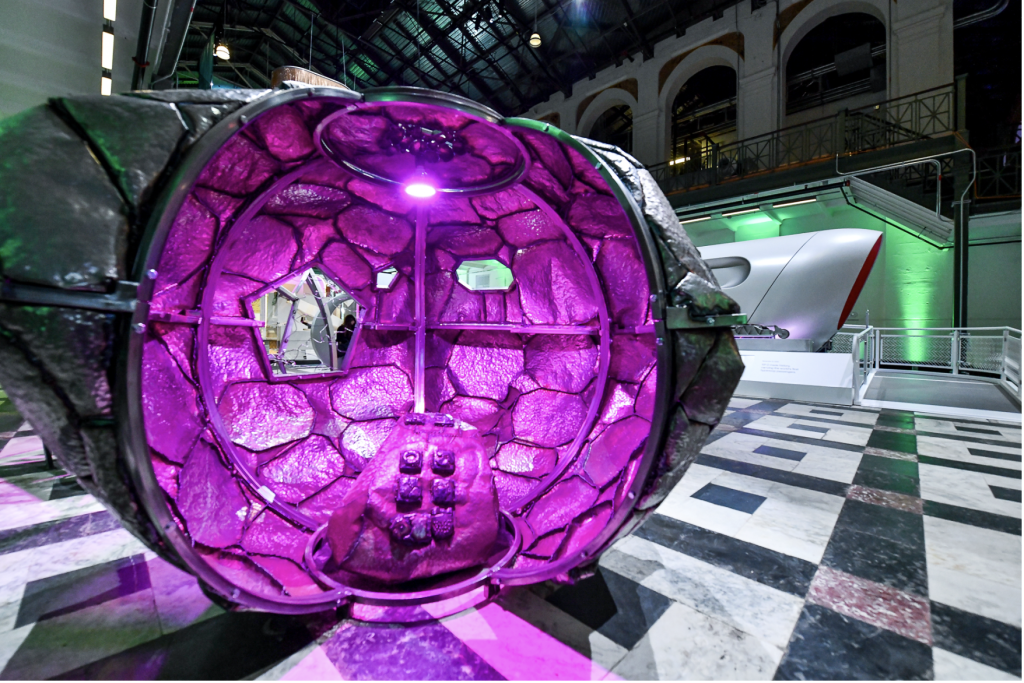
Chultun El Semillero, 2021
Welded steel
Chultun El Semillero adapts ancient Mayan containers, or “chultunes,” to an imagined space-bound capsule, which would contain Indigenous plants, seeds, and spiritual materials. Like many of her other works, the large-scale capsule is made of hand-hammered steel, returning the industrial material to an organic form. The chultun is illuminated pinkish-purple from the inside, calling to galaxy-like palettes. With themes of human survival, access to resources, and the futurity of climate, Cortez underscores the importance of traditional knowledge and active cultivation of plant life within current and speculative approaches to climate solutions.
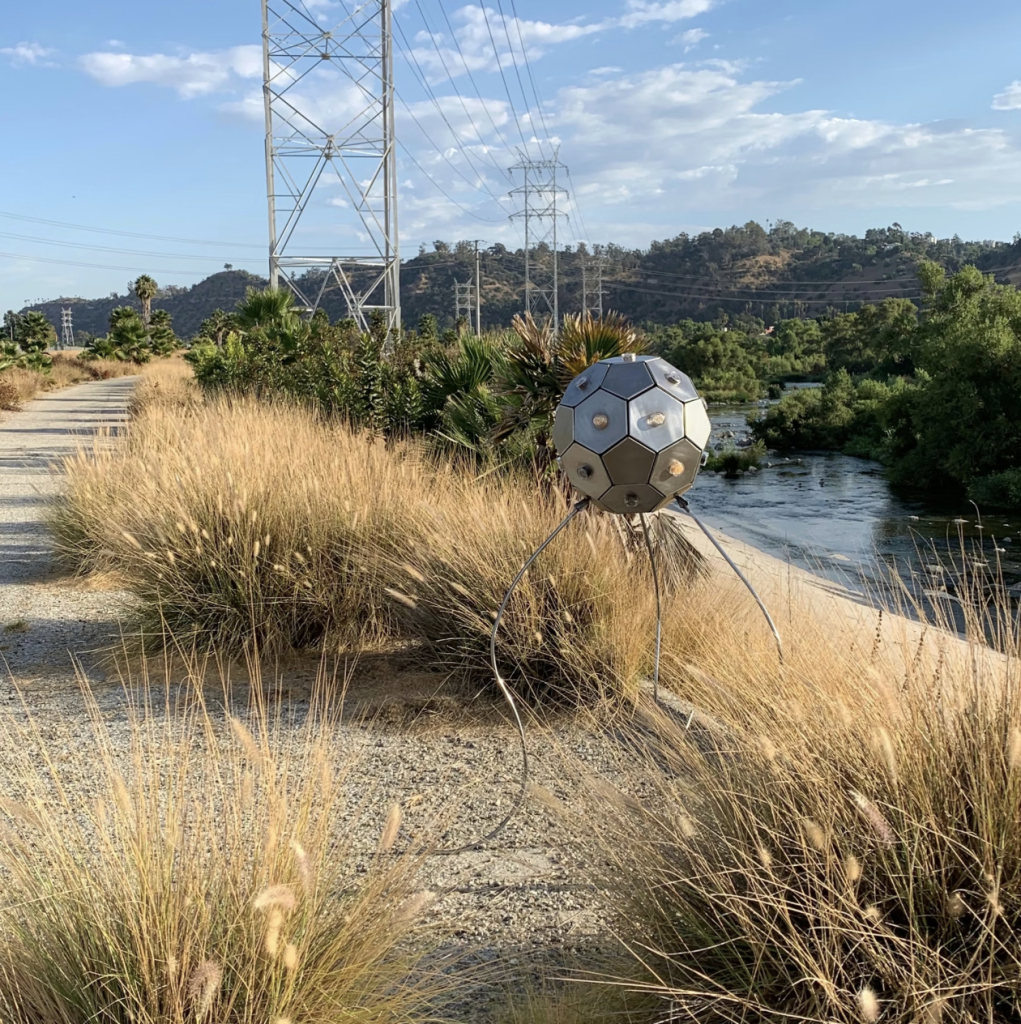
Generosity I, 2019
Seel, plastic, seeds (corn, beans, amaranth, quinoa, sorghum, gourd)
In each hexagon of the silver sphere of Generosity I lives an Indigenous seed, preserved in the spaceship-like structure to be delivered to future beings in need of resources. The non-GMO corn, bean, amaranth, quinoa, sorghum, and gourd seeds are core to Mesoamerican cultural tradition, agricultural practices, and spirituality. A precursor to Chultun El Semilleo, this outdoor sculpture combines this heritage with spaceship-like visuals common to speculative fiction to contribute to imagined futures for Earth, its inhabitants, and its plant species. Merging knowledge from the past, the practices of Indigenous communities today, and the unknown future of such communities and our planet, Cortez posits communal and kinship-based ways of knowing as key to solving climate crises affecting the practices, culture, and survival of so many across the Americas and the world.