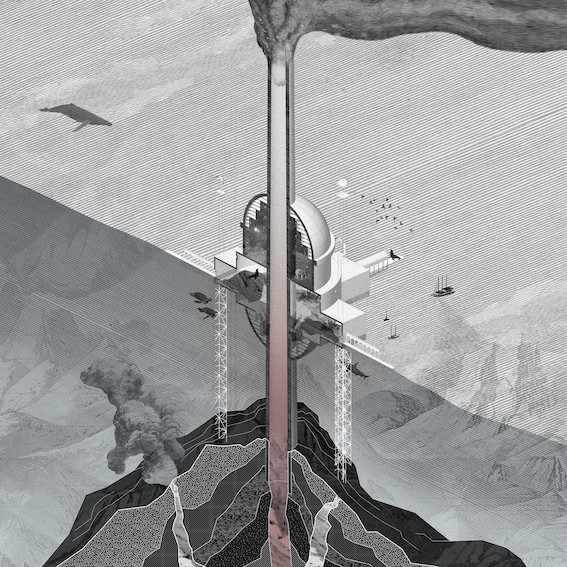
The artistic and research practice of Rania Ghosn and El Hadi Jazairy, under the collective name Design Earth, “engages the medium of the speculative architectural project to make public the climate crisis.” The project was founded in 2010, and, since then, they have written and illustrated various books and developed multiple exhibitions at international biennales and in museums such as MoMA, ArkDes Sweden, and Matadero Madrid. Ghosn and Jazairy are both professors of architecture (at MIT and UMichigan, respectively), and they utilize their research for the Design Earthpractice. Their work comes in many forms and explores many different facets of the climate crisis, but this collection will take a focused approach to just one aspect of Design Earth’s speculative questions: How does climate change affect animals, and how can we imagine a different way for animals to interact with a human-structured world?
Design Earth approaches these questions about animal life on Earth through various genres such as fable, speculative architectural drawing, and imagined interventions into the environmental systems which contribute to the climate crisis. The exhibition draws from four works by the collective: “Elephant in the Room”, an illustrated fable about an elephant in a museum, Geographies of Trash, a book-length exploration of trash on Earth, Geostories: Another Architecture for the Environment, a book about new ways of environmental engagement, and, finally, “Climate Inheritance: Cautionary Tales of UNESCO World Heritage Sites” which explores the impact of climate change on world heritage sites. Ghosn and Jazairy question the established ways of thinking about animals: as specimens to admire in museums while, simultaneously, the impact that human development projects have on their habitats is ignored. These speculative drawings imagine a world in which animals of all kinds have agency in how their habitat changes and in which they can express their desires directly to humans. They take recognizable forms such as the architectural drawing and the fable and make animal life visible where it is often ignored or not pictured at all.
Part 1: Elephant in the Room, 2021
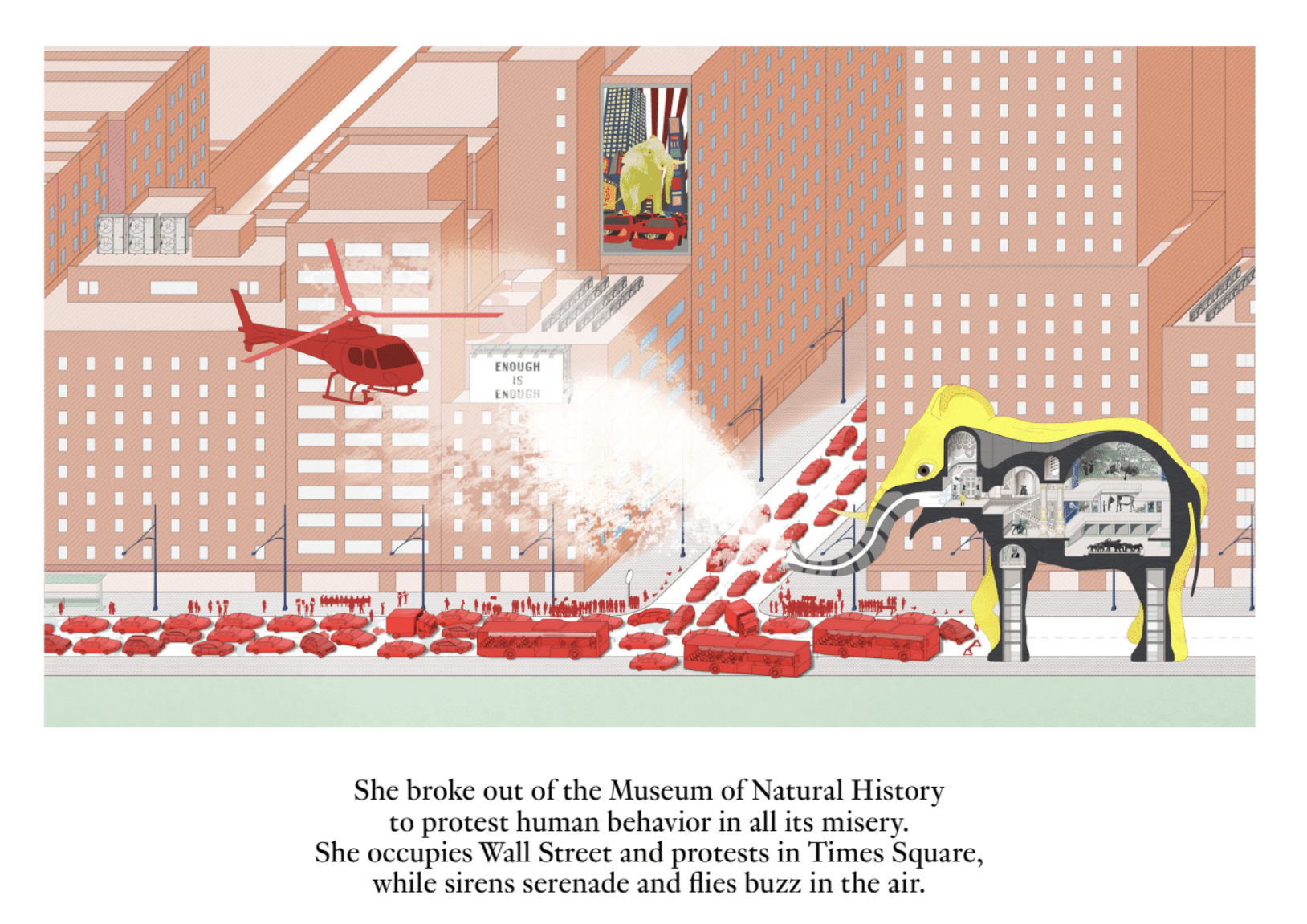
Elephant in the Room #4
The idiom “the elephant in the room” is repurposed in this fable to mean both the character of the African elephant and the climate crisis. The elephant, usually a static figure to be admired in a museum, comes to life in order to decry the issue that allowed her to be placed in that museum in the first place. The protesting elephant’s body tells the story of how she got to the museum: hunting practices turned her and her family from living beings to specimens. Her presence in the street, instead of stuck on a pedestal, echoes the texts on the billboard: “ENOUGH IS ENOUGH.”
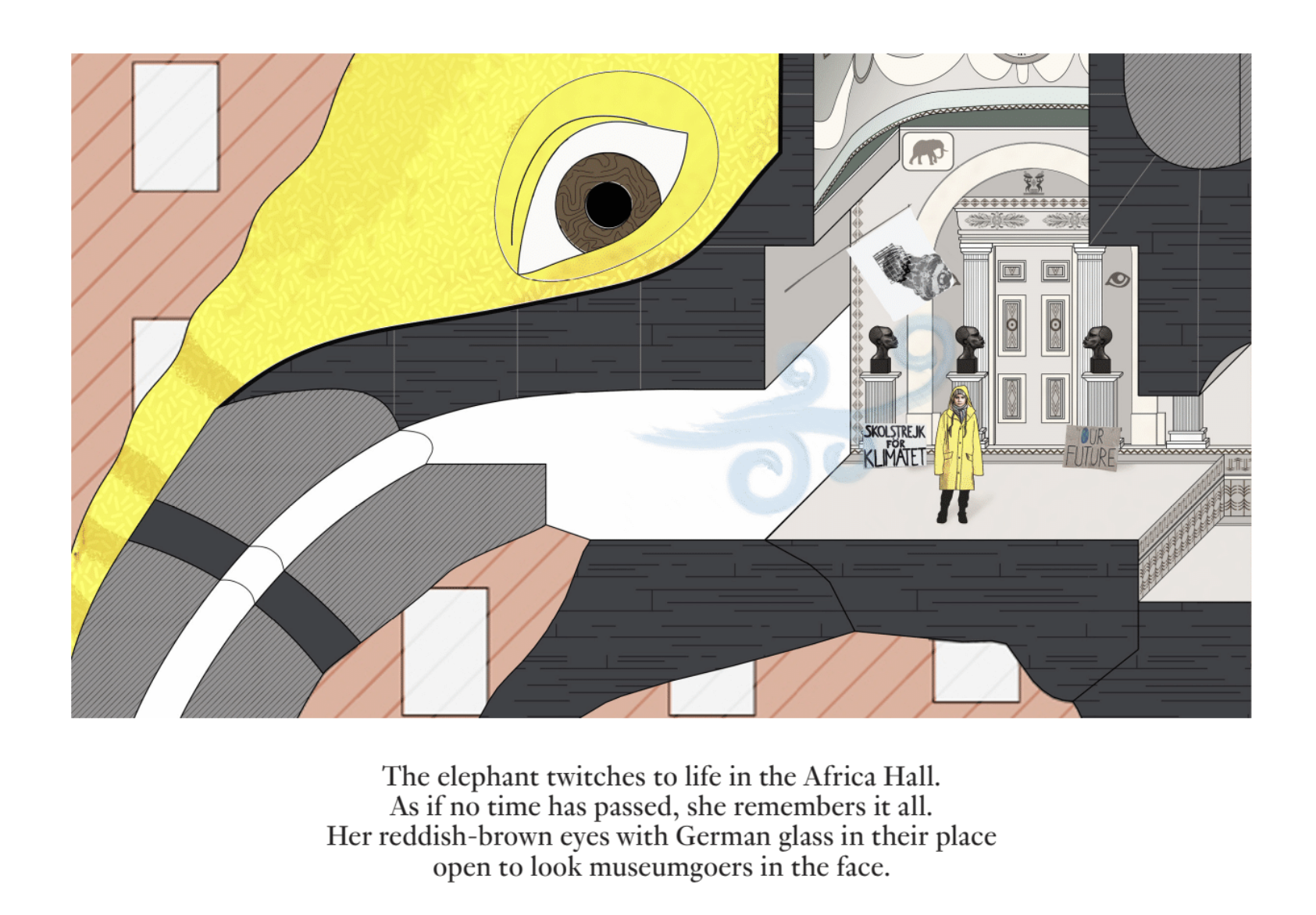
Elephant in the Room #9
The illustration zooms in on the inside of the elephant that was visible earlier in the story. This panel focuses on “her reddish-brown eyes with German glass in their place” and a small version of Greta Thunberg and her sign protesting for climate action. Time collapses in this panel. The elephant “remembers it all,” looking back to the moment of her death, and she also looks forward to other climate activists working towards the same goal of the recognition of climate change. The eye also looks out to “museumsgoers” within the world of the fable and to us, the viewers of this fable. The eye asks us to question what has been done to make the “elephant in the room” of climate change visible so far and what can be done in the future.
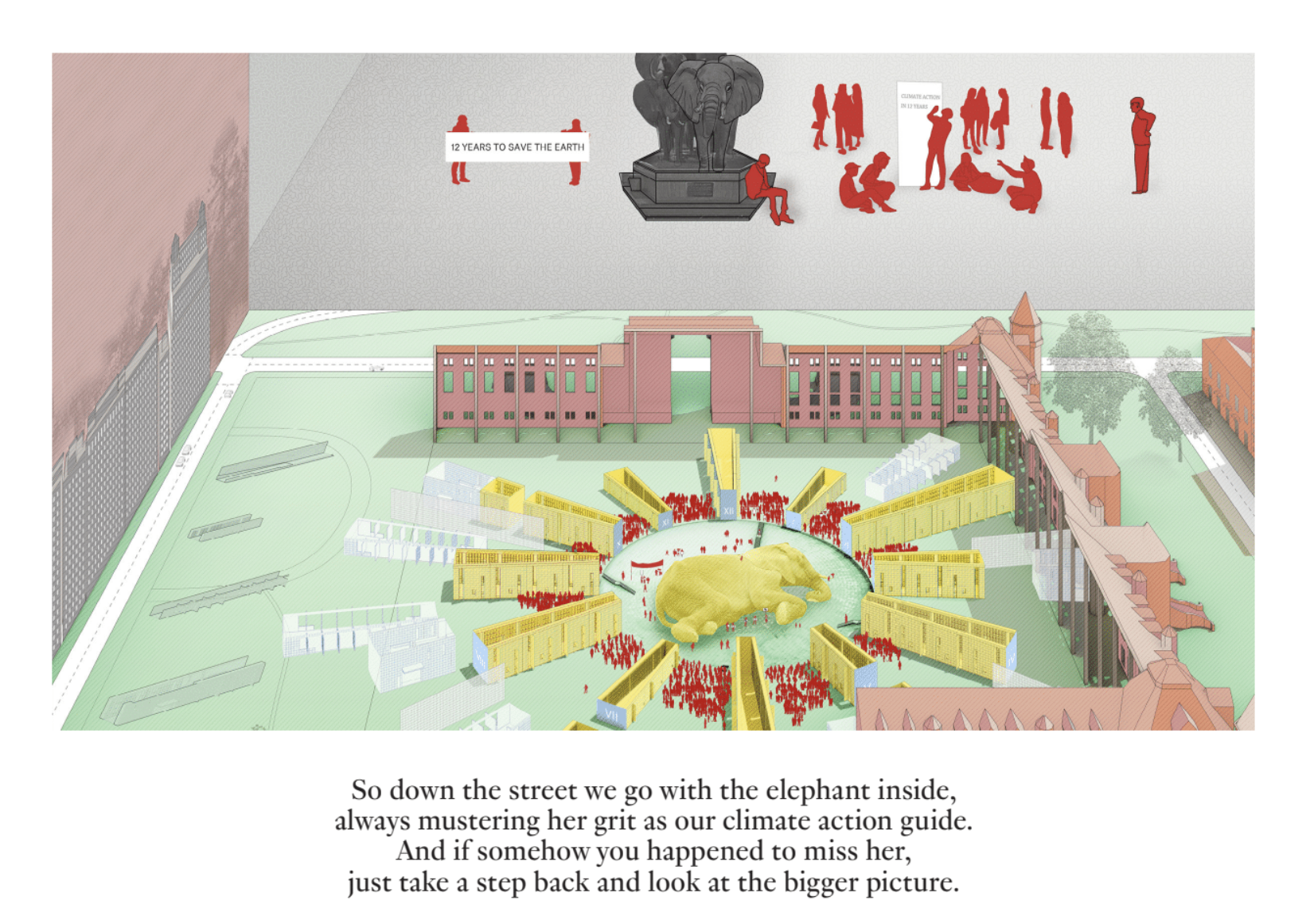
Elephant in the Room #19
The fable ends with a new institution made in place of the museum. The natural history museum and its policy of making living beings property has been dissected. It becomes the final resting place of the elephant, and the people of the fable’s future use her body and ideas as a “climate action guide” instead of following the ideas of “division, dispossession, and violence” that Design Earth identifies in the curatorial practices of museums. Finally, the fable invokes another idiom, “look at the bigger picture,” as the view zooms back out and compares the image of people coming together to fight climate change to the people sitting around looking at a sculpture of an elephant you might see in a museum.
Part 2: Geographies of Trash, 2015
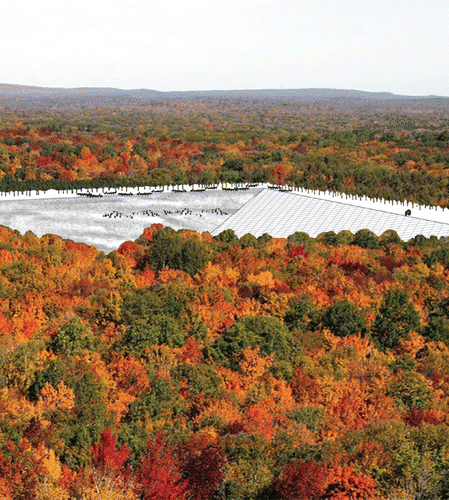
Preserve, Ground View.
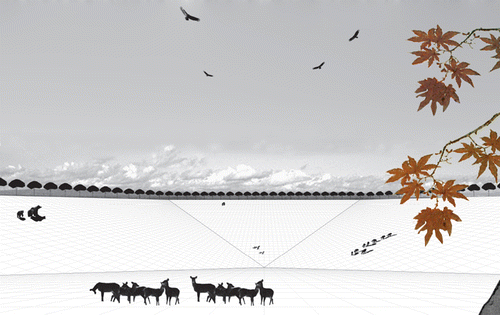
Geographies of Trash is Design Earth’s response to the problem of the “management and processing of waste” made by humans (10). They cite an image of a plastic bag floating in space to demonstrate the anxiety-inducing quality of the production of trash with nowhere for it to go. The book imagines new waste management systems in Michigan, specifically, that call attention to the space trash takes up, instead of maintaining the invisible operation that usually characterizes waste management. The project argues that by making trash more visible, it becomes less of an insidious and misunderstood force. In the nine sections of the book, the authors create a new way of looking at trash through the lens of climate change and provide “alternative aesthetics and forms of landfilling, recycling, burning, re-using and reusing” (13). One section of the books focuses on an alternative to a landfill: a golf course made into a living landfill with a rich microbiome which makes trash biodegradable.
Preserve, A Bird’s Eye View, Ecological “dump” site
The imagined golf course landfill in Michigan allows for all types of life to work together to manage trash. The authors conceptualizes this place, with “bears, wolves, deer, and vultures”, as a way to foster an environment where “trash is eaten, absorbed, and diffused, gradually [becoming] a vital component in preserving the natural ecology” (114). This ecological system is directly in contrast to the real organization of landfills that use plastic fillers that make waste decomposition more difficult and impact animals, plants, and, ironically, humans negatively.
Part 3: Geostories: Another Architecture for the Environment, 2018
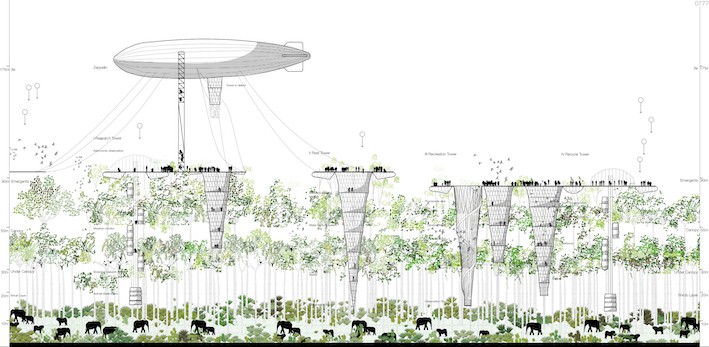
Towers on Wire #1: Tensile structures rest on the forest canopy to delimit ecological corridors that are critical for the survival of endangered elephants
The opening of Design Earth’s second book asks, “What’s the matter with climate change?” (11). The authors ponder how people can recognize changes on the daily and local level, but it becomes more difficult to understand issues like “climate” or the “global.” Design Earth uses architectural drawings to ground the issue of climate change in legible, realistic representations and show “environmental externalities as matters of concern for design” (15). One of these sets of speculative drawings is named “Towers on Wire.” The set concerns deforestation of tropical rainforests and imagines a restoration of these forests through a collection of inverted towers. The towers help new trees to grow by collecting humidity, provide sites of recreation for humans, and “establish a continuity of habitat and ecological corridors that are critical for the survival of endangered species like the elephants and the orangutan” (43). Development in rainforests becomes generative instead of destructive.
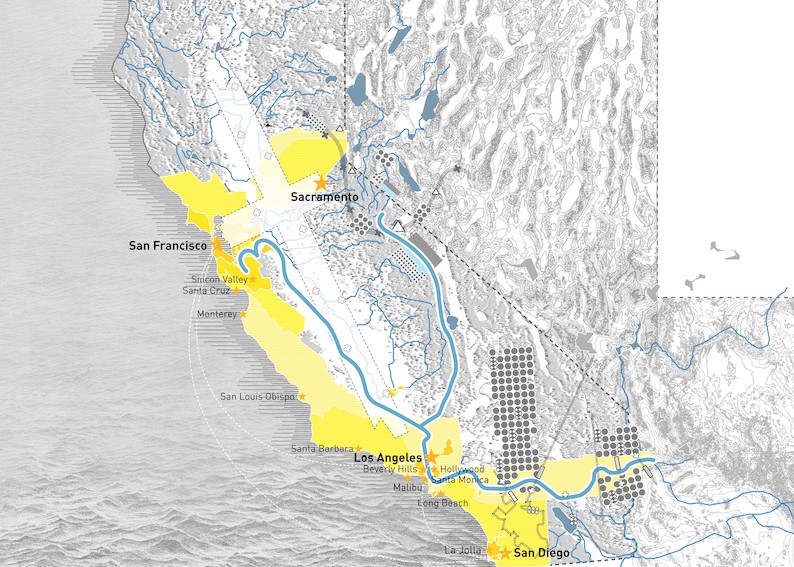
Apart, We Are Together #1 and #2
Similar to the place-specific exploration of Michigan in Geographies of Trash, the set of drawings from Geostories entitled “Apart, We Are Together” focuses on the ecology and ecological futures of California. The project would build a giant cross-shaped structure across the length of California and form a green space in order to combat rampant drought in the state. The cross represents salvation from the extreme dryness, and in this green space, the artists visualize a “sanctuary for climate refugees” (86), humans and animals alike. They show sea animals swimming off the coast, as water both at sea and on land should be cherished.
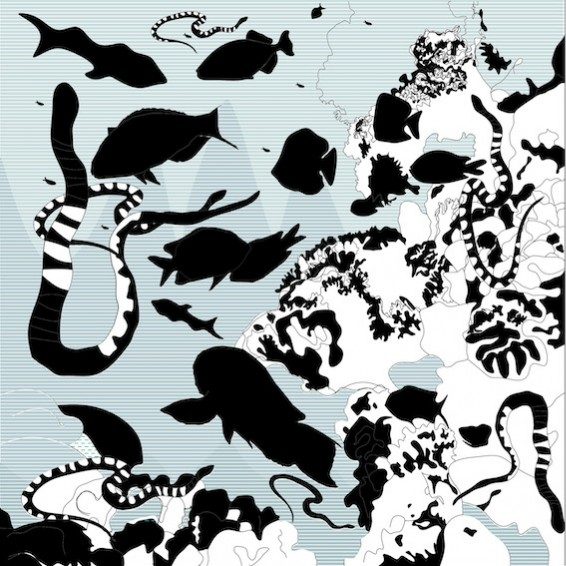
Pacific Aquarium #1: Parliament of Refugees
Human interference is everywhere, including the vast space of the Pacific Ocean. Design Earth mentions the Clarion-Clipperton zone, where rare earth metal mining is becoming popular for battery and alloy production. They imagine a new system of the “cohabitation of economy and ecology” (114) in the zone instead of the purely extractive and destructive system that exists now. The drawing called “Parliament of Refugees” shows what the authors call “an assembly of Anthropocene things, such as sea turtles, plastic bags, CO3(2-) molecules, scallops, bleached corals, drowning wetlands, hammerhead sharks, algae, Homo sapiens, Brighamia rockii and Nihoa finches” (114) If the ocean is to be governed, all types of life must be represented in the discussion.