SUPERFLEX and the Systems of Climate Imagination
This collection brings together nine works by the Danish artist collective SUPERFLEX, whose practice confronts climate change not through direct messaging, but through disruptions of the everyday worlds and infrastructures that shape contemporary life. SUPERFLEX’s exhibitions, which span a wide range of mediums such as film, installation, public art, architecture, and even participatory performance, reimagine climate change as a condition embedded in systems around us. Systems of power, consumption, and geological time. By transforming familiar spaces and symbols, they invite viewers to imagine climate change not as a distant catastrophe, but as an ongoing reconfiguration of the worlds we inhabit.
Across their works, SUPERFLEX exposes the instability of systems presumed to be permanent. Flooded McDonald’s (2009) showcases a global icon of fast-food capitalism as it fills slowly with water, rendering consumerism vulnerable to environmental collapse. The film demonstrates the ease with which familiar spaces become containers for climate anxiety. Similarly, Après Vous, le Déluge (2019) marks sea-level rise directly onto a Parisian department store, visualizing a future shoreline within a beacon of capitalist enterprise. These interventions reveal how deeply climate change is entangled with the everyday systems of corporate consumption that define modern life.
Other works stretch climate imagination across species and timescales. Experience Climate Change As an Animal (2009) displaces human perception entirely, workshops inviting participants to inhabit the perspectives of species facing extinction and displacement under warming conditions. Modern Times Forever (2011), a 240-hour film of a building decaying over millennia, reframes climate change through a temporal lens, highlighting the impermanence of modernity. Together, these works challenge anthropocentric approaches to environmental crisis, urging viewers to imagine climate futures from frames far beyond the human.
SUPERFLEX also interrogates the institutional and economic systems that shape climate politics. Power Toilets (2010–) and The Corruption Contract (2009) examine the bureaucratic structures through which authority operates. These exhibitions directly call out how governance, corruption, and exclusivity impede climate action. Oil Fountain (2012), created during public scrutiny of Norway’s fossil-fuel industries, materializes the tension between petrochemical industry and its limitations.
Finally, The Nursery Garden (2017) and As Close As We Get (2022) propose alternative models of coexistence rooted in traditional ecological knowledge and multispecies urbanism. Rather than imagining climate change only through destruction, these works envision new modes of our relation to natural systems, and how we can heal through art.
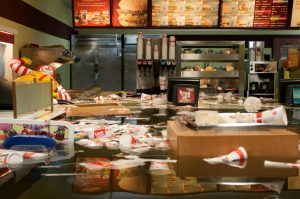
Flooded McDonald’s was a film by SUPERFLEX released in 2009. They constructed a life-size replica of a McDonald’s in a studio in Bangkok, then filled it with water until it was flooded to the brim, transforming a global symbol of consumerism into a gradual disaster scene. The film echoes declensionist themes that were a response to contemporary world issues: “the financial crisis had happened, end-of-the-world rhetoric was circulating, global warming was really kicking in, and Hollywood was making films about all of this.” Global warming and capitalism intertwine: the rising water engulfs the architecture of mass production, and in the process SUPERFLEX exposes how the power consumerism becomes fragile under climate catastrophe.
An issue of the climate crisis that the film unintentionally brought to light was the role of media and the relatability of imagined, familiar spaces. During a heavy flooding season in Australia, news outlets accidentally used a clip from our film, believing it was real footage. SUPERFLEX noted that it “reveals the responsibility and ambiguity of creating a one-to-one scale set that viewers can easily imagine themselves in.” Familiar spaces, especially those that are affected by environmental disturbance, become outlets for imagining loss, mourning stability, and narrating climate change through everyday life.
Experience Climate Change As an Animal, 2009
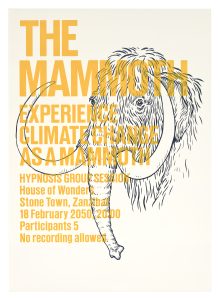
Experience Climate Change As an Animal (2009) was a series of workshops that began with participants at the Copenhagen climate summit to undergo hypnosis and perceive climate change through the eyes of a cockroach. During the following months they hosted five other hypnosis sessions as other species: eagles, jellyfish, polar bears, mosquitos, and mammoths. SUPERFLEX intentionally selected animals that were “either extinct or about to become extinct, or on the contrary carrying dangerous diseases.” The workshops were a unique approach to “imagining climate change,” taking the empathic rhetoric environmental movements employ to the highest degree.The intentional selection of such radically different species highlights how unevenly climate change is felt across the planet, pushing participants to consider a spectrum of ecological experiences—from extinction-level precarity to the spread of disease—and to imagine the crisis from perspectives far beyond the human.
Power Toilets, Ongoing
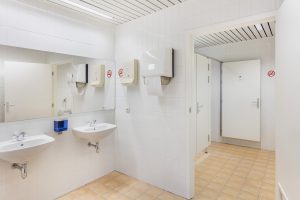
As a part of their “transformation of power” project series, which deals with the flux nature of governmental bodies, economic structures, and shifting social conditions, SUPERFLEX began the Power Toilets project in 2010. Power Toilets involves creating exact replicas of toilets in corporate, “powerful” places such as the United Nations Framework Convention on Climate Change in Bonn or the Executive Board of the UNESCO headquarters in Paris and making them accessible to the public. SUPERFLEX writes that the work “invites its users to question the relationship between original and copy, exclusivity and inclusivity, and, ultimately, the infrastructures of power and its everyday manifestations.” The project turns the literal spaces of institutional authority into sites of shared waste, ironically redistributing the power to access and “use” these global decision-making bodies. By collapsing the distance between elite climate governance and ordinary publics, Power Toilets exposes the absurdity of centralized control over environmental futures and imagines a world in which the infrastructures of power—and the waste they produce—are open to all.
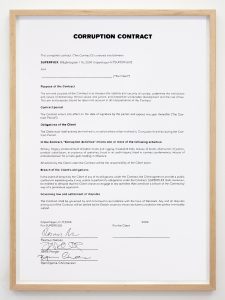
The Corruption Contract, 2009
Corruption Contract (2009) mimics a formal legal agreement in which SUPERFLEX invites a “client” to participate in what they describe as activities that “threaten the stability and security of society, undermine the institutions and values of democracy, ethical values and justice, and jeopardize sustainable development and the rule of law.” Adapted from the United Nations Convention against Corruption, the contract requires the client to “actively be involved in, or solicit others to be involved in, Corruption Activities,” defined to include “bribery, forgery, embezzlement of public funds, bid-rigging, fraudulent bids,” and more. By framing corruption as a bureaucratic obligation, one complete with signatures, obligations, and penalties, SUPERFLEX satirizes the administrative language through which power is maintained. It exposes the absurdity and permeability of systems meant to safeguard democracy amid global crises like climate change, as bureaucratic systems often serve as an impedance to the climate change movement.
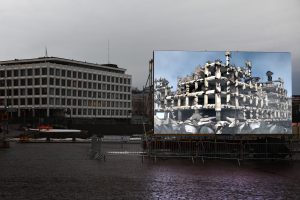
Modern Times Forever, 2011
Modern Times Forever (2011) is a 240-hour film that imagines the gradual decay of Helsinki’s Stora Enso building over thousands of years. Described as a work that “collapses notions of time, permanence, and modernity in public urban space,” the film subjects the iconic structure, known locally as “the sugar cube,” to an accelerated future of erosion. Designed by Alvar Aalto and completed in 1962, the building has been a site of artistic controversy, many describing it as the “ugliest building in Finland”with its modernist architecture style. Viewing the building through a distant temporal lens, SUPERFLEX reframes climate change as a slow, geological process that will outlast current political horizons, asking viewers to confront the fragility of “modernity” and the inevitability of environmental transformation. It ultimately positions the building as a monument to impermanence, a reminder that even steadfast symbols will erode under the pressures of environmental disaster.
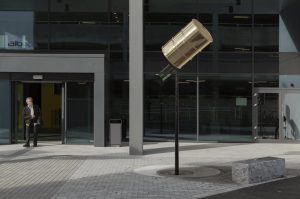
Oil Fountain, 2012
Oil Fountain (2012), installed in Haugesund, Norway, presents an oil barrel tipped on its side, suspended as a continuous stream of oil pours from it. The sculpture “appears to achieve the magical feat of being suspended in the air as oil streams from it endlessly,” yet the illusion is “far less stable than it seems.” SUPERFLEX highlights how oil, “a substance which has consistently fueled corruption and catalysed war and conflict,” continues to define value in petrochemical economies, especially in the situated country of Norway. But “few things last forever,” they write, and the seemingly eternal flow gestures toward a resource that might be running dry” By staging this tension between abundance and depletion, the work imagines climate change through the temporality of extractive industries. This message becomes clear when viewing the work in the context of the climate change movement, at a time when the oil-dependent industries were being scrutinized and pressures to transition toward renewable energy: fierce national debates over Arctic drilling in Lofoten and the Barents Sea, public criticism of Statoil’s tar sands investments, and growing political concerns about Norway’s “oil addiction” amid mounting global climate pressures.
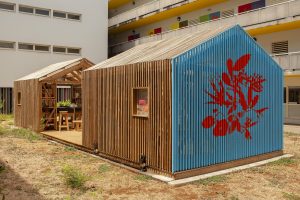
The Nursery Garden, 2017
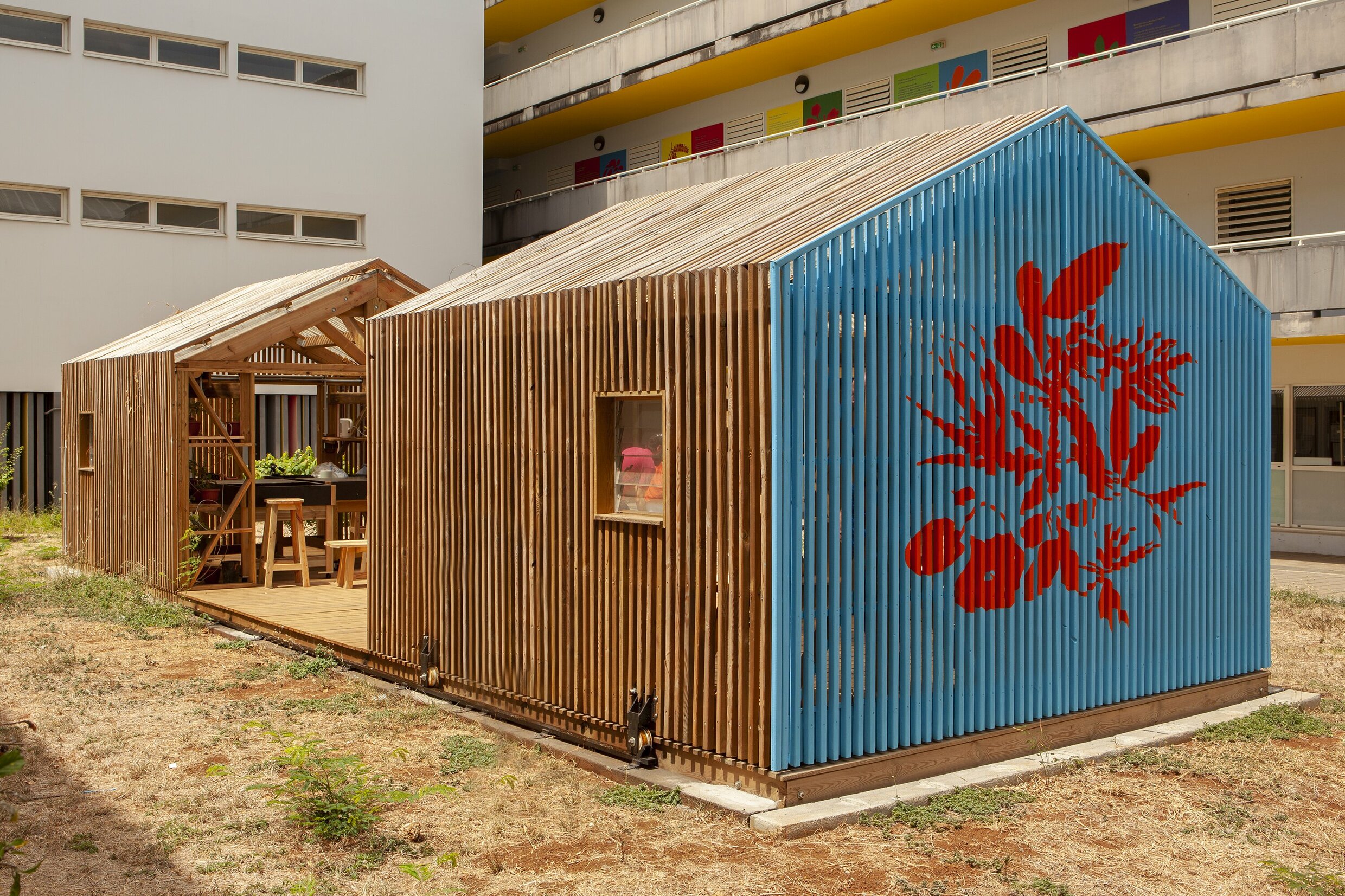
The Nursery Garden (2017) is a public artwork created for hospitals on the French islands of the Indian Ocean. SUPERFLEX writes that “the project aims to facilitate an exchange of knowledge between different cultures of medicine, challenging the common boundaries between ‘modern’ and ‘traditional’ medicine.” In each courtyard, a nursery of medicinal plants “provides a neutral setting where patients, visitors and hospital staff can take a break, meet each other, learn about botany, join a workshop, or nurture the growing plants.” By elevating local medicinal knowledge and re-centering healing around ecological relationships, the project resonates with broader movements to imagine climate change through traditional and Indigenous modes of understanding: approaches that emphasize interdependence and the restoration of reciprocal ties between humans and their environment. The Nursery Garden highlights this need for a synthesis between what is modern and what is traditional, especially in ecological approach.
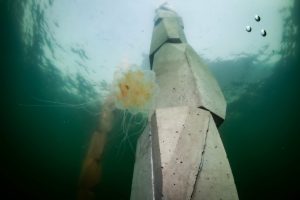
As Close As We Get, 2022
As Close As We Get (2022) is a monumental sculpture that extends from above the water’s surface into the underwater landscape, creating a shared architectural space for both humans and marine life. SUPERFLEX describes the work as part of “an open-ended research examining the relationship between humans and other species, proposing a new kind of urbanism that reimagines how we live together.” The piece acknowledges rising seas and the shifting boundaries of habitable space, and serves as a symbol of cohabitation between humans and nonhuman species. It imagines climate change as a catalyst for new forms of multispecies coexistence, and the artistic monument form it takes allows viewers to consider futures in which built environments must adapt to ecological transformation rather than resist it.
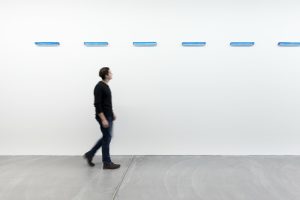
In Après Vous, le Déluge, 2019
In Après Vous, le Déluge (2019), SUPERFLEX installed a thin blue dashed line along the atrium walls of Galeries Lafayette on the Champs Elysées in Paris. The work consists of blue tubes lining the building’s atrium. This discontinuous line is an indicator of an invisible border: the height of ocean level rise within the next century as a result of climate change. Similar to their Flooded Mcdonalds piece, SUPERFLEX uses the intervention of a familiar space of the department store to highlight the “cause and effect” nature of consumption. A department store is a space defined by the very consumption that threatens the climate. The blue line marks how the climate crisis is “rapidly threatening the structures of our quotidian reality,” visualizing a future shoreline inside a temple of consumerism.
Works Cited
SUPERFLEX. “Flooded McDonald’s (Short Intro).” YouTube, uploaded by SUPERFLEX, 2009, www.youtube.com/watch?v=gsJsb2BKBLE.
Austvik, Ole Gunnar, et al. “BP Spill Seeps into Norway’s Arctic Drilling Debate.” Reuters, 29 July 2010, https://www.reuters.com/article/idUSTRE66S27H.
Solsvik, Terje. “Norway Rejects Greenpeace Appeal Against Statoil Drilling.” Reuters, 30 May 2014, https://www.reuters.com/article/world/norway-rejects-greenpeace-appeal-against-statoil-drilling-idUSKBN0EA1HR.
Macalister, Terry. “Gas Build-Up Threatens North Sea Oil Rig.” The Guardian, 27 May 2010, https://www.theguardian.com/environment/2010/may/27/north-sea-oil-rig-gas-threat.
Adomaitis, Nerijus. “Norway Environmental Lawsuit Says Arctic Oil Plan Violates Constitution.” Reuters, 14 Nov. 2017, https://www.reuters.com/article/business/environment/norway-environmental-lawsuit-says-arctic-oil-plan-violates-constitution-idUSKBN1DE172.