Remembering Death:
“Memento mori” is a Latin phrase that can be translated to “remember (that you must) die.” This phrase is often associated with a human skull (known as a “vanity”) and an hour glass, which together symbolize the fragility and finitude of our time on Earth, which we have no power to prolong, nor can we predict when it will end. In the 21st century, the concept of our finite existences loom over us now more than ever with the threat of climate change cutting our time even shorter.
While the concept of memento mori can seem as an unwholesome warning to some, to many, it is a call to action. Memento mori, in a similar fashion to the latin phrase carpe diem (seize the day), reminds us that we only have so much time on Earth, so we should use this time to the best of our abilities. One such person who views life and death, and in turn humanity’s role in climate change, in a similar fashion is environmental artist Anne de Carbuccia.
Anne de Carbuccia, the TimeShrine series, and Choices before Dying:
Anne de Carbuccia– born in New York – is an artist, film director, photographer, and charity founder. While studying anthropology and art history at Columbia University, de Carbuccia explored the concept of the Anthropocene: a term describing the time in which we currently live where humanity acts as a geological force of change (climate change). These changes include pollution, deforestation, and the extinction of organisms and habitats.
In 2013, de Carbuccia set out on a global expedition. Her goal: to document the fleeting beauty of unique environments across the world before they are lost to climate change. This project took her 10 years to complete. Using objects found on-site for each location, de Carbuccia constructed shrines dedicated to each location’s natural beauty. One commonality between all of her shrines (dubbed the TimeShrine series) are the two hallmark symbols of memento mori: a vanity and an hourglass. To de Carbuccia, these objects represent not only death, but more importantly choice. “…it’s true we are mortal and, you know, we need to be reminded of that,” she explains in an interview about the collection. “But more than anything, what we need to think about every day when we get up is the fact that we have a choice…we can choose whether we want a positive and productive life or a superficial, vain life, thus the term vanity.”
Saying Goodbye and Looking Ahead:
After photographing, de Carbuccia uninstalls the shrines. Additionally, some of these sites no longer exist due to climate change, further connecting the concept of climate change to memento mori through its temporality. In her TimeShrines, de Carbuccia juxtaposes the beauty of nature with the objects of memento mori, conveying how we as humans have limited time to make choices that will better this Earth. Although our time is fleeting, de Carbuccia’s strides in environmental art and advocacy prove that the time we do have is significant. The fate of mother nature lies in how we choose to live our lives, and we can choose to fight against climate change and heal mother nature.
Selected Works:
This exhibit includes 11 selected works from Anne de Carbuccia’s TimeShrine series, focusing on those within the Americas. The date of these images ranges from the year 2013 to 2018. You can locate more images and information about de Carbuccia here: Anne de Carbuccia
1) CHRISTMAS TREES FIGHTING EROSION | SAGAPONACK, USA, AUGUST 2014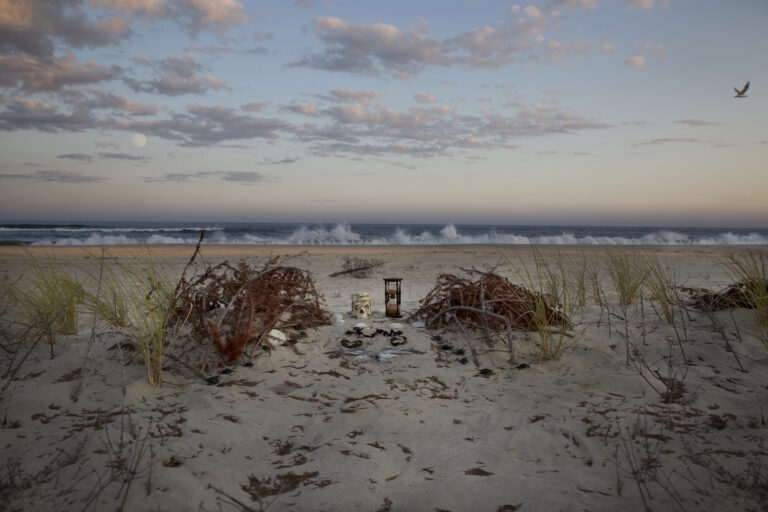
In Christmas Trees Fighting Erosion, de Carbuccia situates her shrine on the shore of Sagaponack, New York. Between two wilting pine or “Christmas” trees lies the vanity and hourglass, encircled by seashells and preceded by what remains of a seagull carcass: the wings. In the background beyond the shrine, one lone pine tree has succumbed to the effects of erosion and has collapsed in the sand. Due to the composition of the piece, our eyes naturally travel from the front of the photograph to the shrine in a seemingly pre-ordained path of death. A path where humans choose to do nothing about the destruction of the Earth. However, off this beaten path, in the right corner of the photo, we see one lone seagull escaping the scene of death. This seagull still has its wings and is free to leave the photo.
2) WOMEN EMPOWERMENT | UNITED NATIONS HEADQUARTERS, NEW YORK CITY, MARCH 2017
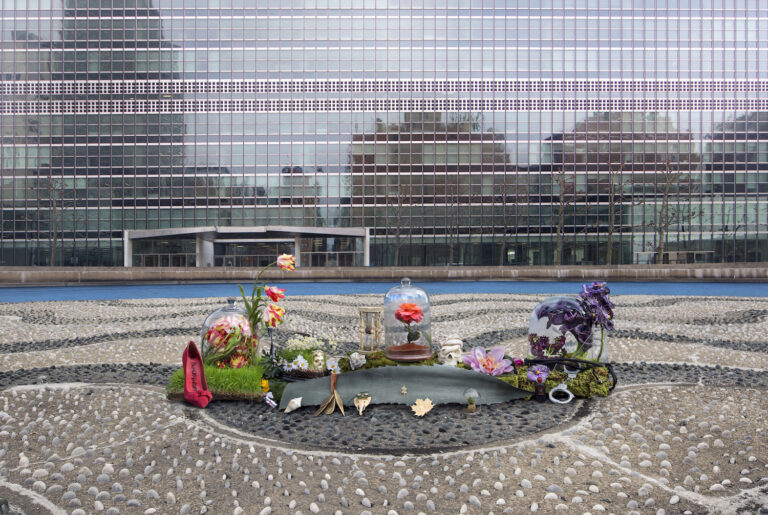
Anne de Carbuccia has stated that this timeshrine was one the the most difficult for her to create due high winds from an impending blizzard. While many of her shrines last at least two days for photography, de Carbuccia only had one day to capture this shrine in front of the UN headquarters due to her acquired permits. In this piece, the hourglass and vanity take a back seat, as flowers and plants comprise most of the shrine. Not only do flowers have short lives, symbolizing the fleeting beauty of mother nature, but flowers are commonly associated with feminine beauty and power, hence the title. The shrine’s centerpiece, an aloe leaf, can symbolize how women’s choices have the power to soothe Earth’s wounds from climate change.
3) TRIBAL FEATHERS & ALLIGATOR | WAKUNUMA, RIO BATOVI, MATO GROSO, BRAZIL, NOVEMBER 2013
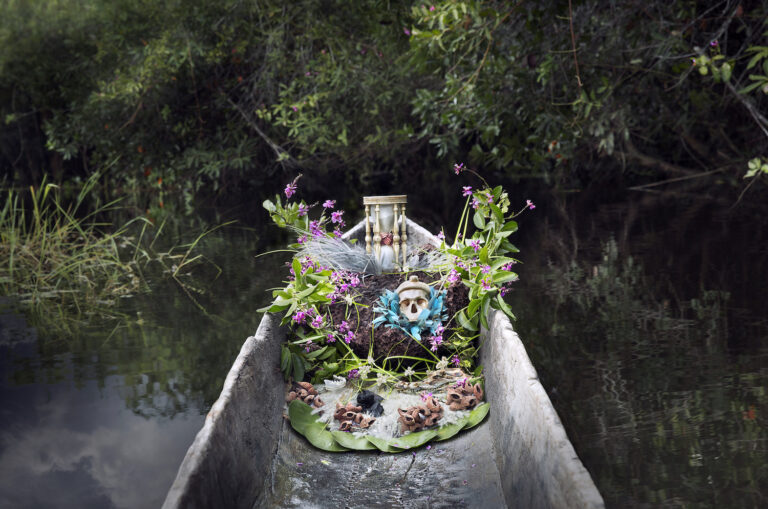
Rio Batovi ( theTamitatoala River), located in Mato Groso, Brazil, is a part of the Amazonian river system. Situated nearby is a village inhabited by the Xavante people, a community indigenous to Brazil. de Carbuccia represents them and other indigenous communities situated in the Amazonian River Basin through the tribal feathers that caress the vanity in this shrine. Here de Carbuccia articulates how humanity’s choices thus far have not only reduced the miracles of the natural world, but also the world’s richness of culture. Corporations within the Amazon that fail to realize memento mori make superficial decisions based on material extraction and wealth. Their choices of deforestation, mining, and pollution to the land and water has greatly shortened the lives of indigenous Amazonians as well as nearby flora and fauna.
4) VANISHING REEF & BLUE MOON CRAB | BAY ISLANDS, HONDURAS, AUGUST 2014
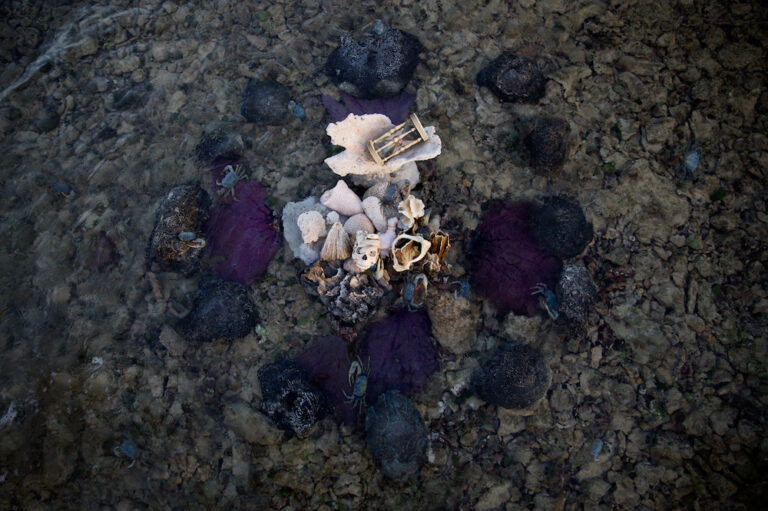
In this shrine, from a birdseye view we observe a vanishing coral reef within the waters of Honduras’ Bay Islands. Below the water, though slightly camouflaged, are blue moon crabs native to the area. Dead coral breaches the waters’ surface, cradling the vanity, hourglass, and the jawbone of a fish. Their position just above the water’s surface creates a sense of tension and anticipation, as it is only a matter of time before the tide changes and the ocean swallows the shrine whole. The crabs seem to be scattered and lost in response to the vanishing reef, running away or to the shrine. This may symbolize how we as humans can either face the loss of nature in wake of our actions and choose to work against it, or ignore it and run away.
5) FICUS TREE & BOA CONSTRICTOR | PICO BONITO RAINFOREST, HONDURAS, AUGUST 2014
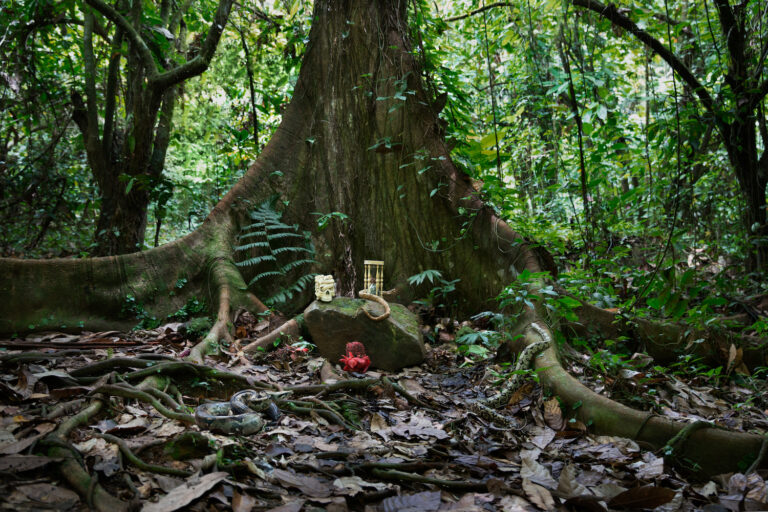
This Shrine is located within the National Park of the Pico Bonito Rainforest in Honduras. In this shrine, the vanity and hourglass are very miniscule compared to the overall composition of the piece. The large trunk and roots of the ficus tree draw our attention away from the two manmade objects and towards the beauty of the rainforest. This scaling symbolizes how de Carbuccia wants humans to make decisions for the good of the biosphere, not for the good of the “Anthropocene”, or only humans. Our lives are not the only ones that are fleeting and valuable. The boa constrictors encroaching on the manmade objects symbolize a synergy between man and nature. We can choose to see nature and humanity as a single harmonious entity to help encourage its preservation.
6) PREHISTORIC FERN & TROPICAL RATTLE SNAKE | PICO BONITO RAINFOREST, HONDURAS, AUGUST 2014
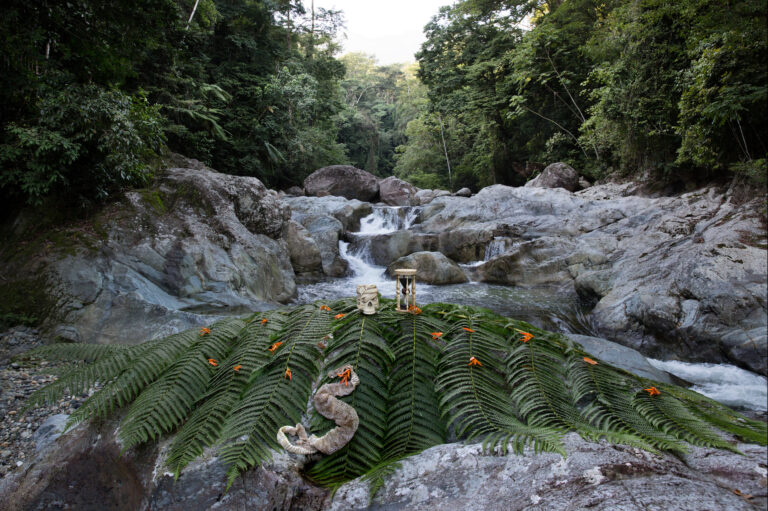
This is another shrine located within the Pico Bonito Rainforest of Honduras. By the title alone, one would think that this photograph would capture another snake interacting with the shrine. However, only the skin of a rattlesnake can be seen, placed by de Carbuccia at the front of the shrine. This juxtaposition represents the passage of time within a single lifetime. Although the skin may no longer be alive, it is an essential part of life for the snake, and therefore still a part of it. Similarly, the possessions and waste we shed in our lifetimes stays behind just like the snakeskin. So, we must choose what we use and how we use it wisely if we wish to lead fulfilling lives that will contribute to the protection of mother nature.
7) VANISHING REEF | UNION, CARIBBEAN, OCTOBER 2014
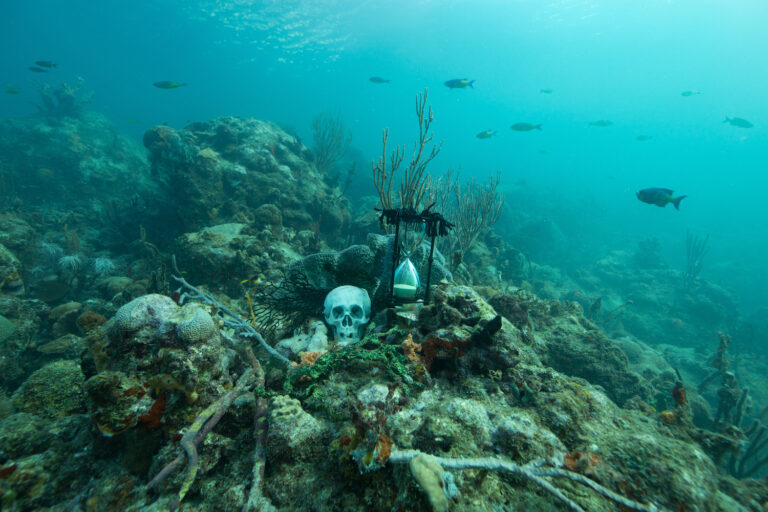
This TimeShrine, which is located under the seas of the Caribbean, is situated amongst bleached coral. Coral bleaching occurs when the temperature of the surrounding water is too high, which stresses the symbiotic relationship between coral and the microscopic algae that lives within its tissue. When water temperatures rise due to global warming or pollution, the algae leaves the coral, creating a green film around the coral at the onset of the bleaching (as seen in the photograph), leaving the coral completely white at the outset. Just as algae and coral depend on each other for survival, de Carbuccia sees humanity and nature as dependent on each other as well. A human depends on nature for survival, and nature must depend on humans as protectors, not destroyers. Without this relationship, all natural beauty will be fleeting.
8) CONSTELLATION I | TOBAGO CAYS, CARIBBEAN, OCTOBER 2014
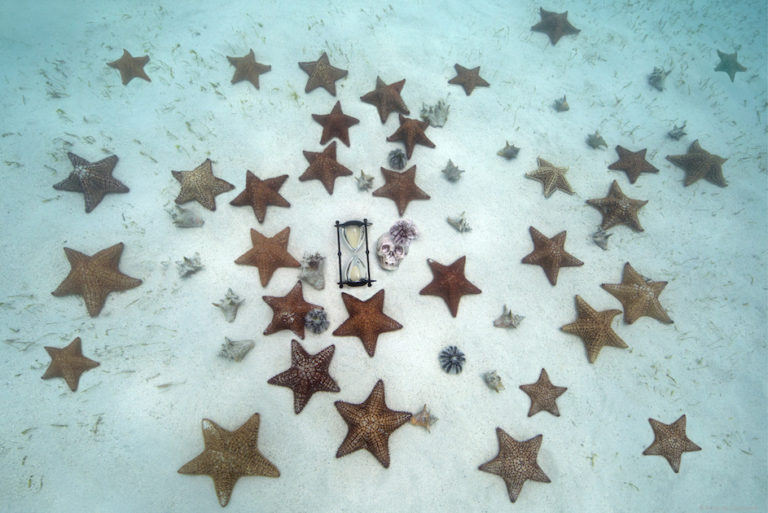
This shrine is located within the protected Tobago Cays is a protected Marine National Park. Although this area is protected, that does not mean that it is immune to threats. Illegal fishing, sewage from yachts, and other human activity threaten this ecosystem. This shrine illuminates the juxtaposition of the different kinds of choices humans can make. Although humans have made strides in protecting this area, others continue to deplete it of its unique beauty through extraction and pollution for momentary pleasure or monetary gain. However, if we live by de Carbuccia’s interpretation of memento mori, we can see that the one true choice would be one that preserves this area for future generations beyond a single human lifetime.
9) PREGNANT BULL SHARKS | 20°37’27.2″N 87°03’37.0″W, MEXICO, DECEMBER 2018
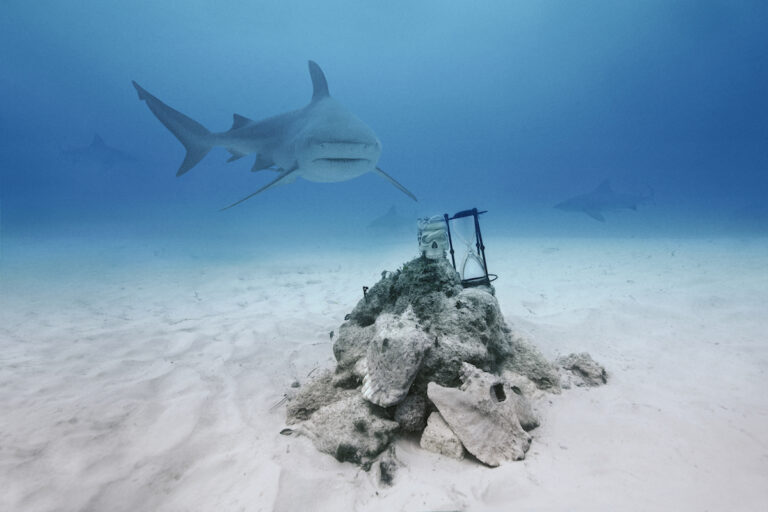
A mother bullshark faces us head on as we observe this TimeShrine in the seas of Mexico. The hourglass and skull are on top of a graveyard of coral– a running theme we’ve seen throughout de Carbuccia’s marine shrines. The death and destruction of coral reefs directly threatens bullsharks, as it reduces their hunting and breeding grounds. This bullshark is not the only mother that is threatened by climate change. De Carbuccia and many other parents fear for the lives of their children and grandchildren. In an interview with news outlet Film Obsessive, deCarbuccia remarks how future generations are “not going to have the same opportunities and… the same quality of life that we’ve had.” This unfair future is “because of the decisions [humans] are not taking right now” within the limited time that we have on Earth.
10) PLANET | GRENADINES, CARIBBEAN, OCTOBER 2014
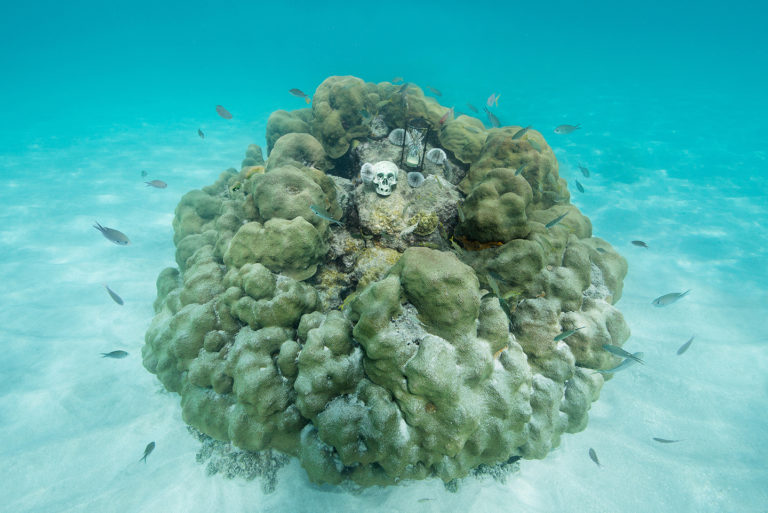
Much like the fifth selected TimeShrine featured in this exhibition, Planet puts the fragility and shortness of human life into perspective with the framing of the photograph. Although the vanity and hourglass are miniscule compared to the planet-shaped bed of coral, they are placed near the planet’s core, or heart. Although human life is small in comparison to the Earth, we are still integral to its fate of either preservation or destruction. As a part of the core of Mother Nature, we have the power and responsibilities to make choices that will help heal this bleached coral and the biosphere as a whole. These choices are those that lead to a life that we can be proud of when it ultimately ends.