Terry Evans has spent decades in the field of photography and is highly recognized for her work on the prairies and plains of North America. She has explored this landscape through aerials, close-ups, and collage. Her focus has ranged from the “virgin parries,” industry brought by humans, the urban, and the lives of those who call these lands home. While she has worked extensively on this landscape, she has also ventured into other areas. A Greenland Glacier: The Scale of Climate Change is a 2008 project in which she ventured to the Jakobshavn Glacier to visualize the changes brought about by climate change in this environment. In this exhibition, the A Greenland Glacier project and her photographs from various prairie projects are brought together in diptychs that highlight her exploration of climate change and how ideas may shift across different ecosystems.
When thinking about climate change in relation to the work of Evans, A Greenland Glacier stands out among all her projects as it is quite explicit in its aims to explore the topic. Such explicitness results from the way Evans speaks about the project and from the glacier being the subject. When asked to imagine climate change, one often thinks of melting glaciers. It is a prominent concern that Evans aimed to highlight through these images. A decision that resulted in images that speak to the fact that our environment is changing at scales that can be hard to understand. But Evans’ work proves that there are those who are determined to understand thse complex scales.
In contrast to glaciers, the prairie is rarely imagined when thinking about climate change. However, Evan’s work challenges this popular disconnect by highlighting the complex stories present in this landscape. For this exhibition, one image was selected from the projects Ancient Prairies, Canada to Texas, Hunger Striker Stamets, and Inhabited Prairie. The chosen photos highlight moments in which Evans captures the different scales on which the environment has changed, and the efforts people have made to live peacefully on the prairie and to fight the harm caused by humans.
Through the image pairings and the exhibition as a whole, we can recognize that environmental challenges are truly global and are not limited to specific environments or habitats. The Jakobshavn Glacier and the North American Prairies might be thousands of miles apart, but their unfolding stories are connected. The photographs fluctuate in scale and reflect the complexities of scale one has to grapple with, but one is allowed to sit with this as one is pushed to recognize all the possible relationships we have with the world.
1.
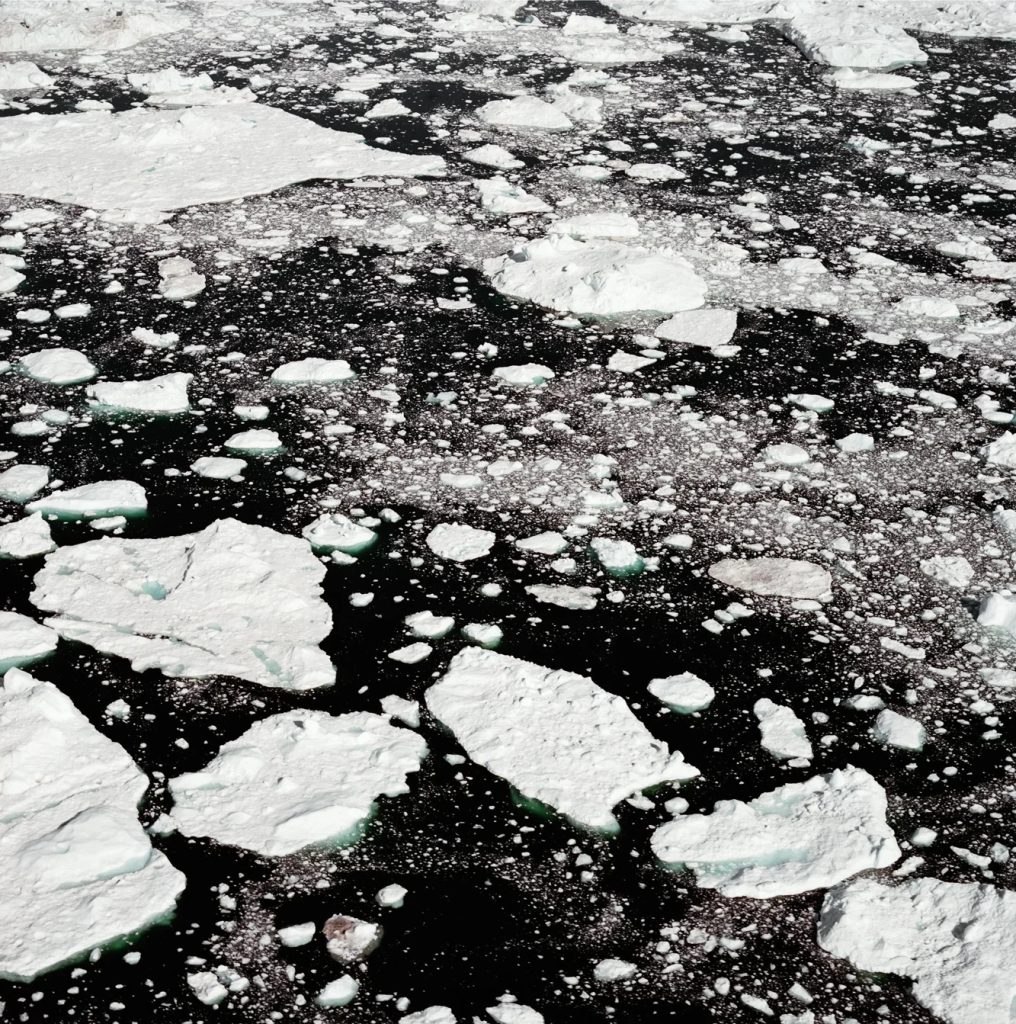
Clarity in scale was one of the biggest issues Terry Evans faced when capturing aerial photographs of the Jakobshavn Glacier. After all, she took on the project as a means to try to understand the rate of melting ice and climate change through a visual format. This issue is particularly prominent in this photograph, as we can’t really deduce the scale of the ice sheets. However, Evans did not dismiss these types of pictures, as she points out that her own frustrations with the work speaks to her frustration with climate change. After all, the scale of climate change requires us to do more work.
2.
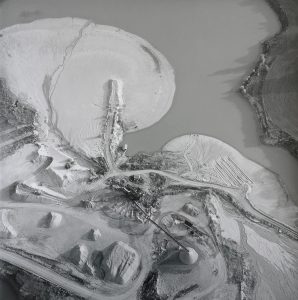
For a long time, Terry Evans was only interested in photographing the “pristine prairie ecosystem.” However, as she continued working on the prairie, he noticed how the inhabited prairie is a fact that could not be ignored. As such, in this aerial photograph, we can see mining activity in the landscape. With this, we can see a story of misuse. Interestingly, as a result of this story being told through aerial photography, we can see a complication of scale. We can see the vast amount of land being used and the way the ecosystem has changed. But at the same time, the large scale also obscures its presence.
3.
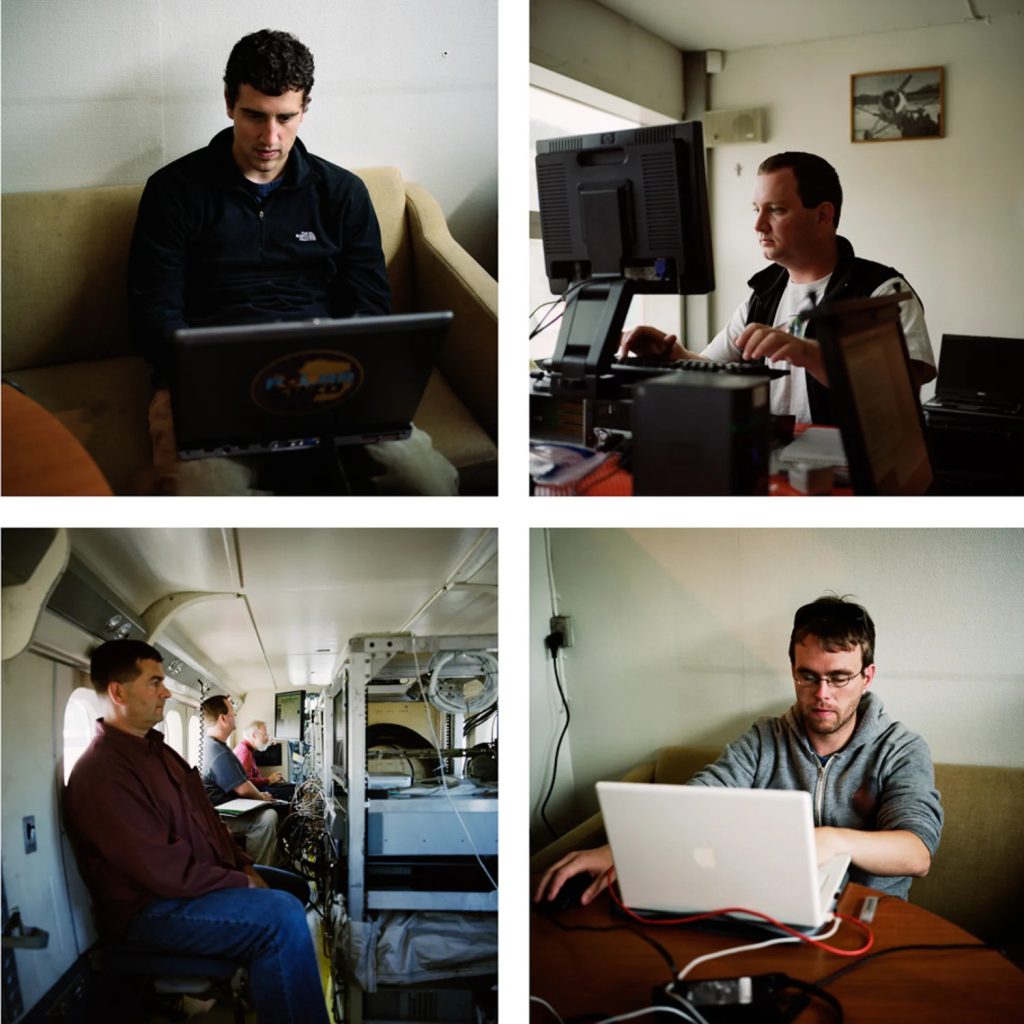
While working on A Greenland Glacier , Terry Evans interacted with a CReSIS and NASA team that was measuring the topography of the Jakobshavn Glacier. She chose to highlight their presence throughout her trip by taking pictures of them at work. As such, these four pictures stand as a representation of the many people who are dedicating their lives to visualizing glaciers and making climate change more understandable to the public.
4.
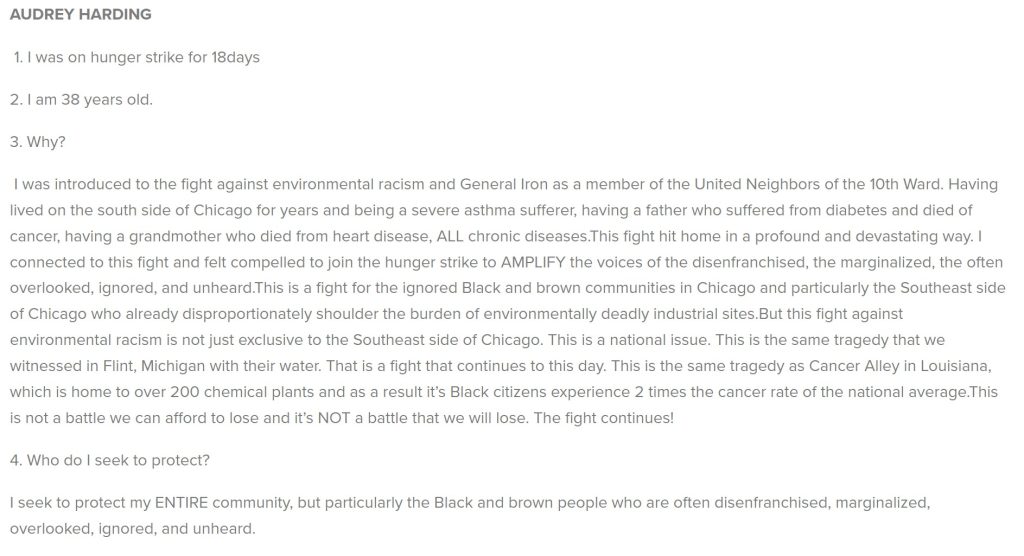
In the project Hunger Striker Statements, Terry Evans takes us through the protests that have resulted from the General Iron relocation from Lincoln Park to the Southeast Side of Chicago. Chicago and the environmental challenges faced within the urban environment are an important aspect highlighted by Evans, as one does not often recognize the city as part of the prairie ecosystem. The prairie here has been altered by human activity and it possesses people like Audrey Harding who has gone on a hunger strike to mitigate the harm being caused by human activity.
5.
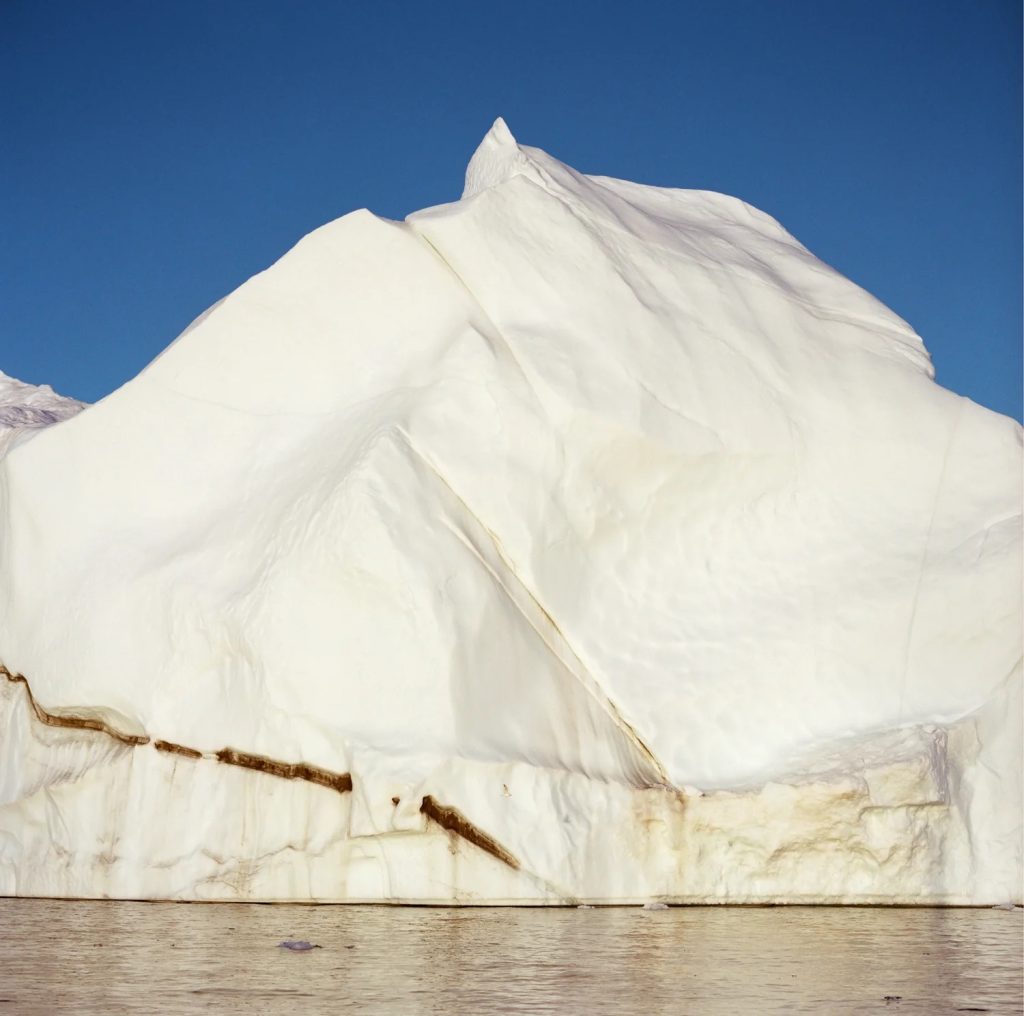
In taking on the A Greenland Glacier project, Terry Evans set out to capture the scale of the Jakobshavn Glacier. It would not be a stretch to say that in this photograph, she was able to showcase the height and mass of a section of the ice. After all, the framing results in the glacier occupying a majority of the photograph. The sheer scale of the ice is increased further when one notices the presence of a bird, as it is rendered almost invisible by the staggering nature of a glacier.
6.
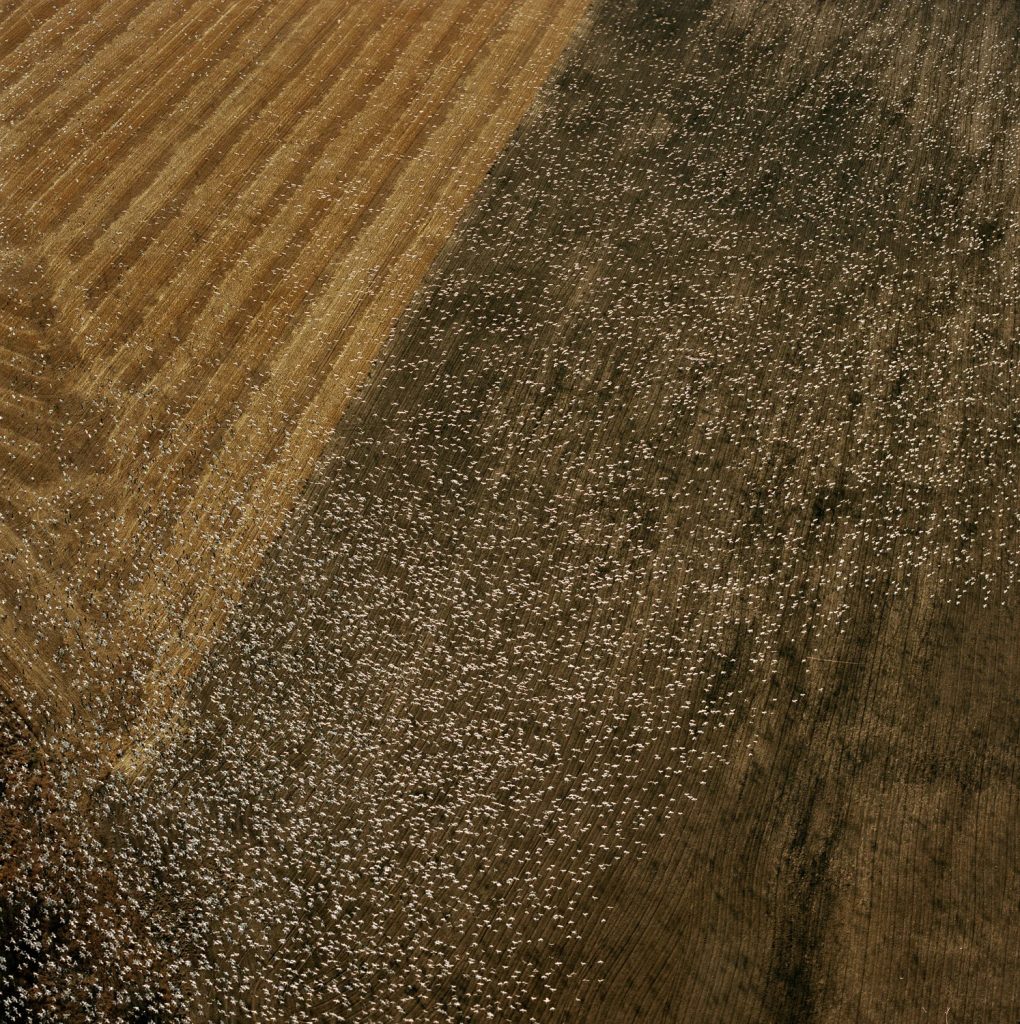
Part of Terry Evan’s Canada to Texas series, this aerial photograph highlights the vastness of the prairie landscape. In this image, we see two distinct fields, one golden and the other dark brown. These are farmlands that now occupy the prairie as a result of human activity. On top of the fields, we can see a large flock of birds, which appear as white dots on the landscape. Their abstraction shows the scale of this landscape by highlighting how much land is been shown in the photograph.

7.
At first glance, one might not notice the human presence and manmade elements present within this grouping of photographs. Instead, one immediately takes notices the greens, browns, blues, grays, and whites that make up the costal Greenland landmass leading to the Jakobshavn Glacier. These are quiet images that, taken together, showcase the small ecological differences that shape how the land exists. However, in showcasing the land, it does not ignore the presence of humans. In taking a closer look at the pictures, we can see shoe prints in the mud, a human shadow, and land markers.
8.
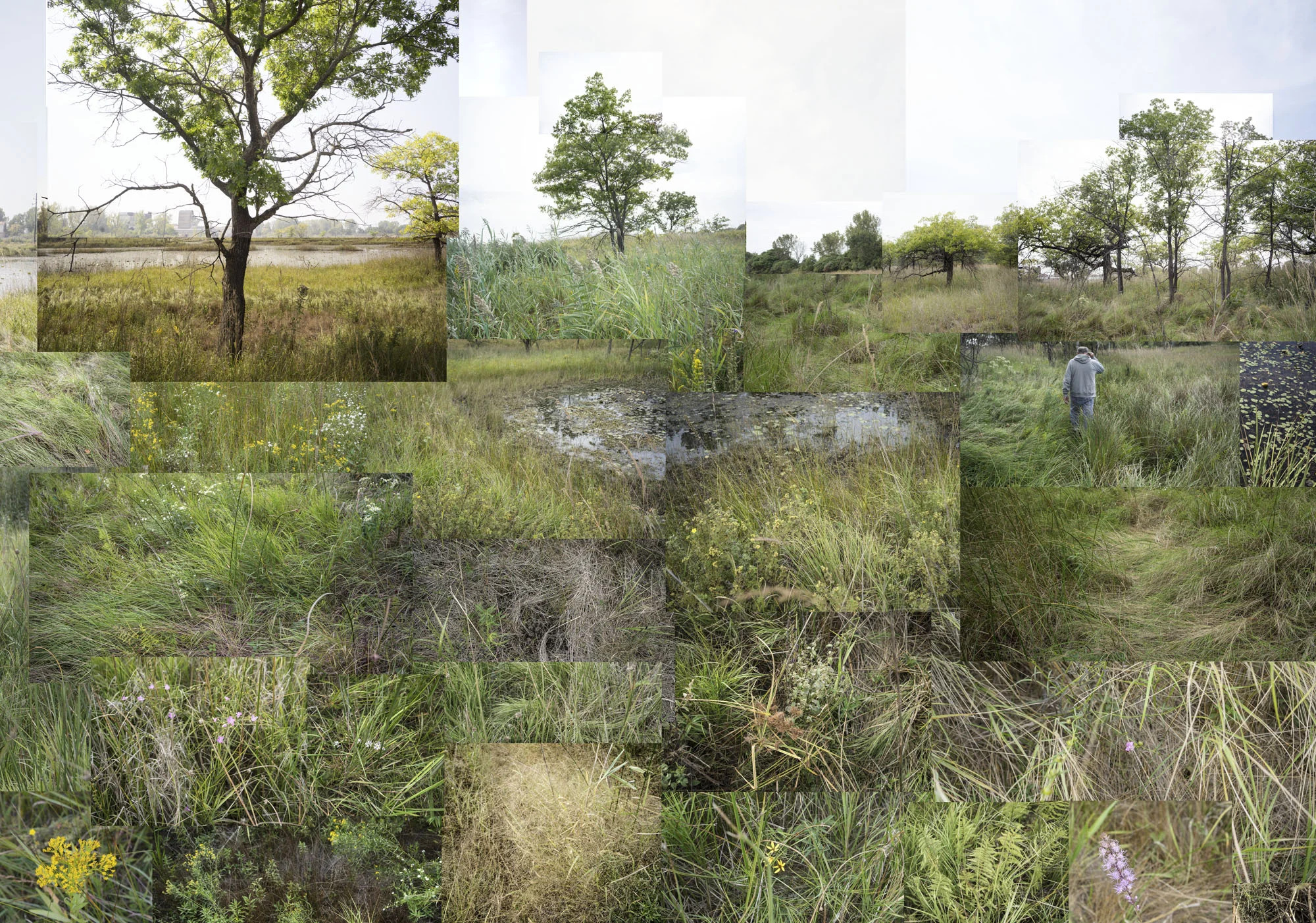
Terry Evans has photographed the prairie for many years. The photographs have ranged in scale and scope. In this work, we see her create a collage of many of her images to highlight the complexities of the prairie. We see the use of close-ups to highlight the intricate details of the different grasses and wide shots to capture the larger landscape. Within this collage, we also see the deep desire to showcase the human presence in the area and to highlight the kinship that is possible. The human figure exists within the land, but causes no harmful impacts.