Introductory Statement
“Attention is the beginning of devotion” – Mary Oliver, Upstream
Mary Oliver’s Upstream is an ode to nature and a guiding inspiration for my contribution to this exhibit. In this collection of essays, Oliver steps out of her usual poetic form into prose, encouraging readers to understand the natural world as a teacher, embracing environmental stewardship. The collection’s metaphor of moving “upstream” frames the essays as a call to resist materialism and societal expectation, to turn towards a life that is based in continued observation and care. In this exhibit, Oliver’s framing becomes a tool for imagining climate change not only as a crisis, but as a call to sustained attention and a more devoted, responsible engagement with the environment.
Bridging together poetry, painting, photography, and music, the works invite viewers to understand nature through small acts of noticing and gestures of care. While these pieces are not images of environmental catastrophe or a call to activism, they articulate out intimate and ethical relationship to the natural world. Sally Weintrobe, a climate psychologist, emphasizes that humans often struggle to feel urgency for the climate crisis because it seems so distant form their notions of self. Hence, Oliver’s work counters this divide as she draws on human experience and the natural world by forging a shared realm built on attention and care.
Dominic Chambers’ Leave Room for the Wind, Vincent van Gogh’s Irises, and Oliver’s poems Work and Wild Geese all point to this shared space between humans and the natural world. They reconfigure our relationship to the natural world via coexistence, not domination. Moreover, musical interpretations by Lori Laitman transform this attentiveness into sound, encouraging viewers to listen to nature, as well. Similarly, Our World, created by Oliver and Molly Cook, demonstrates attention in action, embodying what it means to trust and care.
In the broader sense of this exhibit, “Imagining Climate Change,” to imagine the future of our planet requires us to look beyond urgent warnings alone. Perhaps, rather than merely imagining climate change, this exhibit also seeks to reimagine it, through devotion, a sustained practice of noticing and learning about what must be preserved. In turning to Mary Oliver, my contribution aims to encourage people to evaluate their relationship to the natural world, cultivating a form of care that is both personal and collective. Ultimately, this collection leaves viewers with hope that through a shared community of both attention and devotion, our climate crisis may begin to feel less distant and bleak.
Collection
1. Upstream by Mary Oliver
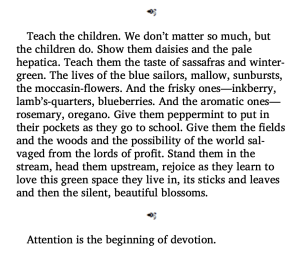
In an excerpt from her short essay Upstream, Mary Oliver frames environmental care as an act of education and devotion. The essay’s closing paragraph opens with the assertion, “Teach the children. We don’t matter so much, but the children do,” as Oliver lists flowers, fruits, and herbs that invite children to inhabit and imagine the natural world as a fragment of their daily lives. Via this focus on the next generation, Upstream models attention in practice. In the context of climate change, this essay emphasizes the necessity of ecological knowledge as a form of resistance to environmental degradation. She notes that children hold “the possibility of the world salvaged from the lords of profit,” responding to environmental extractive capitalism. The final line, “Attention is the beginning of devotion,” which centers this exhibit, is highlighted here through Oliver’s pedagogy, showing that care begins with noticing and engaging with the world.
2. Irises by Vincent Van Gogh
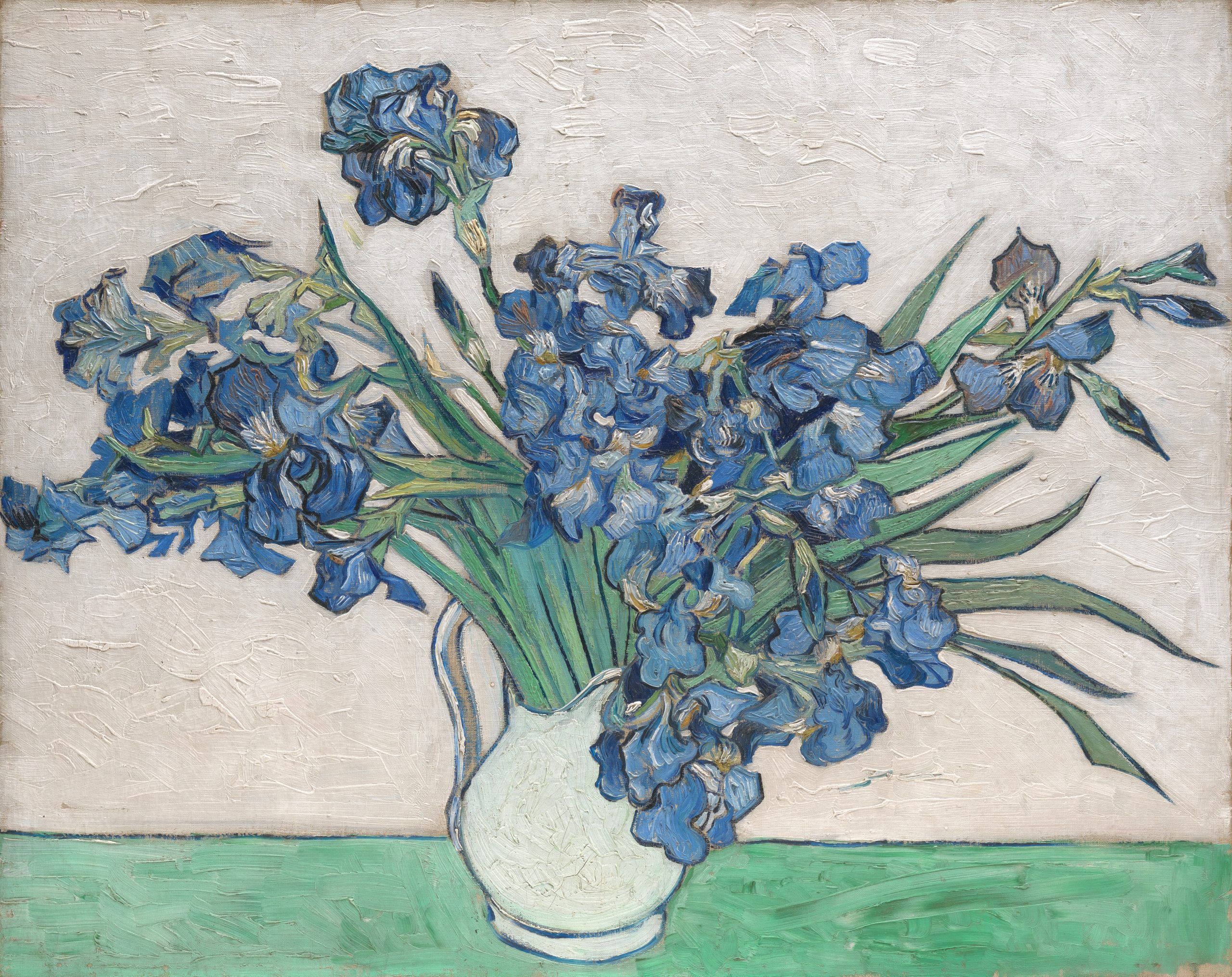
Vincent Van Gogh’s Irises acts as a visual and thematic touchstone for Mary Oliver’s collection of poetry, Blue Iris. The blooming irises, which are arranged in a vase, creates a conversation that calls viewers to take a devotional look at the ordinary, as the painting symbolizes the influence of the natural world on human life. Dr. Scott Allan, a curator at the J. Paul Getty Museum, analyzes that Irises resist the classification of either landscape or still life, balancing human influence and the natural world, as the flowers are contained within a vase. Within the lens of climate change, this tension demonstrates the small, but everyday ecological stakes that exist. Positioned at the beginning of Blue Iris, Van Gogh’s painting compliments Oliver’s poetry, visually representing the relationship between human and nature.
3. Wild Geese by Mary Oliver
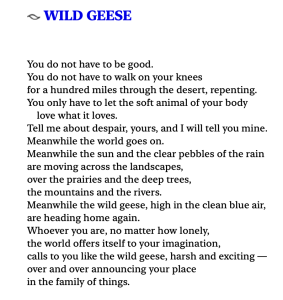
Sally Weintrobe argues that Western society often struggles to take the climate crisis seriously because of a split between the inner self and the external world, where what feels distant fails to feel urgent. Read through this lens, Mary Oliver’s Wild Geese resists this separation by constructing a shared realm between the human and nonhuman. In the poem’s central invitation, “Whoever you are, no matter how lonely, / the world offers itself to your imagination,” Oliver portrays nature as kin. By insisting that the natural world is not distant from our human life, Oliver stitches together Weintrobe’s split, actively inviting readers into this world where the human and nonhuman exist on equal footing. The figures of wild geese, described as “harsh and exciting,” which announce our place “in the family of things,” intertwines human belonging with the ecological. In the context of climate change, this poem becomes a signal for attention for the world that we do exist in.
4. Leave Room for the Wind by Dominic Chambers
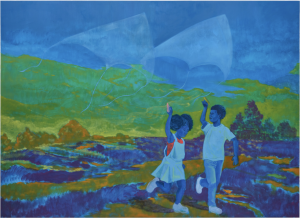
By omitting buildings and other markers of human development, Dominic Chamber’s Leave Room for the Wind constructs a timeless world that is mostly shielded from human influence, besides the two children that are centered in the painting. These figures, which move with the wind as they fly their translucent kites, demonstrate a form of leisure which is only made possible by way of the natural world. At a moment when climate change is often framed within the lens of urgency and disaster, Chambers creates a type of attention for our climate that is rooted in stillness and even childish wonder. While this work may not explicitly reference climate change, Chambers, inspired by Mary Oliver’s poem The Leaf and the Cloud, unintentionally calls for viewers to recognize what is at stake, renegotiating our relationship with nature. Leave Room for the Wind configures nature as a living presence that we live alongside.
5. The Leaf and the Cloud, Work, Section VII by Mary Oliver
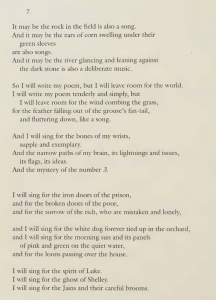
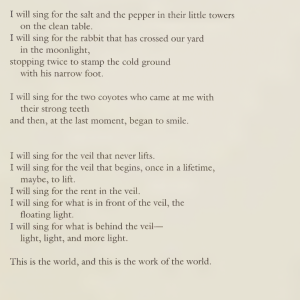
As a companion to Chambers’ Leave Room for the Wind, Mary Oliver’s poem Work invites a similar reconsideration of our relationship to the natural world. Work follows a sixty-year-old woman, presumably Oliver, reflecting on the “work” of her life and how nature has shaped her understanding of her work. In Section VII, Oliver repeats the phrase “leave room” for the natural world, even as she declares, “So I will write my poem,” modeling the need for consideration beyond the self. In the context of climate change, this poem, which constructs humans through the lens of nature, demonstrates the natural world’s role in everyday life. By the end of the poem, the repeated declaration “I will sing,” along with the closing line “This is the world, and this is the work of the world,” becomes a form of advocacy in which Oliver shows that care for the natural world is a shared responsibility.
6. Our World, “Helping the traveler, 1965” by Mary Oliver and Molly Cook
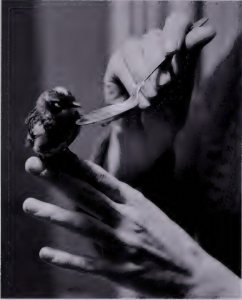
In Our World, Mary Oliver dedicates a collection of Molly Cook’s photography and prose as an ode to their long-standing relationship and creative collaboration. These photographs offer a peek into Oliver’s romantic relationship, but also demonstrate how by observing Cook at work she was able to shape her meaning of attention, a principle that has informed much of her poetry. In this image, which is captioned “Helping the traveler,” depicts a hand that is extending a spoon to feed a bird that rests on the other hand’s finger. This outstretched hand symbolizes a reciprocal trust that is possible between humans and the natural world, emphasizing how attention is a practice of care. Cook’s lens demonstrates how simple acts can build devotion, showing how attentiveness can sustain the living world.
7. The Sunflowers by Lori Laitman and Mary Oliver
This work is a musical interpretation of Mary Oliver’s poem “The Sunflowers,” which is composed and accompanied by Lori Laitman and performed by soprano Sari Gruber. “The Sunflowers” is a poem that invites readers into a field of personified sunflowers that are living beings that seem to have memory and history. Through this personification the sunflowers are no long passive, instead they become social beings of the natural world. Laitman’s musical interpretation reinforces this notion via a swaying piano accompaniment that mirrors the motion of the sunflowers in the wind. By constructing a vocal three dimensional realm, Laitman immerses the listener into the landscape of the poem, creating a common realm. On the other hand, Gruber’s vocals, with shifting tempos and variation, reflects the liveliness of the flowers as well. Together, the music and voice emphasizes how nature is alive and parallel to the human.
8. Last Night the Rain Spoke to Me by Lori Laitman & Mary Oliver
“Last Night the Rain Spoke to Me” is another musical interpretation by Lori Laitman of Mary Oliver’s poem. When the rain “speaks” in the poem, the music moves with a gentle and liquid-like flow. In the middle of the piece, the rhythm softens and slows as the piano pedals lift, representing “the sky cleared.” Light grace notes also appear beneath the words “stars in the sky,” mirroring the twinkling effect of a sky of stars. By the end, this is followed by an irregular and repeating accompaniment that evokes a steady drone of “soft rain.” Through these musical shifts, Laitman transforms Oliver’s poem into a soundscape that is emblematic of the shifts of the natural world. As Oliver merges the speaker, the tree, the rain, and the stars, into a singular living moment, Laitman provides an audible body. Ultimately, this piece calls us to listen to the natural world, affirming the message of sustained attention.